
Myth—or the impossible as I like to think of it—proved to be a useful lens to shoot those stories with.
Introduction
I met Austin Araujo during our time attending the MFA in Creative Writing at Indiana University. He was entering his first year when I was entering my second, and we talked at a coffee shop where we shared our passions of basketball, poets, and love. Over the following months and years, I witnessed Austin’s earnest love in many forms, one of which was his commitment to poetry. The way he read and was excited by poetry. The way he cared for others’ emerging poems in workshops. The way he approached his own writing. He demanded, still demands, so much of his lines and what those lines can reveal. This is the good work of art reaching toward a clarity for the speaker that brings the reader along at the same time. I’m so grateful our dear friendship has continued so I can witness his good work.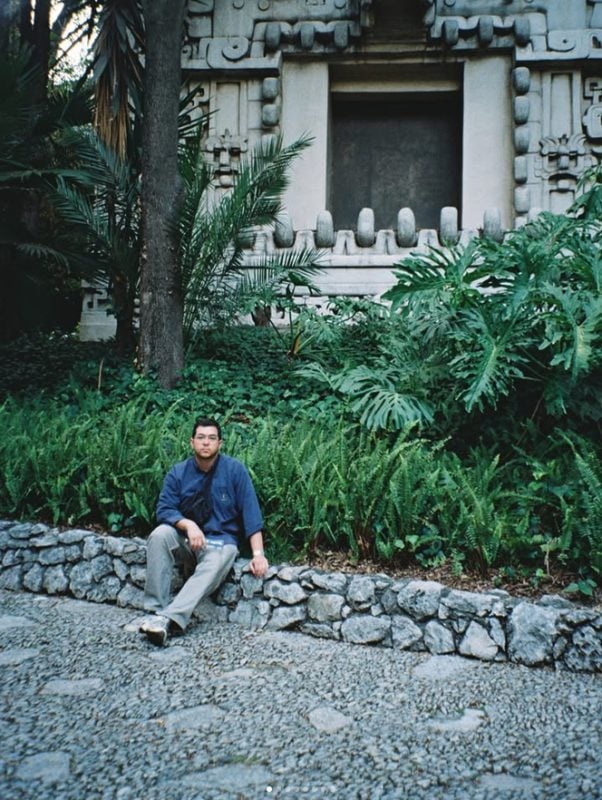
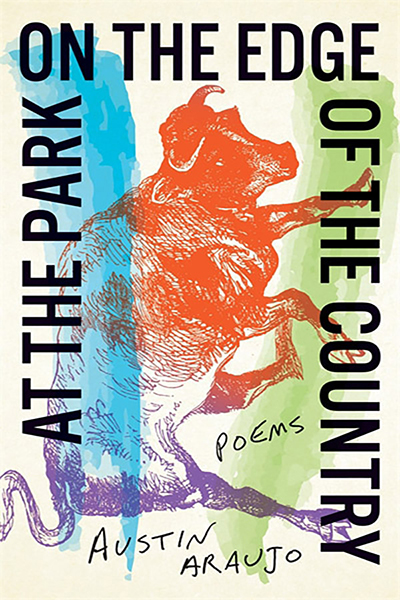
Araujo is a writer from northwest Arkansas. The recipient of a Wallace Stegner Fellowship from Stanford University, his poems have appeared in Poetry, TriQuarterly, and Gulf Coast. His debut collection, At the Park on the Edge of the Country, was selected by Aimee Nezhukumatathil and published in 2025 by Mad Creek Books, an imprint of The Ohio State University Press. He is currently earning an MFA at the Iowa Writers Nonfiction Workshop.
In this conversation, we discuss Austin’s book and its focus on familial histories, immigration stories, the landscapes of the rural South, and myth-making.
The poems in the book that take on family as a subject come from a personal need to take stock of origins.
Conversation
Noah Davis: It is so good to talk with you about your first book, Austin. I am so happy it is in the world.
This collection, At the Park on the Edge of the Country, sets the reader up immediately with its title that we are going to be on the edge of things. The corpuscular spaces. The in between. Other poem titles such as “Another Crossing,” “At the Park on the Edge of the White River,” and “On the Road to Irapuato” continue to situate the reader in this space. Can you speak to that, for lack of a better term, obsession of this collection? Did this emerge in the writing, or was it shaped more in the editing process?
Austin Araujo: The particulars of place emerged in the writing of each poem. Using the proper noun names of places in the title or the body of the poem was one compositional tactic that I found consistently productive. It seemed important when writing that the river, say, in a poem was specifically the White River, and not just any old Southern crick.
Then, when editing the collection, I did find that the obsession with space, as you put it, presented a couple different shapes that I could mold the manuscript into. The Ozarks, in particular, serve as a ground that the speakers leap from or land on by the end of many poems. Once I’d written several poems detailing the Ozark landscape, I felt free to write ones that troubled the supposed stability of place. That’s when I felt like I was really cooking.
The importance of place to me probably comes from a multitude of sources, including personal ones, but one source I’ve been thinking about recently is francine j. harris. She dialed in to Adrian Matejka’s poetry workshop at Indiana in the fall of 2019 and while on the video call, she mentioned her mild exasperation with the appearance of rivers in so many poems by inexperienced writers, for the way they seemed to be a kind of lyric placeholder, something that sounds beautiful and “poetic” but can be unspecific or generic.
I think something clicked for me when she said that. I saw that the landscapes in my poems were in fact specific and important to what they were trying to say. I figured the poems might gain something if I made that specificity legible on the surface of their narratives.
 Noah Davis: That’s interesting. So, the in between can only occur if we are grounded on either end. Nice!
Another focus of this collection is family. I think back to ancient poetry and the common practice of naming the lineage of people when they are introduced as characters. There is this need to show where one has come from. What about poetry lends itself to the cataloguing of a lineage? How did you decide how much time on the stage each family character received?
Austin Araujo: I think I’m one of those writers for whom family is always relevant. Even when I consciously wrote away from family, or family history, like with the poems in the book about films, I couldn’t help but think of the familial resonances.
The poems in the book that take on family as a subject come from a personal need to take stock of origins. I’d like to think that all the family cataloging in these poems is overheard by the reader rather than performed for them. Each time I finished a poem about the figure of the father, I thought, or hoped, that I was finished with the subject. But as these poems accrued, I saw that the collection contended with family as a way for the poems to access broader ideas like memory, dreams, labor, the body, and citizenship. The collection tries, I think, to present lineage as a container for the repetitions and patterns of self-discovery across generations and nationalities.
At one point in writing the poems, I remember sweating about how much or how often each member of the speaker’s family appeared in the collection. This anxiety came from a desire to do justice to the various personae that the family as unit affords, rather than from trying to tell a complete or exhaustive story. Eventually the requirements of the manuscript became clearer to me and the anxiety for equal screentime faded away. (To make room for new anxieties.)
Noah Davis: They always rise to fill the space, don’t they?
You use time so well to flesh out this familial catalogue. The leaps between past and present and looking toward the future happen fluidly. What about the poetic form, and your poetry specifically, lends itself to utilizing the temporal nature of story?
Austin Araujo: I love this question. The writerly response is that I had a big (and basic) revelation about halfway through graduate school that I could just decide what tense I wrote poems in and that this choice carried all these thematic and musical implications. That realization began a fascination with playing with time in my writing, maneuvering between tenses, moods, perfects, and all that.
The personal answer: My attempt to get down (or invent) the story and voice of a family member crossing the U.S.-Mexico border prompted me to take stock of the limits of the lyric poem. Many of the poems in the book emerged from testing my capacity to capture the impossibly complicated and convoluted story of migration, same with the impossibly complicated and convoluted encounters with illness in my family, and with the impossibly complicated and convoluted act of being someone’s brother. At some point, I began trying to write toward those complications, rather than trying to resolve them, which meant finding ways to acknowledge the simultaneity of these stories, desires, voices, and bodies through time. I tried to do so by engaging with time to, ideally, remove the distance between past and present.
Noah Davis: I don’t think that’s a little thing, realizing as you are writing what the parameters of a poem can hold for your subject. I think a lot of poets might struggle with that for a while. Thank you for that insight.
You touched on this a little bit already, but I want to hear more. While the facts of immigration are part of the history of your family, as a poet, you construct the image of this family through myth-making the origin story of the father’s immigration. Can you speak to the need of myth-making in this space? The balance of fact and poetry?
By acknowledging, or simply including impossibilities into real familial stories, I hoped to generate rhetorical tensions that could be provocative and expansive rather than pathos-inducing.
Austin Araujo: Growing up, I had many stories of border crossings, or document forging, or citizenship exam-taking, or just of a family member’s former youth swirling around me. Sometimes multiple versions of the same story would appear and contradict one another. While a different writer might have developed a need to find the master narrative, the “true” story of what happened, I found these contradictions to be enlivening (relieving, really) once I started writing about them.
These poems aren’t closed off from fact, but they don’t pretend to accrete into documentary either. Myth—or the impossible as I like to think of it—proved to be a useful lens to shoot those stories with. By acknowledging, or simply including impossibilities into real familial stories, I hoped to generate rhetorical tensions that could be provocative and expansive rather than pathos-inducing.
Noah Davis: “Including impossibilities,” I really like that.
Thank you, Austin for taking time with these questions. In closing, what’s next for you? And is there a poem, or an excerpt of a poem, from At the Park on the Edge of the Country that you’d like to share? Where would you recommend readers to buy your book?
Austin Araujo: Currently, I’m studying in the Nonfiction Writing Program at the University of Iowa, where I’m working on a few things. These include a long essay about Prince, and smaller essays about citizenship, photography, and place. I’m also writing more poems, which are lately concerned with technology and media.
You can grab a copy of At the Park on the Edge of the Country at your local bookstore! Or at Bookshop.org. Or directly from my publisher, Mad Creek Books. Here’s my poem, “Brothers”:
Brothers
Not even my brother has joined me in the city.
His hours in the country include explaining
to day laborers much older than he is
how to use tools that may save their roof, fence, crop.
I know the paths around my apartment well.
I’ve come to a limited understanding of the trees.
But my brother is a voice. He sends me messages
at the end of his shift. Sometimes,
when he has no one watching him,
he will send me a question about basketball.
Our father comes from Mexico,
which, in our memory, was like what we imagined
Sicily to be: pastoral, nutritious,
with a strange government.
We talk about these things
when I visit him in the country.
I can never finish any work
when I reunite with my brother.
If he doesn’t send me messages,
there’s nothing for me to revise.
“Brothers” was originally published in At the Park on the Edge of the Country by Mad Creek Books, The Ohio State University Press, 2025. It is reprinted here by permission of the author and press.
 Noah Davis’s second poetry collection, The Last Beast We Revel In, was published in 2025 by CavanKerry Press. Davis’s first collection, Of This River, won the Wheelbarrow Emerging Poet Book Prize from Michigan State University’s Center for Poetry. His poems and prose have appeared in The Sun, Orion, Best New Poets, The Year’s Best Sports Writing, Southern Humanities Review, Poet Lore, and North American Review, among others.
Read an interview with Noah Davis, “Many Streams to Follow,” as well as poetry by Noah appearing in Terrain.org: two poems, two poems, and two poems.
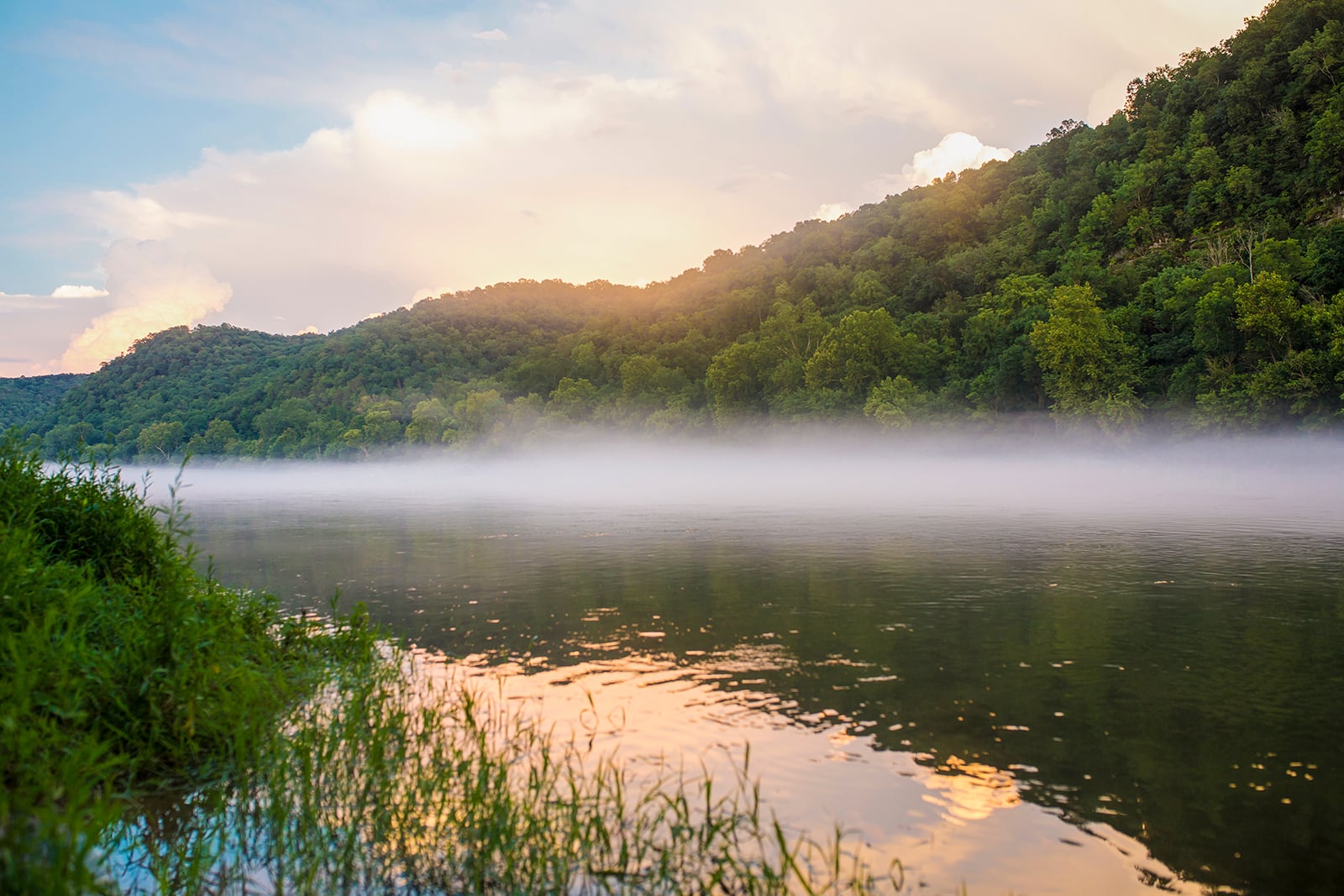
Header photo the White River in the Ozarks by Jennifer White Maxwell, courtesy Shutterstock.