
Wild Forest Lands: Finding History and Meaning in the Adirondacks
By Philip G. Terrie
Syracuse University Press | 2025 | 262 pages
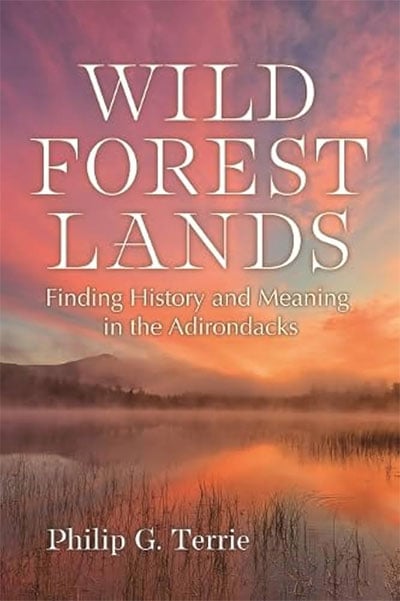
The cover of Philip G. Terrie’s latest book is bathed in pink: a candy-sweet sunrise over an Edenic landscape. It’s a simple image to introduce a complex work centered on that slippery term, wilderness. Residing somewhere between legal and cultural realms, always reaching toward science for justification, wilderness is an American paradox that, for Terrie, remains indispensable, however troubled it may be. “No other single word works,” he writes.
 A major thread in Wild Forest Lands: Finding History and Meaning in the Adirondacks is the attempt to define wilderness, which Terrie knows is an impossible task. He traces the notion through different eras and wrestles with the fact that its definition has been contested, its existence in question, its valence divisive. Even within his own life, his intellectual understanding of the term has evolved along with his personal sojourns in the Adirondacks—the specific wilderness where he experiences whatever the term tries to describe, and by which he measures the validity of the term itself. As a scholar, he knows that wilderness is “good to think with,” and he’s built a career around doing so, publishing a string of books and articles about the region. As a hiker (and later the owner of a vacation property), he feels the Adirondacks to be his “spiritual geography.” There’s no possibility of neutrality here, and indeed Terrie served as an expert witness for one side of a recent landmark lawsuit that added another chapter to the history of wilderness protection in the Adirondacks.
To trouble the understanding of wilderness, to point out all that the term ignores—from histories of race and class to historical human presence in supposedly “pristine” areas—is nothing new, and Terrie folds in William Cronon’s landmark work from the 1990s calling wilderness “quite profoundly a human creation,” or as Terrie phrases it, a “projection of cultural needs.” For Terrie, the project here is to carefully trace all the complexities of the concept alongside his own personal history as both a body and a mind in the Adirondack world. After decades of researching the region’s history, tracing the evolution of academic thought about wilderness itself, advocating for protection, and all the while making pilgrimages to the Adirondacks, Terrie possesses both a nuanced view of what wilderness means and a kind of marriage to it—he knows it’s a mess, but he won’t give it up.
“Once we acknowledge that wilderness is a cultural construct,” he writes, “we accept that wilderness largely exists in the eye of the beholder, that it exists to the extent that it evokes powerful feelings of transcendence. It is a place where we feel and do, where the response is both transformative and performative.” It’s a definition that’s very much centered on the human mind, rather than the place itself. “But,” he goes on, “I believe the notion of wilderness has utility.”
Just what might that utility be? It all begins, Terrie believes, “with a sense of regret of something lost.” If we know a wilderness is out there, a certain hole is filled in our image of the world—how it is and should be. Perhaps that’s why we’re so willing to overlook signs of human presence in the places we define as free of humans.
In the Adirondacks, that has meant both a history of logging (with the hikers of later decades, Terrie included, sometimes following abandoned tote roads) and a history of Indigenous usage that went unacknowledged at the time that the Adirondack preserve was being established. The preserve, a then-novel instance of a state setting aside public land, designated 11 Adirondack counties in which some areas were to be “kept forever as wild forest lands.” Terrie reminds us that for many early wilderness advocates, like Bob Marshall, a connection to what they saw as heroic American pasts was part of the point: “Marshall frequently returned to the notion that time in the wilderness evokes a connection with America’s frontier past, especially the epic explorations of Lewis and Clark.” No wonder, then, that frontier-era thinking on race, class, and gender—blind to the reality that such adventures had opened the way for genocide of Indigenous people—stuck to the concept of wilderness like burrs, through to the present day.
For Terrie, identifying wilderness depends not on binaries (pure/impure, natural/humanmade) but on a feeling. In the mountains, “[w]e are aware of both change and the comforting illusion of permanence,” he writes. A place can be marred, but special; changed, but healing; an illusion, but one with real effects on us. The utility that Terrie refers to, then, is that of making meaning—spiritual or ecological.
Still, the question remains: For whom? There is economic meaning in wilderness, too. Locals in the Adirondacks both benefit from tourist dollars and perennially resent state decisions that define their lives. Terrie asserts that rural woes (shrinking populations, poverty, lack of services) are not caused by wilderness preservation, but also recognizes that in New York, everyone’s tax dollars help support a preserve that only some can afford to access.
Wild Forest Lands is a solid introduction to, and a careful accounting of, these issues. And, as a historian, Terrie is meticulous about chronicling the legal framework that has protected the Adirondacks since 1895—including the 2021 decision in which Terrie was personally involved, one that turned on minute distinctions between “timber” and “trees,” “roads” versus “trails.” “To a cab driver in Brooklyn, this debate must seem endlessly pedantic and trivial,” Terrie writes. “But to those of us immersed in the arcana of constitutions and wilderness, it is profoundly significant.”
This isn’t quite a book for a general readership, though Terrie does keep it moving at a good pace while he juggles various elements of the narrative—including his own publishing career, which has seen him revisit his own ideas as currents of thought have evolved since his first book published in 1985.
For my money, a cover photo for this book that included not only lovely trees and water but a road, dam, or other human mark would have better represented Terrie’s sophisticated understanding of what wilderness means and has meant. But this soft, pink photo stands for clarity and perfection: Terrie’s “spiritual core,” the fantasy of a world apart.
 Erika Howsare is the author of the nonfiction book The Age of Deer: Trouble and Kinship with Our Wild Neighbors (Catapult Books, 2024), a finalist for the PEN/E.O. Wilson Literary Science Writing Award. She previously published two books of poetry and has written essays and reviews for outlets like The Atlantic Monthly, Orion, The Los Angeles Review of Books, and Longreads. She’s also the co-creator of a podcast miniseries, If You See a Deer. She lives in rural Virginia and works as a private writing mentor and retreat leader.
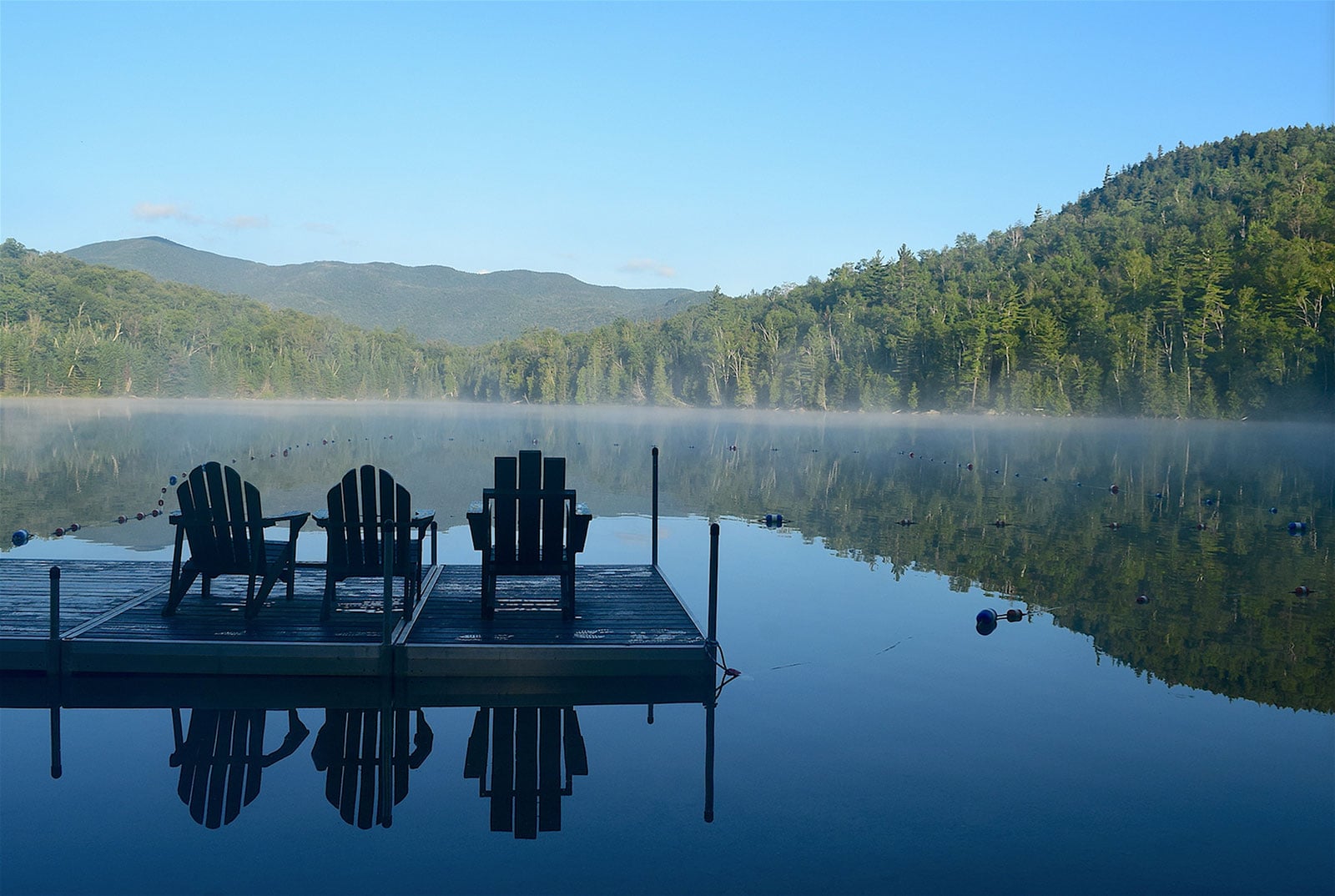
Header photo by Robert Jones, courtesy Pixabay.