
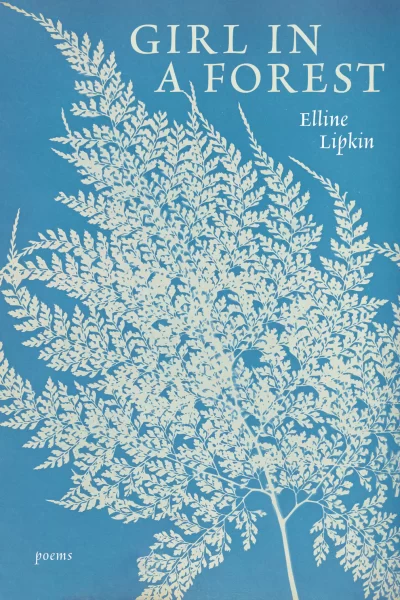
Girl in a Forest
By Elline Lipkin
Trio House Press | 2025 | 86 pages
In Elline Lipkin’s book of poetry, Girl in a Forest, Gretel, from the Hansel and Gretel fairy tale, discovers her body and finds her power. But in the persona poems in this collection, she is not the only one who goes into the forest and has her story emerge. We learn of her buried mother who becomes “a mix of motes I tried to waft into the forest’s scent” and of the witch who can bear to live only in these woods. These are poems about women’s lives and the forests they enter.
 In “Gretel: Home Again,” we meet Gretel as a prepubescent girl. She has been in the forest and emerged:
Hair, a tangle of pollen and twigs
clouding my ears like powder
just tapped. Unbrushed, to keep
a wildness before I’d have to tame
it down my back, molting innocence
to quiet sheen. Two cloves curled
inside my flat chest, ticking beneath
gingham, pressed against my dress.
When she comes back to civilization, the physical parts of the forest have literally become part of her: pollen and twigs tangled into her hair. But the forest is also a metaphorical bomb, a power that she has tapped into. Choosing to keep her hair “unbrushed,” she’s not letting that power go. Not only does Gretel keep the power of the forest with her, but the poet combines it with the power of the girl’s changing body, a ticking time bomb, pressing against civilizing structures like her dress. Lipkin’s young Gretel is self-aware, in control, eager to be part of the forest where, as she tells us in “Gretel: Looking Back,” she has become “so blood-sure, so strong.”
In the second section of the book, Gretel is married and trapped outside the forest. The section starts with “Gretel: Older” where Lipkin uses a series of metaphors to show us this marriage. I almost said “Gretel” instead of “Lipkin” because these persona poems so strongly give voice to each of these characters. Gretel compares herself to a doe, “complacent, observing” a row of cups “like ears turned to catch / your growls or a sudden stomp,” and the moon:
I was the moon peering in,
animal, mineral, elemental,
the cabin like a trap that you
set after you slipped into the
early dark while I tried to sleep,
seeing the trees lace above
the roof, saying again,
there is always a way out.
Lipkin establishes this as a dangerous marriage with Gretel passively observing her life and attuned to her husband’s growls, but when Gretel thinks of herself as the moon, she becomes larger than the dangers—“elemental.” The forest is where young Gretel tricks the witch and triumphs, and it is the place that promises hope and a return to self.
From the title and the bulk of the poems, I understand this is a book about Gretel, but the witch and her pain are powerful leitmotifs. We learn of the witch’s miscarriage that makes her crave children. In “Witch: Once, I Was,” the witch tells of her past beauty and power: “I could quartz my eyes / into a stare that meant / getting what I wanted.” We can see those hard, inhuman, and yet gorgeous eyes from the way Lipkin turns the noun “quartz” into a verb. This technique, which Lipkin uses regularly, creates surprise and layers of meaning.
The witch’s beauty and power are ruined by a blight. “Witch: Once, I Was” continues:
When the blight came, it
was sudden, a rake clawed
my forehead and left its mark.
A caul pulled over my beauty,
hazy what I even wanted,
but that day was an abyss.
I raged to find a way out,
went into the woods,
swore I’d live where no one
would see me: wretch,
wrecked, removed, alone.
For the witch, the way out of the abyss of humiliation and loss of beauty is to go into the woods “where no one would see me.” I find the last four words of this poem—“wretch, wrecked, removed, alone”—heartbreaking. It’s the disintegration of community. The slant rhyme and alliteration of the first two words, “wretch” and “wrecked,” keep them tied tightly together. Then we lose the rhyme with “removed;” the last word is “alone” in sound and meaning.
Gretel goes into the forest and finds her power. The witch goes into the forest when she loses her power. But for both, it is a place of refuge. Ellen Bass has said of place:
Not all poems need to be in a location, but naming and specific detail actually allow the poet to destabilize the reader and the narrative to such an extent that we enter lyric time and space, where there is no separation between oneself and the experience, and the region we have to make our way through is the region of interiority.
That is the forest Lipkin creates. We are in the darkest parts of a fairy tale. The opening preamble poem “Leaving” speaks of “each memory / adrift, rattled / by wind, spiraling / downward.” The speaker asks, “Is this really all / that is left?” and the rest of Lipkin’s book answers: the fairy tale is still here, the forest is still here, and we bring it with us.
 Deborah Bacharach is the author of Shake and Tremor (Grayson Books, 2021) and After I Stop Lying (Cherry Grove Collections, 2015). Her work has recently appeared in Poetry East, Last Syllable, Only Poems, and Grist, among many other journals, and she has received a Pushcart prize honorable mention. She is a poetry reader for SWWIM and Whale Road Review. Find out more about her at DeborahBacharach.com.
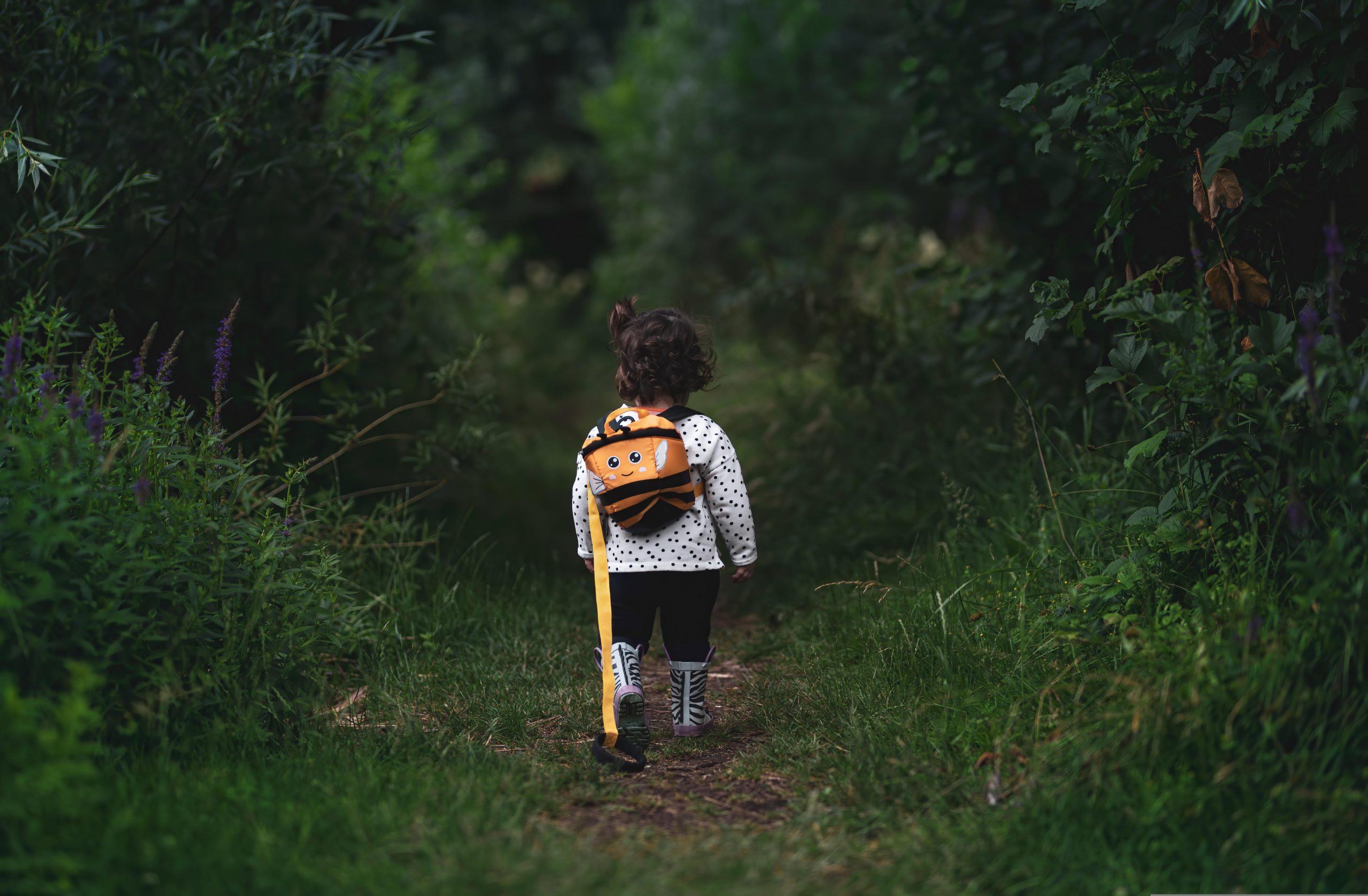
Header photo by JonPauling, courtesy Pixabay.