
Nightshining: A Memoir in Four Floods
By Jennifer Kabat
Milkweed Editions | 2025 | 360 pages
“Trying to find my father I have been likewise outside myself,” writes Jennifer Kabat toward the end of Nightshining: A Memoir in Four Floods. Kabat’s latest book sees her travel far outside of time itself, as well. She begins as a daughter trying to better understand her father, his life’s work, and the principles that drove him, but soon turns her focus to a centuries-sprawling ecological investigation of her village and other communities in New York’s Catskills region.
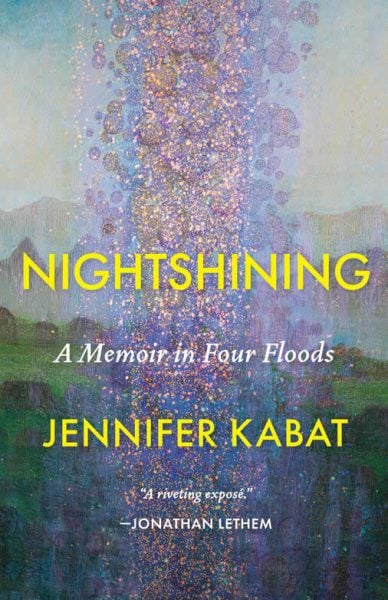 When pollution sensitivity and the desire to be closer to her aging parents prompt Kabat and her husband to move from London to the village of Margaretville, New York, she is cautiously optimistic. She writes, “I think I am safe. I have to be.” Her caution is well-founded. Two floods rush through the village in 2006 and 2011. The devastation they unleash, and her father’s death during this period, upend her community and life.
Amid cleaning up, starting (and eventually abandoning) a novel, exploring her surroundings, nurturing ties to her village, and grieving her father comes Kabat’s decision to seek answers about the floods and the forces behind them. She begins to understand the floods are not just reflective of the world’s current dire environmental conditions. They have deep roots in a complex past—specifically two other destructive, man-made floods that occurred in the early 1950s, an era of scientific advances and Cold War politics in which her father played a small but meaningful role. Collecting details about one of those floods becomes the “first of an accumulation of coincidences that string this story together,” and Kabat gathers her information with gusto.
Kabat presents a large, at times unwieldy, but consistently fascinating cast of characters and topics throughout the book: Shakers, astronomer Johannes Kepler, author Kurt Vonnegut, philosopher Walter Benjamin, poets Diane di Prima and Mary Norbert Korte, hydrologist Luna Leopold (Aldo’s son), the successful effort to ban leaded fuel, botany, the science of clouds, Greek mythology, and more are included in her discussions. Every mention is relevant to her discoveries; copious research, interviews, and explorations yield a layered and complex assessment of the “white men of a certain era” who changed the environment of upstate New York forever.
She eventually hones her focus on a small group of 20th century scientists who hold opposing views about their work: some are dedicated to scientific pursuit that will help humanity (this is her father’s stance), and others are committed to science for science’s sake—“joy with no responsibility or accountability, just curiosity and following your interests.”
What becomes clear is that none of the scientists who experimented with weather and water in the second half of the 20th century fully considered the cost to the region’s people and environments—including her father, who staunchly believed in “the public, the greater good, shared resources, the collective, the communal,” but only to a point. Original indigenous inhabitants continue to fight for land they never ceded (echoing information in “The Sacred and the Superfund” chapter of Robin Wall Kimmerer’s Braiding Sweetgrass, published by Milkweed Editions in 2013 and which similarly features Mohawk leader and activist Tom Porter). Others who worked and lived in towns now under water are left with little more than memories of those places, while New York City benefits from the dam that destroyed their communities.
“The only thing about building a utopia is that it often means not seeing what is there already,” Kabat writes. She is deeply disappointed to realize that the idyllic, principled, and passionate argument for hydropower her father makes in July 1955 to the U.S. Senate Subcommittee of the Committee on Public Works, testifying that he believes it is “a great natural resource belonging to the people,” gives no thought to those it strips of place, traditions, and power—specifically, the land’s original indigenous inhabitants.
In weaving together all that she learns, Kabat has written a weighty, lyrical, and thoughtful book, styled mostly in the present tense. Initially disarming, the style effectively dissolves the borders and boundaries of history, memory, and time. Every moment that happened in and to this place “then” continues to happen “now.” Tensions grow across centuries and cultures; lives, traditions, and environments have always been, are, and always will be at stake as society advances. Her observations take on an elegiac quality: “To write against chronology is to hold all these moments together and all at once so they are not over. They are unresolved and uncomfortable. There is no epiphany at the end.”
Kabat’s late father, a leader and believer in the energy cooperative movement, remains a consistent, beloved presence in her explorations, driving her back into history and forward into the present day. He appears throughout the book in memories and photos; each mention provides a grounding effect that helps her shape the wealth of history and information she shares. As she does with her father’s life, Kabat also unearths the circumstances that shaped the scientists she studies and drove their scientific pursuits throughout the Cold War into the years of the Reagan Administration’s “Star Wars” program. Her analysis and keen hindsight enable her to write that “[i]dealism always comes laced with innocence and hope, bearing the seeds of its failures.”
Published in 2025, shortly before the Guadalupe River Flood in Texas became the deadliest flood in the U.S. since 1976 and during a year that saw significant flooding events in every region of the country, Kabat’s work is full of warning: “Today in the paper it is the hottest year ever, yet again. We are always crossing that line; the winters that no longer snow, the glaciers that disappear, the horizon we thought might be decades away only to find that it is now, today, this day.”
As of May 2026, historic floods have swept through Washington as well as parts of Europe (France, Spain, Italy, Greece), Africa (Zimbabwe, South Africa, Algeria, Morocco), and the Middle East (Yemen, Afghanistan). With more predictions of severe heat, storms, and flooding, she questions our ability to work together with “radical empathy between communities” to help and heal our environments—as her father imperfectly tried to do. Can we overcome mindsets that inherently, persistently seem to cause us to separate each other into “us” and “them”?
“We are all experiencing the acceleration of catastrophic time,” she writes. Yet there is a sense Kabat is hanging onto hope, even if her hope is as paper thin as her father’s worn Progressive Citizens of America membership card and the “faith and optimism and patriotism” it symbolizes.
Immersed in vast and disconcerting history, Kabat finds her father to be both a man of his times and an unwavering optimist about humanity’s potential to do more good than harm as it progresses. In writing this memoir, Kabat invites us to live outside ourselves as she has done, to acquire knowledge of our histories and our times, and to ask questions that confound us about our capacity to work together to heal and save a hurting planet. “It feels more important to live with my questions,” she encourages us. For in the questioning, we may find solutions that help us all.
 GKS Waller is an award-winning short story writer, essayist, and teaching artist whose work has appeared in multiple publications in the U.S. and abroad. Having completed her first novel, she is currently working on her second novel and a collection of short stories.
Header photo by Corinna Behrens, courtesy Pixabay. Author photo by Anita Healy.