
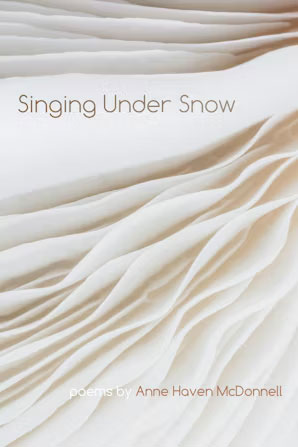
Singing Under Snow
By Anne Haven McDonnell
Michigan State University Press | 2026 | 114 pages
Come, here’s a place where the land
lies down in deep darkness.
 This is the invitation that awaits readers in the opening poem, “Darkness,” of Anne Haven McDonnell’s newest prize-winning collection, Singing Under Snow, published by Michigan State University Press. And down Haven McDonnell takes us: into the earthy, mycelial web that smells of “gold, peach, butter,” under the snow where pine marten hops from tree to tree “like water unspooling branch to branch,” to the edge of shore where “the earth goes under water again” and threatens to take all we love with it. Yet what we find in these places surprises: silence interspersed with song, liberatory and limitless love, and a kinship beyond any species-boundary.
Selected as the winner of the 2024 Wheelbarrow Books Prize by Leila Chatti, Singing Under Snow is a must-read collection of Haven McDonnell’s most stirring, urgent, and deeply moving work. A renowned ecopoet, Haven McDonnell brings a much-needed queering and deepening of human-plant-animal-ecosystem relationships to sharp poignancy in this new book. This wisdom does not seek to fix or resolve our climate-chaotic world, but instead invites us to love our home a bit more fervently, and to hold the grief of such fierce love lightly, with joy and reverence. Like the elder tree speaking to us in “Singing Inside a Tree” in “a hush, a swell, a silent rolling wave,” this book whispers long after the last page, reminding us what we must not forget: go outside and listen to the “quiet that doesn’t blink” and hear “everything is singing.”
This collection insists on this sort of radical love through the weaving of humor, ecological kinship, and queerness as liberation. In “Here Come the Lesbians and Their Dogs,” Haven McDonnell showcases scenes of joyful refusal—refusal to let death, or anything else, stop their queer, multi-species loving:
Here they come, kicking up dust
in their four-wheel drive trucks crossing
the rutted road to cliff’s edge. Where
the Chama snakes up pale canyon cliffs
and fields of sage stretch out
where dogs can run.
They mark their lives
in dog deaths.
Think of it, sweetheart—
if we’re lucky, we’ve got time
for one more dog.
Or in another stunning poem, “Truffle/Coming Out in the Dark,” the speaker alternates between the somatic experience of truffle hunting in the forest and a first fall into young love hidden in the dark—both connected by smell and the blurring of boundary:
The smell of truffles is not heady like fruit or flowers. It’s a low cello
Starting in feet, in the body’s nooks and caverns. It’s a smell that rides
The edge of repulsion, but tips into desire…
In sealed dark of the closet, her skin slipped against mine like water. In
dark, she smelled of soap and sweet wax, of butter and mint and snow.
In the second of the collection’s three sections, Haven McDonnell expands upon these themes in a series in which mushrooms and eco-queer love intertwine in their own sort of mycelial relationship. With dedicated poems for chanterelles, Agaricus, hawkwings, morels, ink mushrooms, oysters, and more, Haven McDonnell balances a wealth of scientific and ecological knowledge about these foundational species with the pleasure of walking in the woods with those you love. Through these poems, as well as others in the collection, we are shown how to cultivate intimacy—how to gather mushrooms, injured rams, young elk, lichen, lovers, friends, mothers, and the wider earth web “in the front of my shirt” to carry home. “I was not a lonely child,” the speaker admits in “Chantrelle,” because how could one be lonely when surrounded by such inextricable interdependence? Such wonder and heartbreaking life? Despite the ongoing socio-ecological devastation, Haven McDonnell insists on a mycelial intimacy as our north star, on “all of us here and elsewhere, soft creatures. At the mercy together.”
The speaker’s mother, a central character in this collection who is shown as both “limping down / the hall on her metal knee” as well as noticing “the snow / spirals in crystals lit and spun / through darkness,” becomes a sort of guidepost on how to gracefully love a world so marked by loss. The end of the poem “Inside a lateness, a singing under snow” sums up the heart of the collection:
Because I know so much
is dying, I love this marten
with some desperation,
the way I love my mother and cannot
imagine this world without her. I know
she will die and I will not be
ready. The creek makes a ribbon
of living trees the marten
needs in this mountain of snags.
I don’t know where the story goes,
but there’s my mother, laying out
a piece of salmon skin again.
This image of an aging mother feeding the dying “mother” of us all— the earth, the waters, and all her creatures—is one of deep wisdom. By joyfully insisting to feed what small thing she can—hurt knee, memory loss, and climate catastrophe be damned—the mother offers us the sort of intimacy we need: fierce, unmoving, and ever-generous with what is still alive, with what is still capable of life. Stick with me, kid, the mother tells the speaker, and us readers, in one of the last poems: “When the End is Near.” As in stick with the trouble, the dying, the wonders of this world, the love, and the inevitable heartbreak. And the speaker responds, “I do, I will, I am.”
As witness, as lover, as daughter, as wild human, as body, as friend, as traveler, as scientist, as poet, as dog walker, as mushroom hunter, as ocean wader, as wolf-howl listener, as giant open heart—this collection insists that we “stick with” the mess of these times to wherever the story goes, listening for this mantra singing out under the snow:
I do, I will, I am.
I do, I will, I am.
I do, I will, I am.
 Geneva Toland is a writer, songleader, naturalist, and educator living in the juniper-piñon pine foothills of the La Plata Mountains, homelands of the Ute, Diné, and Puebloan peoples. Her debut poetry collection, Council of Thunder, is the winner of Wayfarer Book’s 2025 Homebound Poetry Prize, and will be available in October 2026. Her work has also appeared in Southern Humanities Review, Camas, Reckoning, and humana obscura, among others. She is grateful to receive her MFA in Poetry from the Institute of American Indian Arts in May 2026. See her other offerings at www.genevatoland.com.
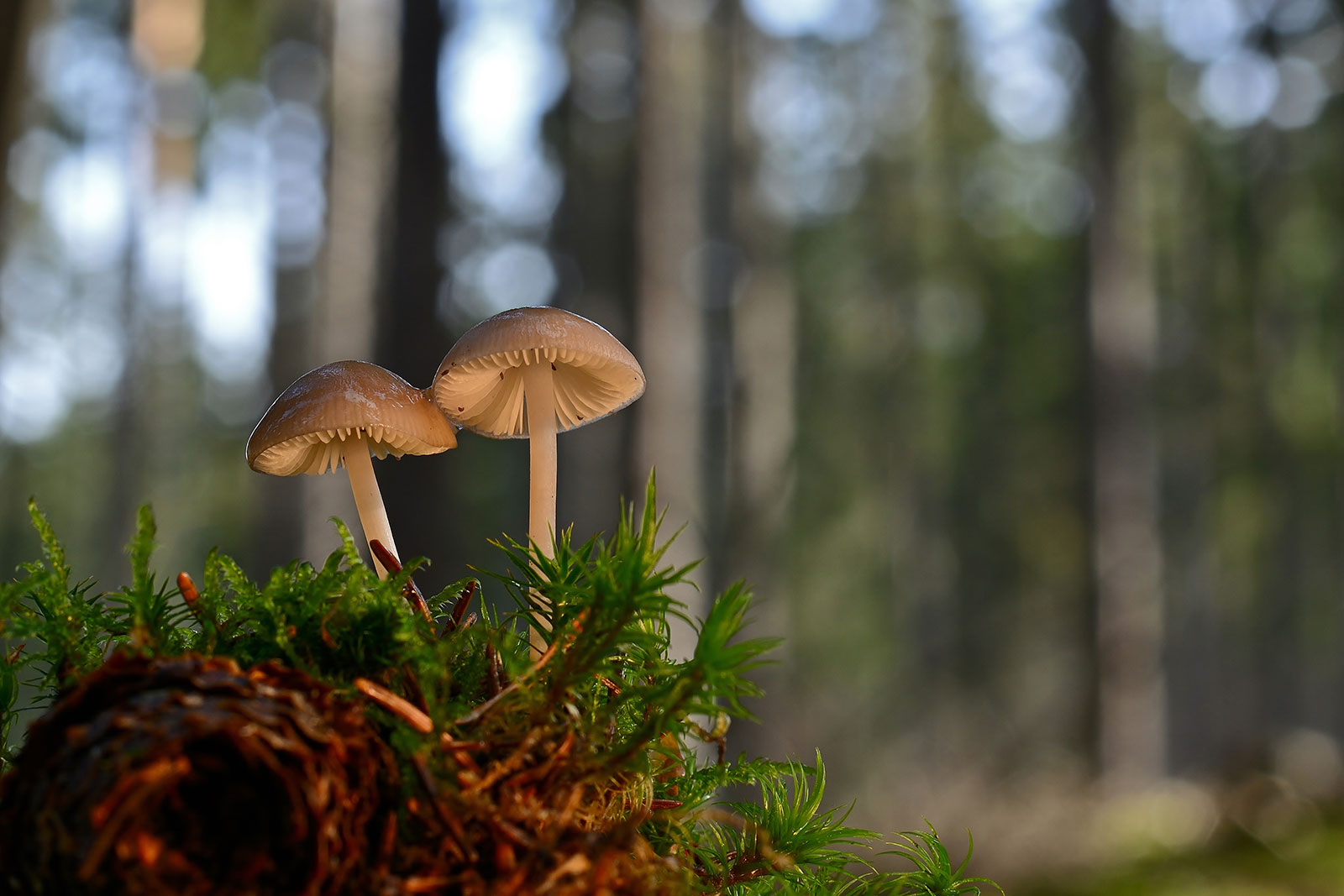
Header photo by Jürgen, courtesy Pixabay. Photo of Geneva Toland by Vivian Saint Rain.