
tic tic tic
By Heidi Seaborn
Cornerstone Press | 2025 | 101 pages
From the dedication, “For my children and their children,” to the final one-poem section of her third full-length book, tic tic tic, Heidi Seaborn creates a sense of the unbroken line that anchors us to the natural world, to the planet, to each other, to the past, and to the future, moving back and forth through time in ways that suggest we set aside our linear notion of time and glide with the poet. She offers what the poet John Ashbery once termed a “whole reality,” a “logbook of a continuing experience that continues to provide new reflections.” Like a long poem, the collection is best read not as individual poems but rather as a single piece, despite its clear titled sectioning.
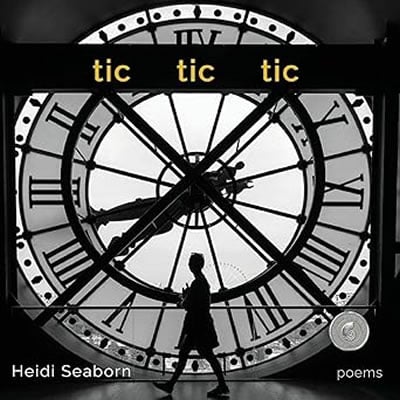 In this collection, poems are paired with evocative photographs. The cover photo, Eric Falk’s “Passing Through Time,” captures the pedestrian activity of walking in the great mystery—what it means to live a long and full life, all the while paying attention. Time’s circularity is mirrored by the circle of the Ferris wheel seen in the distance through the window glass of the Musee d’Orsay in Paris. Which one is reality, or is it all real/unreal?
Seaborn has certainly hit her stride as a writer, with a polished voice and command of the language. Variation in line length and format of the poems gives a sense of virtuosity and symphony with the graceful movements of her music.
The poet has arrived at what she calls her “cashmere years,” giving the collection the texture of a bouquet of lisianthus—each section a layered blossom that opens more fully with age, eventually to wither and ultimately end. Still the poems, as they look back over a life, and then ahead to a future, reveal the pluck of the poet as displayed in earlier works, carried forward through time. We see the hiker, the fisher return to what these things mean/have meant, and yet:
… the story about the fish—it’s
a diversion.
But the squall,
the gulls, the blanketing fog,
the weight of my body—
is all true.
Well, almost.
Beneath that heaviness
of the quilts, the fog, the day—
my body was lighter,
emptied.
I’m trying to tell you: that day,
I was gutted.
The seasonal umbrella (Winter/Spring/Summer/Fall) used by a less skilled poet might have seemed cliché, but in the hands of Seaborn, one is left instead with a true sense of the cyclical, both in terms of repetition through the years of a human life as well as the eternality of life on the planet throughout the millennia. Each section is tailored both in terms of its subject matter, as well as its forms, and the feeling of “season” takes on new and deeper meanings as we make our way through the poems. She uses as inspiration and referents other works that rely on seasons, in particular Vivaldi’s Le Quattro Stagioni, which deepens the experience. Eliot’s Four Quartets as well as lines from “The Waste Land” also make an explicit appearance.
She effectively showcases the words of others, introducing the collection and then each of the four sections with epigraphs of other poets’ work, which reinforces the sense of lineage. We are invited to walk through time with other practitioners now at the forefront, now by our side. For example, she begins with a line from Danez Smith in which it is suggested to pray not “for time…” but rather “to Time,” setting the stage for all that follows.
In the initial poem “Accidie” she introduces one of the strong throughlines of the collection, gathering us into her yearning with a shift in language that at the same time imparts a shift in point of view and poises us for what’s to come:
If I stay here long enough. If I long
enough.
Seaborn does not disappoint us. As we are led in quick succession through the cataclysms of the COVID-19 pandemic, the January 6th siege on the United States Capitol, the overturning of Roe v. Wade, the October 7th attack and ensuing war, we witness that our chronicler has been shaken from the tree and asked to attend to the new reality, albeit from a different vantage point in regard to time, which seems to have, in the words of Audre Lord (whom she quotes) “collapsed.”
The “Time Capsules” throughout the work comprise carefully crafted and spare vignettes. Those in “Spring” are arranged to help us travel back and forth from 1958 through 2001 via discreet events (class photo, diploma, stiletto) and then back again to 1981 through 2011 with repeated symbols (passport, Ambien, wedding ring), using photos and documents as inspiration, ending finally in “Photos of Sunsets, 1984—” (the chosen year, no accident, we feel):
The evening ritual of day dying captured
with a click. Ticking across time. Lem-
on and mandarin peel, violet, rose and,
in late summer, imperial red crashing
the horizon as the world catches fire.
But she does not risk losing our companionship by remaining “inside the box.” Rather, she expands line length and form as time flies on, as in the poem “Lookout,” building momentum and elongating the breath:
Seven fire seasons. I imagined living out a summer—
watching over the rippling North Cascades, watching—
the sediment of light, the sky pressing against the land, watching whence the smoke arose—
and then shortens line length again to help us to feel her heart beating in the exquisitely intimate poem “Split Second”:
… before I woke
to you
holding me
steady wash
of breath
on my nape
& I felt your body
shift as it left
a dream…
… you saying listen
I hear a washing
machine I think
you hear
my blood
washing
through my arteries
my heart
filling.
Seaborn’s writing conveys reverence for the natural world, as she “kneels in the forest.” Indeed, she explores throughout her relationship to the Divine, as witnessed through the natural world, and we see her “falling into the maple’s knuckled roots,” and we find we want to humble ourselves right along with her. “You came to kneel,” she reminds us Eliot said in The Four Quartets, and we do not doubt that is why we are here. She wonders if she’s “angered God;” ponders if “perhaps God is the shark in this story;” declares:
So, when I say I imagine there is a god,
it’s because from this morning’s window,
I inhaled honeysuckle and jasmine. Heard
god in the syncopation of birdsong.
The collection ends as it began, with the quotidian, but imbued now with the “giddiness of love,” a “teetering syncopation.” Indeed, although we have arrived back with the icons of daily life, the poet and the reader are forever changed. In the final, single-poem section, she tells us to “Take Five,” and we are happy to be given the opportunity to rest—but only in order ultimately to hear more from our guide after she, and we, have caught our breath.
 Charlie Kalogeros-Chattan is a poet who followed her heart from her native New England to the deserts of New Mexico. She divides her time between the high desert of Carson Mesa, on the Rio Grande near Taos, and the Chihuahuan desert of Las Cruces, down at the Mexican border. Her work has been published in journals including Santa Fe Literary Review, Trickster, Sin Fronteras, Taos Journal of Poetry, and Stag Hill Literary Journal; anthologies including the New Mexico Poetry Anthology and Lummox Press’s Last Call, Chinaski!; and popular magazines including Pasatiempo and CURE Magazine. Track to the Lotus from Thixotropic Press is her first chapbook.
Header photo by Gerd Altmann, courtesy Pixabay.