
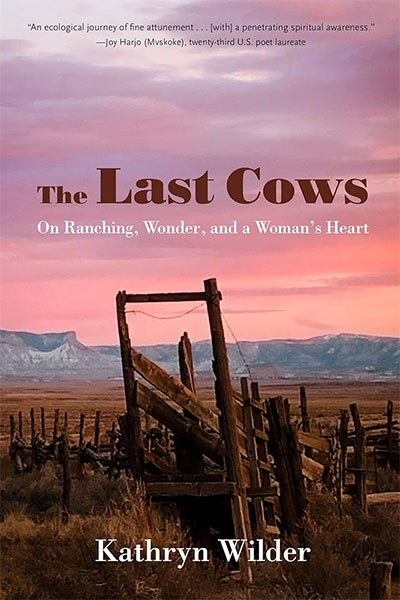
The Last Cows: On Ranching, Wonder, and a Woman’s Heart
By Kathryn Wilder
Bison Books | 2025 | 284 pages
“All my life I have been strong except sometimes,” Kathryn Wilder writes in passing in her new book The Last Cows, as she recounts a day spent roping and branding calves. She’s caressing her horse Savanna’s neck, tenderly, while all around her, her family and friends carry out the untender work of ranching: “Tyler holds the back legs and my friend TJ kneels on the neck as Ken brands.” A minute later, Wilder snaps out of reflection, into action. She lassos more young cattle, their mothers watching from behind fences. “Each calf a life, a story, which I know almost as well as I know my own children’s birth stories.”
 Wilder is a woman in her early 70s with ranching in her blood—a person marked by the peculiar demands, the toughness, of the business of raising beef. She’s also a sensitive chronicler of her experience in southwestern Colorado, running a ranch with her son Ken. The Last Cows is a beautiful document of a world, full of heifers and hay, that most readers will find exotic. But Wilder writes it from the inside, enveloped in details, with a gift for observation. “Smells of blood, singed hair, and dust texture the air,” she writes of the branding operation.
That scene contains multitudes: the complexity of these working ranchers’ relationships with animals and with each other, a deep and unsettled connection to the land, shifting gender roles, the bodily reality of actual cows and horses. Wilder and her son started their ranch operation in the early 2010s, interested in Criollo cattle, a heritage breed, and in regenerative management of both cattle and land. The relatively small Criollos are said to be adapted to arid places, and the family plans to raise grass-fed beef by rotating the animals seasonally between their own property, BLM land, and National Forest land.
Those unfamiliar with the realities of ranching life will find the book eye-opening. Getting rammed by bulls and thrown from horses, hiking snowy mountains to track cows, suffering concussions and injuries to limbs are all part of the deal. “Falling from a horse isn’t so bad, even for an older woman,” Wilder writes with no small bravado. “I’d done it lots in my early years, often for fun.” She remembers “swimming in the river—sliding off our horses’ backs and grabbing their tails, letting them pull us through the water.”
Because she’s lived this life so long, Wilder is an excellent spokeswoman for the rancher’s point of view, especially about finances and the role of public land in the beef industry. Yet she makes it plain that her ultimate loyalty is to the health of the land. “I believe in the ethics of low-impact grazing,” she writes, in a passage discussing the pressure on ranchers to raise bigger cattle that do more damage to the range. “But ethics and finances don’t always mix…. My ethics could cost me right out of the cattle business.”
All of the practicalities and problem-solving of the ranch are truly absorbing: on a single day, Wilder and Ken deal with three different escapes of their cattle, a vet visit for horses, and a three-hour round trip to a processor to pick up hundreds of pounds of beef for a farmer’s market the next day—all on top of regular chores. Meanwhile, the fledgling operation takes shape against the backdrop of chronic drought in the West. For Wilder and her family, that means extra work keeping cattle watered plus elevated risk of both wildfires and (when the rains do come) flash flooding.
Daily ins and outs are not the book’s true center, though. That locates in Wilder’s own sensibility as a thinking and feeling person, as attuned to the earth and all its denizens as she is to her own inner landscapes, including chapters of her past that profoundly shape her. Her connections to people and animals, creeks and mountains, flow lyrically, soulfully, through the narrative. “The world suffers on so many levels, yet for me drought seems the hardest to bear. Is that selfish?” she asks. “I don’t know. I do know the ache as I watch a puddle in the creek recede.”
Wilder is both rooted and nomadic. She writes her long-term observations of nonhuman neighbors (“Mostly golden eagles, ravens, and magpies feast on animals hit on the road. In winter we see bald eagles and more goldens”), knitting herself into her place. But in the same chapter she seems to drift toward a vision of a post-ranching life, speculating that the venture will ultimately prove too difficult, and noting that her dozen years on the ranch to that point comprise her longest residence anywhere. Shadowing her partnership with Ken are two losses: one, an ancestral ranch in California that was sold; two, the fact that, after her separation from Ken’s father when he was young, Wilder lost custody of him.
The ranch is their hope for a renewed connection. Yet over and over she senses echoes of her failed marriage in their disagreements, and sees metaphors for their separation in the predicaments of cows and calves. When one calf dies, Ken tells his mother he’s sorry. “But we were both sorry. We were all sorry. The cow bawling, wailing, as I once did—we are mother and son who endured forced separation and we are working so hard to do right by our cattle and maybe for each other after 20 years, but we couldn’t fix this.”
Wilder has carved her place as a woman rancher over a lifetime, in many contexts, but the toughness required by that lifestyle coexists with softness. “Riding with Ken at a slow trot through grassy meadows and grazing cattle, saddle and Savanna fitting not only my body but my heart, felt like the most cleansing, rejuvenating work I could possibly do…. We are running cattle, and growing our own family stories.”
It’s a treat to revel in this book’s potent mix of family and place—each an analog for the other, and like Wilder herself, “strong except sometimes.”
 Erika Howsare is the author of the nonfiction book The Age of Deer: Trouble and Kinship with Our Wild Neighbors (Catapult Books, 2024), a finalist for the PEN/E.O. Wilson Literary Science Writing Award. She previously published two books of poetry and has written essays and reviews for outlets like The Atlantic Monthly, Orion, The Los Angeles Review of Books, and Longreads. She’s also the co-creator of a podcast miniseries, If You See a Deer. She lives in rural Virginia and works as a private writing mentor and retreat leader.
Header photo by Philippe Ramakers, courtesy Pixabay.