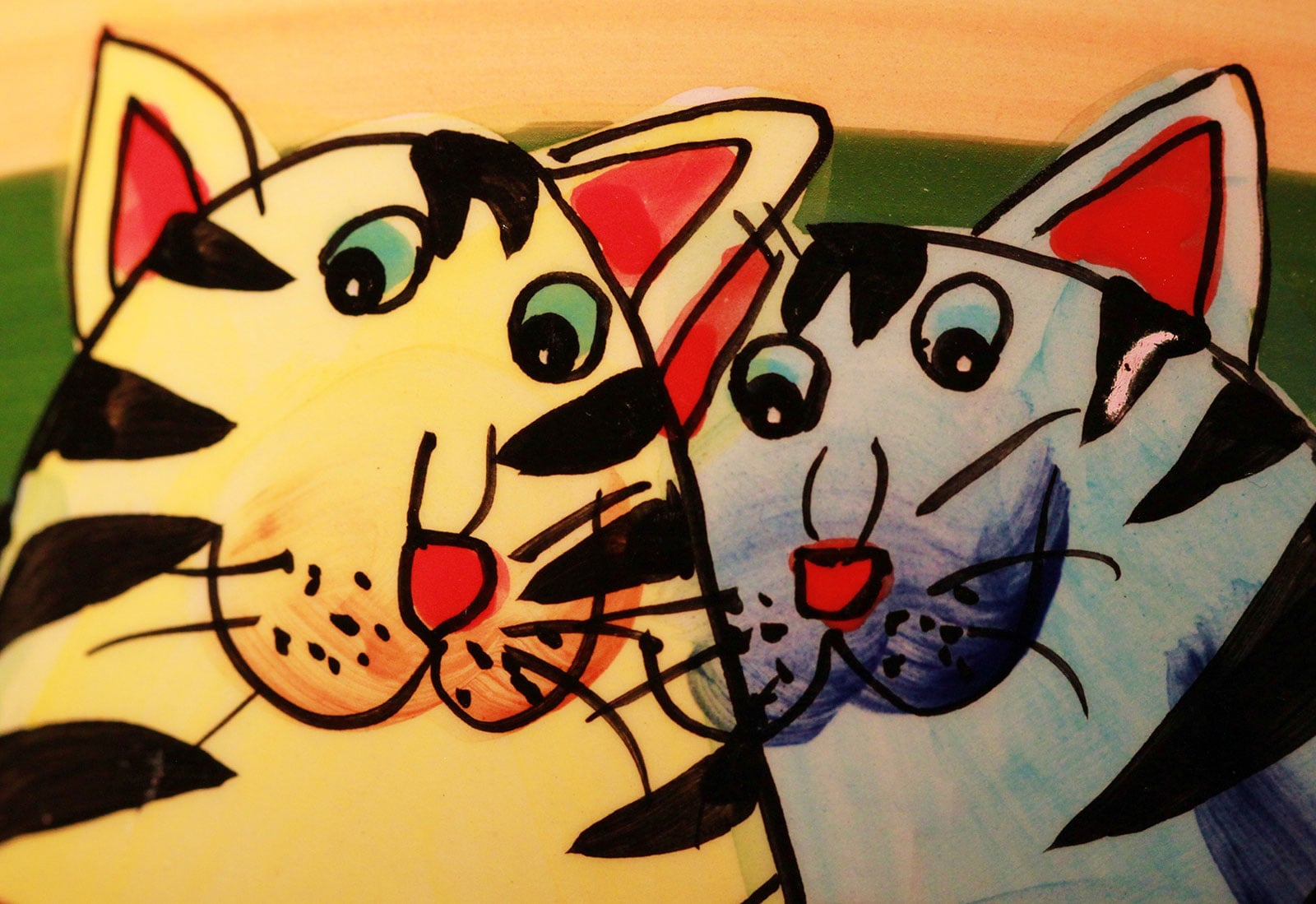

Did You Kiss a Cat Today???
By Geri Lipschultz, Diane Stevenson, and James Berger
Artvoices Books | 2025 | 52 pages
Poets Geri Lipschultz, James Berger, and Diane Stevenson have collaborated on a lively book of children’s poetry titled Did You Kiss a Cat Today???. Here, a remarkable sort of nature figures prominently: the sky as a “blue-black bed”; a conversation between a tree and its leaves; “a lonely-looking owl / (sitting) alone on a limb”; flower-eating rhinos and mammal-chasing dinosaurs; even an ornery little walnut. It’s the natural world as seen through the lens of a child’s imagination: unruly, colorful, and full of contradiction.
The finest children’s poetry retains its vitality long past our childhood. It nestles deep inside of us, emerging unexpectedly years later. The sight of falling snow may rouse many to recall Maurice Sendak’s delightful “Chicken Soup with Rice”:

In January
it’s so nice
while slipping
on the sliding ice
to sip hot chicken soup
with rice.
This new collection is designed to inspire children to write their own poetry. “Words are music,” writes Stevenson in a note to readers, “and the music of words can seem like flying an airplane in your head or riding a big wave in your brain.” Berger urges children to imitate the poems they most like: “Grab hold of the words of a poem like a dog grabbing and chewing a bone! Uh oh, a metaphor!”
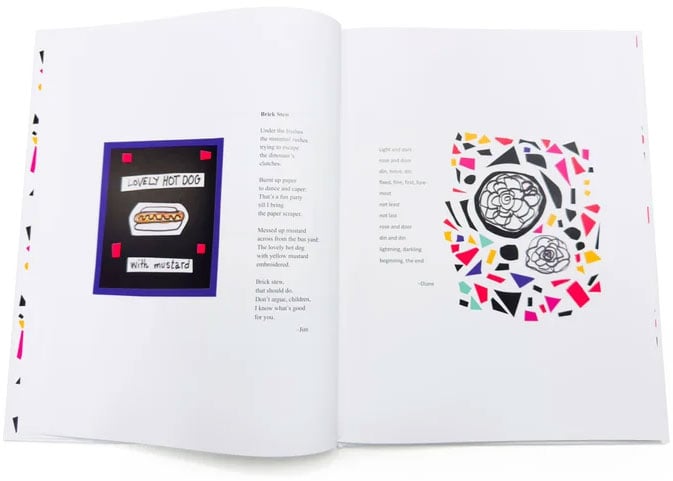
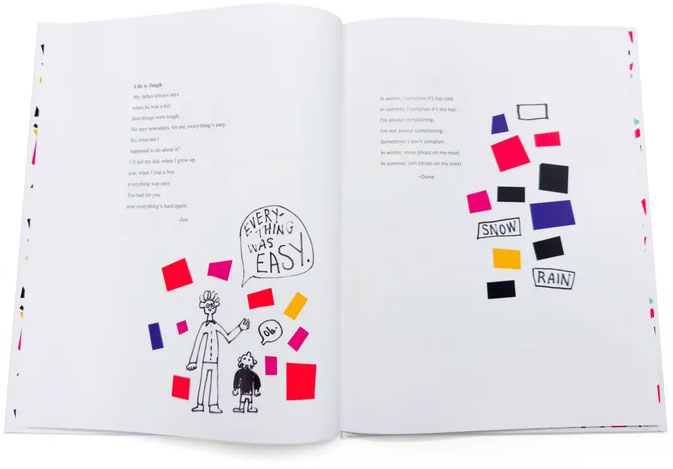
Bright, block-y illustrations, created by Stevenson, contribute a sense of informality. Four blank pages and a sticker sheet of Stevenson’s illustrations are provided, along with instructions: “Now it’s your turn…. Have fun!”
All three of these authors are accomplished poets and literary scholars. Stevenson, a college professor, is a Pushcart Prize nominee and Bread Loaf Scholar. Lipschultz is a two-time Pushcart Prize nominee whose first novel, Grace Before the Fall, was published in 2025 by DarkWinter Press. Berger, a senior lecturer in American studies and English at Yale University, has written six books of poetry and two books of literary scholarship.
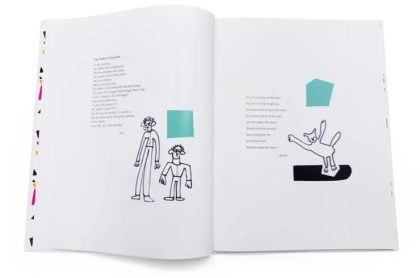
In this collection, Stevenson’s poems brim with joyful, uncomplicated nature imagery that young children will find particularly appealing: a galloping horse, a kissable cat, a colorful moth wing. Her works all benefit from extensive word games, as demonstrated in this poem, which begins: “The bumble bee / the fumble bee / the mumble me / the stumble me…” The opening lines, short enough for a child to master, benefit from being read aloud, over and over again.
Beyond their linguistic appeal, these poems touch on familiar topics. Here’s one that will send a tiny shiver down the back of any reader (young or old):
There really aren’t monsters
under my bed.
There really aren’t monsters
behind my door.
There really aren’t monsters
anywhere in the house
but sometimes at night
there are.
Emotions such as fear, as any child knows, cannot be whisked away with a simple mantra: the poem, with its quietly foreboding, chant-like rhythm, taps into this understanding.
One of Stevenson’s most enchanting poems begins with the simple conceit of the sky as a bed. From the first lines, a reader will be drawn in by the gentle question-and-answer format:
The sky is
a blue-black bed.
Who sleeps there?
The moon sleeps there.
Does the sun sleep there, too?
Yes, at night when people do.
Through alliteration and assonance, the poet builds on this initial image to create a cozy scene of a sun settling in comfortably amongst her companions:
The sun on a blue-black bed
with planets near her head—
on a river of stars
on a sea of stars
on a bedspread spread with stars
and planets next to her head.
The sun sleeps, dreaming rainbows.
She snores.
Her snores, not loud, her
snores are clouds….
While not a lullaby, the poem describes a natural world where all is in sync.
The natural world, both real and imagined, figures prominently in the poems of Lipschultz. The most remarkable of her poems invoke a mythical world depicted through archaic syntax and melodic vocabulary. Readers—children in particular—will relish this language. “How the Owl Got So Wise” would be an expected title for a children’s poem. Lipschultz’s title—”How the Ouchol Got So Why Eyes”—is infinitely more interesting:
Did you know about how the Ouchol
Came to hoot so wizarly
Wise, wise, wise must he be.
…
… the Ouchol, he made his own wish
Selfless as a bumbly bee
He prayed and prayed like a childie:
May he never think he so wise
As the stars in skies
May he never be a hootlin’
When they do their tellin’
May he borrow their bright light shine
For he two wizarly eyes.
With fanciful nouns like “bumbly bee” and “childie,” and a rusticity derived from words like “hootlin” and “tellin,” the poem is evocative of an ancient legend passed down through generations.
In “The Sad Tale of a Child’s Tail,” the poet’s inventive language describes a dreamlike realm where babies live before birth:
… there’s a wonder worth pondering
The child born of humanese birth
Who carries a tail that he will lose
As he wanders all across the skyeland
…
The tail that helped him fly
Now swims away, and quite alone
He falls, as if out of the skyeland
He cries for leaving the tail behind
But a memory lingers
Even as he joins us on the other side
Of this world.
Thereafter he flies every night of his newborne life
Until the darkness invades his memory box
And he loses all trace of his tail
Once and for all.
Lipschultz’s mythical world is all the more attractive for being left behind. The double misfortune that befalls the “newborne”—losing first his tail, and then the memory of his original home—gives the poem poignancy.
Berger clearly appreciates the intensity and vividness of a child’s world. Some of his poems, which are narrated by children, offer surprising commentary on the adult world. Other works depict realms infused with bold imagery and action. In these, entities of nature—reptiles, flowers, crustaceans—abound. In the enchanting opening of the poem “Fits and Bits,” the imaginative domain and the natural world are mingled:
The lobster and the shrimp
sat beneath a lamp;
in a purple chair
they combed their hair,
watching a fat rhyme
trying to climb
a steep hill, like a metal
flower petal.
In “My Father is a Big Turtle,” the narrator is both a boy, playing in the sand, and a creature of the wild:
My father, my mother,
They hold on to the back
Of an alligator.
….
We’re building a road
Which the waves
Unpaved.
We make footprints.
My mother is a sea gull.
My father is a big turtle.
These are worlds governed by their own rules, their own if-this-then-that logic. The opening of “After, After” depicts this perfectly:
After the rhinoceros ate all the flowers
he turned all different colors
and smelled like apricots.
The central tension, in many of Berger’s poems, arises when this imaginative sensibility bumps against the rules of an adult world. Consider this lively scene, which opens the poem “Brick Stew”:
Under the bushes
the mammal rushes
trying to escape
the dinosaur’s
clutches.
At the poem’s conclusion, the tone changes with the introduction of abrupt, clichéd phrasing that can be attributed only to an adult:
Brick stew,
that should do.
Don’t argue, children,
I know what’s good for you.
Berger depicts his characters—some are children, others are imaginary creatures—with nuance and humor. At an emotional level, they’re immensely likeable.
One of the poet’s most memorable characters hails from the natural world. “Sturdy Walnut” tells of a determined little nut who rolls around town wreaking havoc—yanking down the pants of one person, then splashing through another’s bowl of soup:
And (the man) thrust his hands into the soup.
Sturdy Walnut desperately swam in a loop.
Then the man turned the bowl upside down;
the soup spilled all over, green and brown.
Sturdy Walnut may be obnoxious, and his actions outlandish. A reader, however, cannot help but share with him a giddy satisfaction derived from besting those who are bigger and stronger.
When, as adults, we recall a beloved poem from childhood, we take immense pleasure in the work’s imagery and rhythm. But the primal emotions evoked by the work—a frisson of fear, a nighttime contentedness, the thrill of a magical adventure, even the surmounting of a challenge—are what we most seek.
 Tucker Coombe writes about nature and conservation from Cincinnati, Ohio and Chatham, Massachusetts. In addition to reviews for Terrain.org, she has contributed to Brevity, The Rumpus, and the Los Angeles Review of Books.
Header image by Anja, courtesy of Pixabay.