
A new poetry anthology re-centers the conversation on war to destruction of the environment.
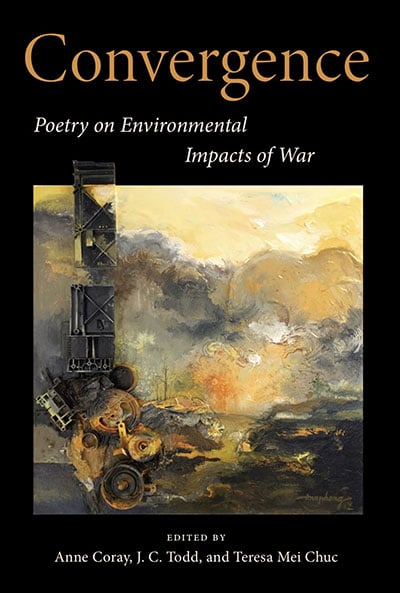
Teresa Mei Chuc is the co-editor, with Anne Coray and J. C. Todd, of Convergence: Poetry on Environmental Impacts of War (Scarlet Tanager Books, 2206), a collection of highly accessible, uplifting poetry celebrating the small wonders and peaceful moments of everyday life.
Convergence offers a groundbreaking and vital perspective on war’s destruction of the natural world—the creatures, plants, soil, water, and atmosphere of Earth. In poems and contextual comments, 61 contemporary poets focus on military damages to the ecosystems on six continents and the moon. Framed by a cogent introduction and a pair of forewords, one on the poetry and the other on global consequences, the poems are accompanied by a tally of ecological costs and a set of thought-provoking discussion and writing prompts for teens and adults. This anthology alerts readers to environmental degradation of our planet while affirming nature’s resilience and regeneration.
Terrain.org will reprint three of these poems over the next three days.
I was born in Sài Gòn, Việt Nam and fled my Vietnamese homeland in a boat with my mother and brother shortly after the American war. We spent three and a half months in the East Sea before being rescued. The war and its human impacts were tremendous. However, hardly mentioned was the impact on my motherland: the rainforests, the rivers, the land, the flora and fauna. In 2023, I was invited to co-edit, with Anne Coray and J.C. Todd, Convergence: Poetry on Environmental Impacts of War, released by Scarlet Tanager Books on May 11, 2026.
This series of three poems by Sean Mclain Brown, Jaylan Salah Salman, and John Balaban publishing in Terrain.org offers a glimpse and introduction into the anthology. Each poem in the anthology is accompanied by an author’s note that specifies the war—and the geographical and historical context of the poem.
In his author’s note for “First Snow,” Sean Mclain Brown writes:
During the Gulf War, the U.S. and allies dropped 88,500 tons (1,777,000,000 pounds) of bombs. The skies were thick with coalition aircraft, oil well fires, and the sounds of thunderous explosions. This poem arose when I recalled hearing about snow falling in the mountains of the northern region of Saudi Arabia while I was stationed at our forward air base near the Kuwait border. I imagined our aircraft (Marine Corps AV-8B Harriers, VMA-542) in formation, readying for a bombing run on Iraqi artillery positions, while snow was falling and as locals made futile attempts to save their animals from the inevitable onslaught.
Brown served in the U.S. Marines. His unique perspective on the battlefield gives the reader a close-up account of the military bombardment on the land and her creatures. For example, in “First Snow,” Mclain Brown shows how a father and son hurried to save their horses when war planes flew overhead.
Poet Jaylan Salah Salman focuses on the destruction of gardens in Gaza to reveal the war’s disruption of daily life and warmth. In her author’s note for “You Killed My Rosemary Garden,” Salah writes:
Palestinian land is known to be fertile and rich, the perfect climate for cultivating herbs and other plants that are included in recipes mothers and grandmothers pass down as they bring the family together over food and warmth.
Entire families, including children and newlyweds, are deprived of this sense of home now because of the war. Through my poem, I want to show how daily life is affected by the ongoing war.
Rosemary is a nurturer, a special plant. When land is destroyed and taken, the ceremony of gathering from one’s garden and cooking for the family is also destroyed. In essence, the humanity of the Palestinian people is stripped away through the destruction of land.
In the final poem in this series, John Balaban focuses on the effects of chemicals used during the Việt Nam War when the U.S. specifically targeted the destruction of the rainforests, farmland, and the water and food supply of the Vietnamese people. In his author’s note for “Crossing on the Mekong Ferry, Reading the New Yorker,” Balaban writes:
I was a conscientious objector to the Vietnam War volunteering as a teacher at a university in the Mekong Delta, where I was wounded by shrapnel during the Tet Offensive of 1968. Following that, I worked for a medical group that treated war-injured children, traveling into countrysides of overwhelming tropical beauty to confer with their families out in the farming villages, and always aware that napalm, white phosphorus explosives, gunfire, 2,4,5-T defoliants, and landmines were wounding children near their homes, and that some of those munitions and defoliants would be around for decades to come.
Balaban’s poem takes us on a journey with him along the Mekong Delta and also a journey in which the chemicals travel through the rivers, blood stream, and milk of animals and humans into future generations, including his unborn child.
The three poems in this series give a sample of the depth and breadth of poems in Convergence: Poetry on Environmental Impacts of War. From ancient Rome to the wars of colonization, through the two World Wars, the Vietnam War, the Gulf War, the Iraq War, and the destruction of Gaza, the anthology covers a range of military conflicts.
The conversation on war most often focuses on human death and injury and the destruction of the built environment that supports human life. This anthology re-centers the conversation on war’s destruction of the environment. Our very existence depends on it.
 Teresa Mei Chuc (Tuệ Mỹ Chúc) was born in Sài Gòn, Việt Nam and fled her Vietnamese homeland in a boat with her mother and brother shortly after the American war. Her father, who fought in the Army of the Republic of Vietnam, was imprisoned in a Vietcong reeducation camp for nine years. Teresa grew up in Pasadena and Altadena, California. Former Altadena Poet Laureate (2018-2020), Teresa is the author of three poetry books, Invisible Light (2018), Keeper of the Winds (2014) and Red Thread (2012). Her poetry chapbook, Incidental Takes, was published by Hummingbird Press in 2023. Teresa’s poetry was recently published in the anthologies–Here Was Once the Sea: An Anthology of Southeast Asian Ecowriting, Attached to the Living World: A New Ecopoetry Anthology, and Colossus: Current, The Ways and Workings of Water; as well as in About Place Journal’s “On Freedom” issue. Teresa is co-editor of the anthology, Convergence: Poetry on Environmental Impacts of War (Scarlet Tanager Books, 2026). She holds an MFA in Creative Writing (Poetry) from Goddard College and is a public high school English teacher in Los Angeles in her 21st year of teaching.
Read three poems by Teresa Mei Chuc appearing in Terrain.org.
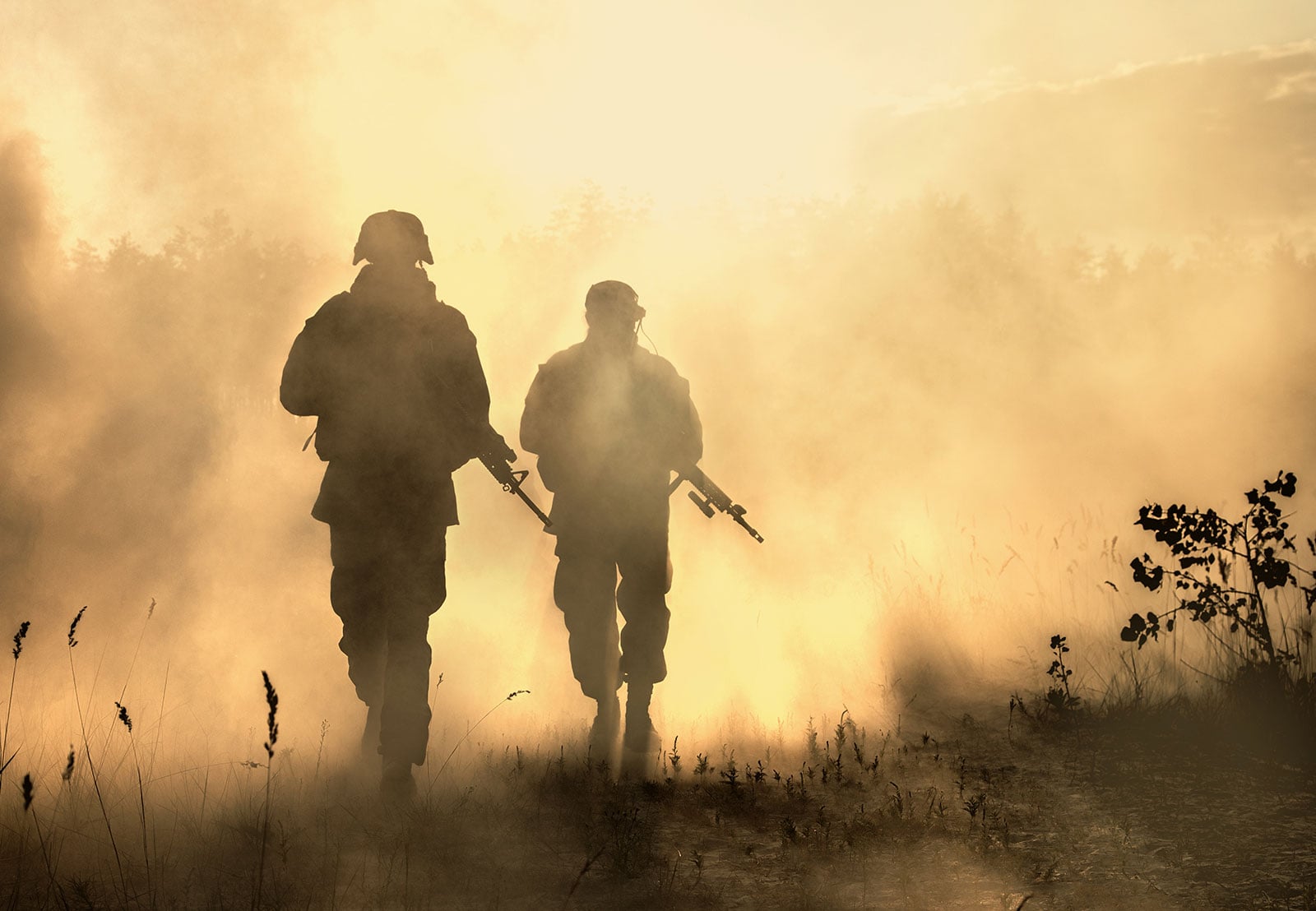
Header photo by Getmilitaryphotos, courtesy Shutterstock.