
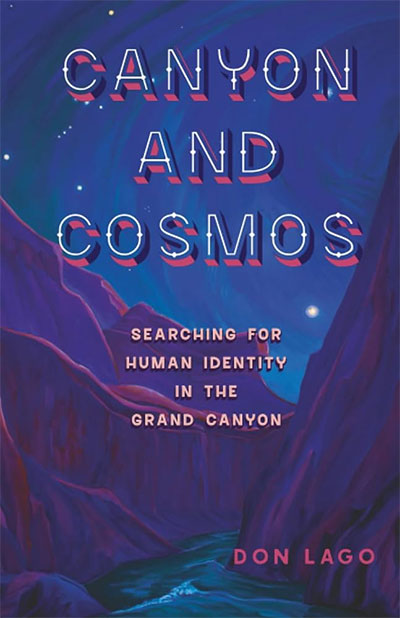
Canyon and Cosmos: Searching for Human Identity in the Grand Canyon
By Don Lago
University of Nevada Press | 2025 | 353 pages
To get to the Grand Canyon, Don Lago first takes us to Walden Pond, but only for a few pages in Canyon and Cosmos, to make a point about his purpose. “Thoreau gave us a powerful tool for exploring our connections with nature,” Lago reminds us. “He was pleased to find nature’s aesthetic beauty along the way, but he was searching for deeper beauties.”
 Lago himself proposes to do that in one of the deepest beauties on earth, the Grand Canyon, which is not just bigger and deeper than Walden Pond, but which “embodies deep time, geological forces, and biological evolution, allowing you to touch them with your hands and be touched by them, to feel them within yourself.” He invites, even challenges, us to go deep with him, down into the canyon, into the depths of time itself, back some 13.8 billion years ago, to the universe’s beginning with the Big Bang. It’s a long trip in a long book, but Lago leads us through, often with diverting narrative switchbacks, always getting us back on track, asking that we focus on seeing and sensing the effects of eons.
The Big Bang suffuses the book, from beginning to end—perhaps even to the end of time, if there ever is to be such. Thoreau lived too early to know about it, and so did the Native peoples who had inhabited the Grand Canyon for thousands of years. Their stories of creation began not with a bang, but in the womb of Mother Earth. Human beings emerged into the canyon and took their place in it: “They turned the canyon into stories that made connections between people and rocks, plants, animals, and stars, stories that made more sense of life and death, that made them feel more at home in the canyon and the universe.” In its own way, Lago’s notion of the Big Bang underscores those connections, with an explosion of atoms that swirled in time and space and eventually formed themselves into everything we know—including ourselves.
But how we know ourselves may be the problem, Lago says. We never acknowledge the atomic processes that made us, “never pause to consider and thank our atoms for their talents and hard work on our behalf.” Instead, we create comparatively shallow social identities to put before the other collections of accumulated atoms we encounter in other people. Even in as grand a place as the Grand Canyon, where the atoms that formed the rocks and the river might provide an existential perspective on where we are and who we are, too many people put too much emphasis on themselves: hikers want to talk about how far they’ve gone, “having conquered here, there, and everywhere for years,” while some kayakers come to the canyon “mainly to prove their superiority over the Colorado River and other kayakers, and they viewed the canyon as an ego trophy, not an invitation to grow beyond ego.” But the Grand Canyon has other ideas, “trying to wean us from our social identities,” Lago warns. “It is telling us that we are simply human bodies.”
Sometimes, those human bodies never make it out of the canyon. Hikers slip and fall from a canyon trail, kayakers flip and drown in a river rapid. Accidents happen, death comes next. But not all canyon deaths are accidents. In the longest single section of the book, “The Abyss,” Lago writes of the people who come to kill themselves.
He knew several of them personally, and his account of one in particular runs throughout the section. Dale was a park ranger and rafting guide, a man with “a love of exploring, both intellectually and physically.” But he also explored the depths of his own psyche, falling into a depression that made it impossible to be “the conduit through which the canyon gets to speak” to visitors. Instead, the canyon may have spoken death to Dale, Lago suspects, “nature itself telling him that he might as well die.” If so, Lago sought to come between Dale and nature. “I asked him to promise that if he ever felt suicidal he would give me a call, and he promised.” But then comes the deadly addendum: “He broke his promise.” After Dale’s memorial service, after Lago has dropped a handful of his burned bone particles over the rim of the canyon, the broken promise gave way to a promise of another sort: “I thought of these ashes becoming soil and trees, lizards and ravens, further river journeys.”
Lago writes of his own journey as well. In the final section of the book, “The Raven,” he recounts a week he spends alone above Lava Falls, a famous rapid that can overpower paddlers, giving them a “quick plunge into chaos.” Instead of chaos, though, he finds contemplation. He’s there ostensibly to assist in a National Park Service project on the effects of changing water levels on sedimentation and such—useful scientific stuff—but his solitude sucks him down into deeper levels of his own consciousness. “I felt my life flickering away,” he writes. “Soon the canyon and the universe would go on without me . . . Time would go on, burying my sand grain of it.” To make better sense of the transience of his existence, he tries to rely on various real and imagined encounters with the raven—or The Raven, a primordial god of many identities, many guises—hoping for a sighting but above all a sign, something the dark bird could show him about the cosmos and his place in it. But the raven is, after all, a trickster bird, and the trick was on Lago. Just when he felt he most needed to see it, the raven seemed to be hiding. “It was as if the ravens were trying to frustrate me further and finally.”
“The Grand Canyon can change your sense of reality and identity,” Lago observes early on. What it can’t do is give you answers about either. Neither rock nor river nor raven can reveal the secrets, much less the meaning, of our human existence. “Creation is a mystery,” Lago concludes, and “its ultimates will remain hidden.” The Big Bang is only billions of years old, and it may have billions more to go. But as Lago helps us understand, it will eventually go on without us.
 Gregory Nobles is professor emeritus of history at Georgia Tech, and he lives in Atlanta, Georgia, and Northport, Michigan. He is the author of, most recently, John James Audubon: The Nature of the American Woodsman (2017) and The Education of Betsey Stockton: An Odyssey of Slavery and Freedom (2022).
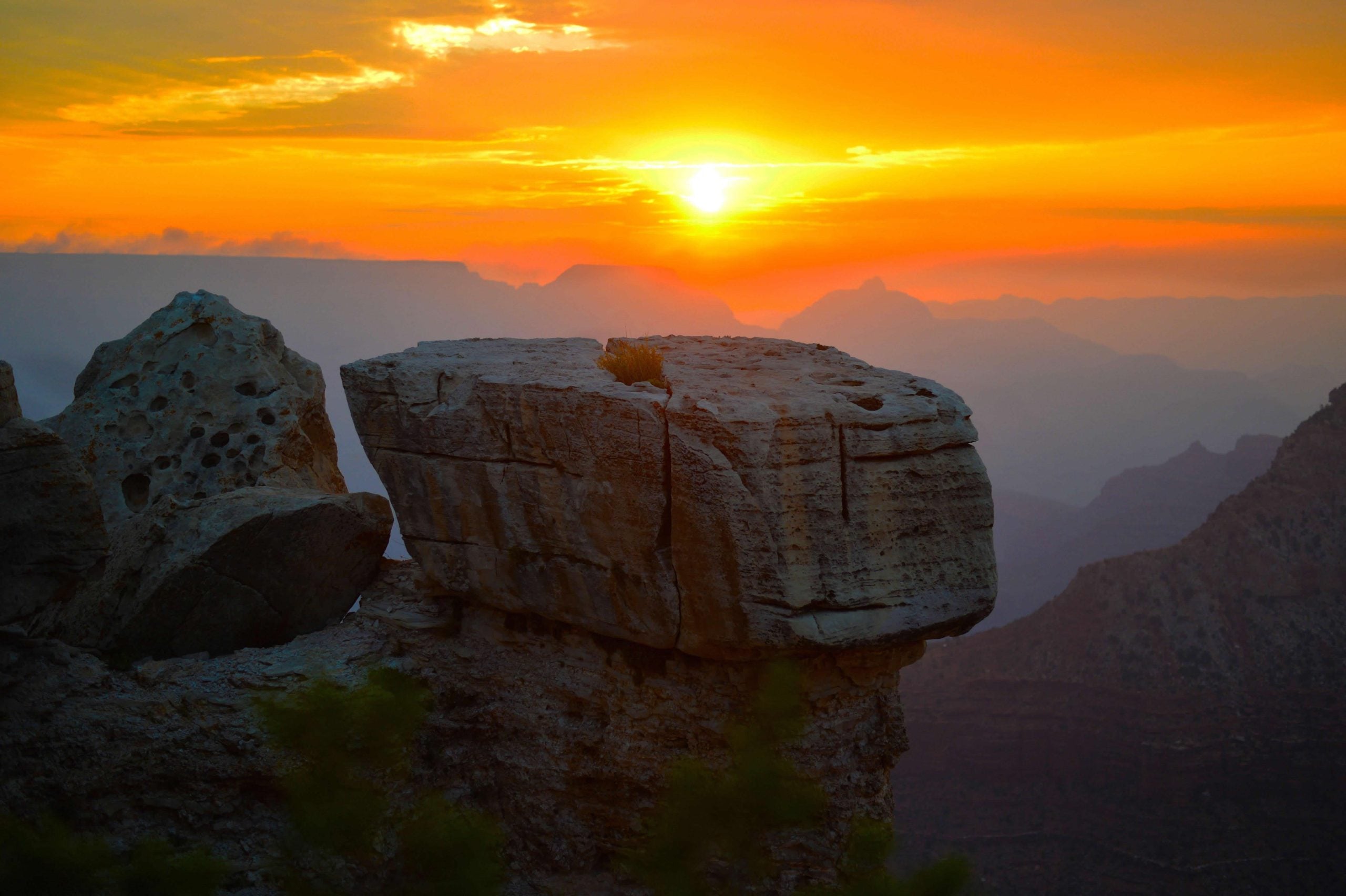
Header photo from Pixabay.