

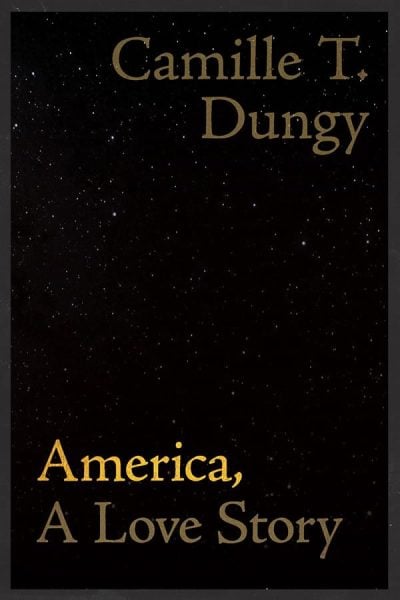
America, A Love Story
By Camille Dungy
Wesleyan University Press | 2026 | 104 pages
What happens when a place you love threatens to kill you and those you love most in the world? Camille Dungy’s America, A Love Story attempts to answer that question in this deeply personal and political new poetry collection.
 In the introduction of Against Forgetting: Twentieth Century Poetry of Witness, Carolyn Forché writes, “The distinction between the personal and the political gives the political realm too much and too little scope; at the same time, it renders the personal too important and not important enough.” Forché calls for a third term: “the social,” as this is a space of resistance and struggle, “the sphere in which claims against the political order are made in the name of justice.” It is precisely here, in the sphere of the social, where Camille Dungy centers her new collection of poems, creating a beautiful place of resistance and struggle.
The collection begins in the very place many poetry professors warn students about venturing: the grandmother poem. But in Dungy’s deft hands, “This’ll hurt me more” is a love letter to the poet’s grandmother, yes, but it’s also an unsentimental love song that directly addresses America. Dungy writes, “America, there is not a place I can wander inside you / and not feel a little afraid.” America is a dangerous and frightening place, but also one filled with natural beauty where the “lilac blooms show up like a rash decision the bush makes each spring.” Like many of the poems in the collection, this first one contemplates natural beauty, transgenerational trauma, and the dangers of moving through a warming world, specifically in a Black, female body whose labor is unending.
Loving the world—and in this case, a specific place in the world—means contemplating differing kinds of environmental loss. Paying attention is a way to express love, and Dungy not only notices the specific natural wonders, but she carefully names them. In “this beginning may have always meant this end,” the speaker catalogs the flora and fauna of the American West: “quail, scrub jay, mockingbird… tumbleweed, lichen on the rocks and pill bugs underneath, rattlers sometimes, the soft smell of sage and the ferment of cactus pear.” The poem then turns to the ominous: “dry grass whispering long after the last rains,” the “trash hurled by the hottest wind,” and the realization that “all of it, everything could flame up that quickly, could flare and be gone.” Because of the threat of environmental loss in these poems, every love poem is also a ghost story, a deep longing for what was, what is, and what may not be passed down to the next generation, specifically the poet’s own daughter. This longing, however, is complicated as the past is also a marred and tragic place, especially for Black Americans.
America, A Love Story explores the legacy that’s being left to our children, and the poems are ruthlessly honest about the difficulties of motherhood in contemporary America, especially for Black mothers in a world where four girls in Sunday dresses become “bone, ash, bone, ash, bone” in the poem “On ‘Brevity,’” which remembers the four girls murdered in the 1963 Ku Klux Klan bombing of the 16th Street Baptist Church in Birmingham, Alabama. But the poems are also self-aware of their own small acts of creation, and “Revision is a struggle toward truth.”
In keeping with the social as a place of resistance, the poem “Jamestown, 2019” connects the poet’s own experience of motherhood with those of enslaved mothers of the past. This poem is also aware of itself and the impossibility of writing a poem about such tragedies but going ahead and doing that impossible task anyway, even if representation can never quite reach meaning, even if the act of witnessing, of writing, is like lullabies that were cut short by slavery: “what rhymes with snatch a life and name it / building—this burden—don’t end there— / what rhymes with help the mothers love / these babies—help them help them help them / —help them rock their stolen babies down.” The poem shows there is no rhyme nor reason for something as horrific as a stolen and sold baby, but the poem becomes the incomplete lullaby, the attempt to name, to understand, to remember.
These poems dwell on historical events and are also deeply personal, placing them into the realm of the social, where the body holds history and the natural world, joy and sorrow inside of it, making this book a graceful and lyrical act of witnessing and resisting. America, A Love Story is a love letter to America, yes, but it’s also a love letter to mothers everywhere, as well as to the poet’s daughter. The poems mine the dangers of motherhood, from losing sleep to dying in childbirth to the risky business of raising a daughter in modern America, where the speaker realizes, “Every time I fool myself into believing who we are (I mean Black people) might be valued, / America proves me wrong.” But at every turn, there’s an act of balancing the scales: a three-legged elephant injured by a mine finds humans to lovingly build a new prosthetic leg every time she outgrows the old one. In each of these poems, we find the monstrous but also each poem offers glimmers of beauty and grace.
An avid gardener, Dungy offers us her garden, and the world, as it is: cyclical and beautiful but difficult and complicated—a proving ground of both life and death. In “The Garden” she writes, “What you love, others will find / ways to take. Nothing is left / to teach that the garden won’t prove.” Another garden poem, “The Lesson,” also offers a meditation on inherited trauma, motherhood, race in America, and politics, but it, too, is rooted in the garden as a place of both the natural, corporeal world as well as a spiritual center of worship, a place where “Not everything will recover. Not everything / will be destroyed.” And lastly, “Garden Style” is a fun, joyful poem, one that makes use of a whimsical style to show what a rollicking good time a garden can be:
platters full—such sustenance! these flowers
like women I have loved—handbags to match
cloche hats & heeled shoes—oh! their flair! black stripes
against gold pistils—can’t no one tell them they aren’t
beautiful—blue blazes hyssop sticks close
to the stalk—small, plucky, pulled together—
smelling sweet as what I reach for hot nights
when I need to recall the taste of joy—
Each poem in the collection does so much work, meaning each one can be read on multiple levels. For example, the poem “One night in 1888, as the French steamboat Abd-el-Kader powered from Marseilles to Algiers, news reports proclaim the sky became quite black with swallows” is a juxtaposition between warring nations and bird migration, race relations in America and random acts of kindness. Because of this deep and intentional layering, America, A Love Story is a book that can be read again and again, the delight and wonder multiplying each time.
The poems in this brilliant collection send a love letter to both a ruined America but also a version of America that’s still possible. In “Late summer then blink and it’s fall,” the poet writes to her daughter Callie, who moves out at fourteen (to pursue professional ballet). The speaker of the poem gathers flowers for her kitchen table but then sees an empty nest outside, and she changes her mind about the bouquet, and gives them away instead: “Every bloom. / Every flower.” She will support her daughter’s flight into this world, as those birds did for their own young. But also, this poet has given the world this thing of beauty and grace, this bouquet of blooms, this collection of poems. In the end, all love stories are fraught and dangerous, and this one problematizes easy judgments and answers, but the final message is full of hope, a message that ends, not with “The End,” but with the last two words: “All Love,” as this is a book that delivers hard messages but is full of heart.
 Suzanne Roberts is the author of Animal Bodies: On Death, Desire, and Other Difficulties (longlisted for the PEN/Diamonstein-Spielvogel Award), Bad Tourist: Misadventures in Love and Travel (North American Travel Journalists Association Bronze Award), Almost Somewhere: Twenty-Eight Days on the John Muir Trail (winner of the National Outdoor Book Award), 52 Writing Prompts: Inspiration for the Creative Writer, and four full-length collections of poetry. Her work has appeared in The New York Times, Ploughshares, CNN, National Geographic, Creative Nonfiction, Brevity, The Fourth Genre, The Best Women’s Travel Writing, and elsewhere. She holds a doctorate in literature and the environment from the University of Nevada-Reno and teaches in the low residency MFA in creative writing at UNR-Tahoe.
Header photo by Gordon Johnson, courtesy Pixabay. Photo of Suzanne Roberts by Lauren Lindley.