
When I was a boy, I was fascinated by outer space. It was an interest initiated by a coffee-table book about the universe that I pored over obsessively in our living room in a small town in southern Ontario, staring at the remarkable illustrations of the planets, trying to fathom the staggering size differential between Jupiter and Earth. I peered at the eerie reflective radiance of nebulae in the dark unimaginable reaches and wondered what it would be like to pass through the gasses of the planetary rings, naively thinking the experience was comparable to being enclosed by scrolling mists on autumn fields. By Grade 7, when I would have been 12, I even dedicated an essay to the mysteries of our galaxy. Reading it today, the blue ink of my handwritten words a little faded but still clear, an awestruck tone shines through the youthful academic reserve.
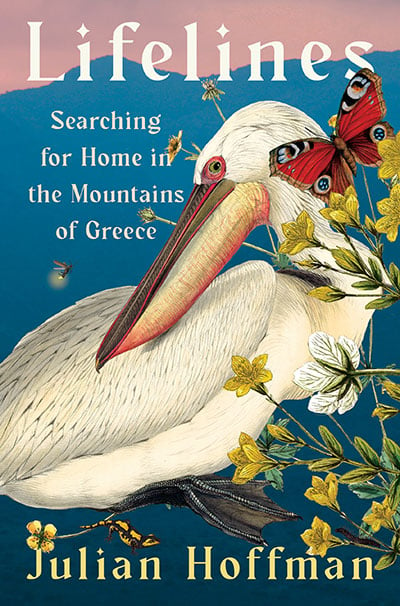
Lifelines is not only the tale of a courageous leap into a new life in Prespa, Greece, but of seasons punctuated by unforgettable encounters, from a stare-down with a bear surrounded by spring wildflowers to a deep-winter meeting with 14 wrens sheltering above a frozen doorway. And into this place encircled by mountains, Julian seamlessly weaves an intricate web of stories—of conflict and possibility; of refuge lost and found; of the wild lifelines that connect us all as we move through the world seeking a home.
A few years later, when I was in my mid-teens, something shifted for me. I altered my allegiance from the book about the universe to an atlas of the Earth. It was our home world rather than everything outside it that increasingly fascinated me as a teenager; but even so, it was still the Earth as seen from out there, as perceived from space. It was the Earth of the Blue Marble image that I dearly loved, in which our globe is pictured afloat in the darkness, captured from a distance of 29,000 kilometers by the crew of Apollo 17 on December 17, 1972. Or, later on, the Earth as a Pale Blue Dot, the extraordinary image coordinated by the astronomer and author Carl Sagan in conjunction with NASA. Taken by the Voyager 1 space probe on February 14, 1990, just before the spacecraft exited the solar system, it shows our planet as a barely visible mote in a dark and incomprehensible vastness. Earth is suspended in a wan beam of lightfall caused by lens distortion in the camera, which makes it seem as though our smallness is being spotlit on a spectacular celestial stage. From a distance of six billion kilometers, the Pale Blue Dot image reduced our world to the nothingness that it is in universal terms.
These images of Earth appealed to me for reasons not dissimilar to my earlier fascination with outer space, but they also fundamentally re-centered my perspective. They held the mystery of what we as humans are a part of but which is simultaneously beyond us too, immersing us—physically, psychologically, intellectually, and spiritually—within a far greater realm. And they were extraordinary in their enlarging register of awe. But I don’t know that these images ever encouraged me at the time to consider what happens on this planet at an ecological or even societal level. Or to explore the closely related range of mystery, wonder, and awe found here because of life itself and the presence of a wild world. That all came much later, when wild things—by happenstance rather than planning—gradually became a source of joy in my life. But back then, on the verge of adulthood, those remarkable images made distance more appealing than intimacy.
There has been much written about the momentousness of the Earthrise moment, that inner transformation occasioned in some astronauts when apprehending our planet in all its unlikely and luminous beauty from space; how it can induce a sudden and humbling reverence for our home world for the few people fortunate enough to have seen our planet framed against the darkness in person. But in an essay written in response to the optics of belonging as portrayed by environmental organizations and at climate conferences when the globe is used to telegraph a sense of moral relationship, Anna Pigott, a lecturer in human geography at Swansea University in Wales, asked whether such popularized images of the planet as the Blue Marble “help to inspire humans to take better care of their one, fragile home.” She argues that such projections ensure that “humans appear on the outside looking in… a perspective that expels humanity from the lifeworld.” She then goes on to say this about such externalizing depictions of the globe: “Rather than the environment surrounding us, it appears that it is us that have surrounded it. From such a perspective, humility is difficult.”
We require stories about our home places, in part, because stories are so frequently silenced. Silenced for reasons of racial exclusion, cultural and class discrimination, and institutional invisibility. Silenced for reasons of fear, anxiety, and self-doubt. Silenced for the sole purpose of retaining privilege and enforcing authority. Silenced because the tellers of a story are gone. Silenced because they come from places that others see as peripheral when for those living there they are the center of the world. And silenced because sometimes silence is the story.
What is lost in this silencing is beyond measure. We lose ways of understanding some of the countless diverse experiences and interactions that make up our common world. We lose ways of recognizing how power keeps systems of inequality and disenfranchisement locked in place. We lose ways of cultivating empathy and understanding; we lose potent tools of agency and change. And we lose ways of considering humility, too.
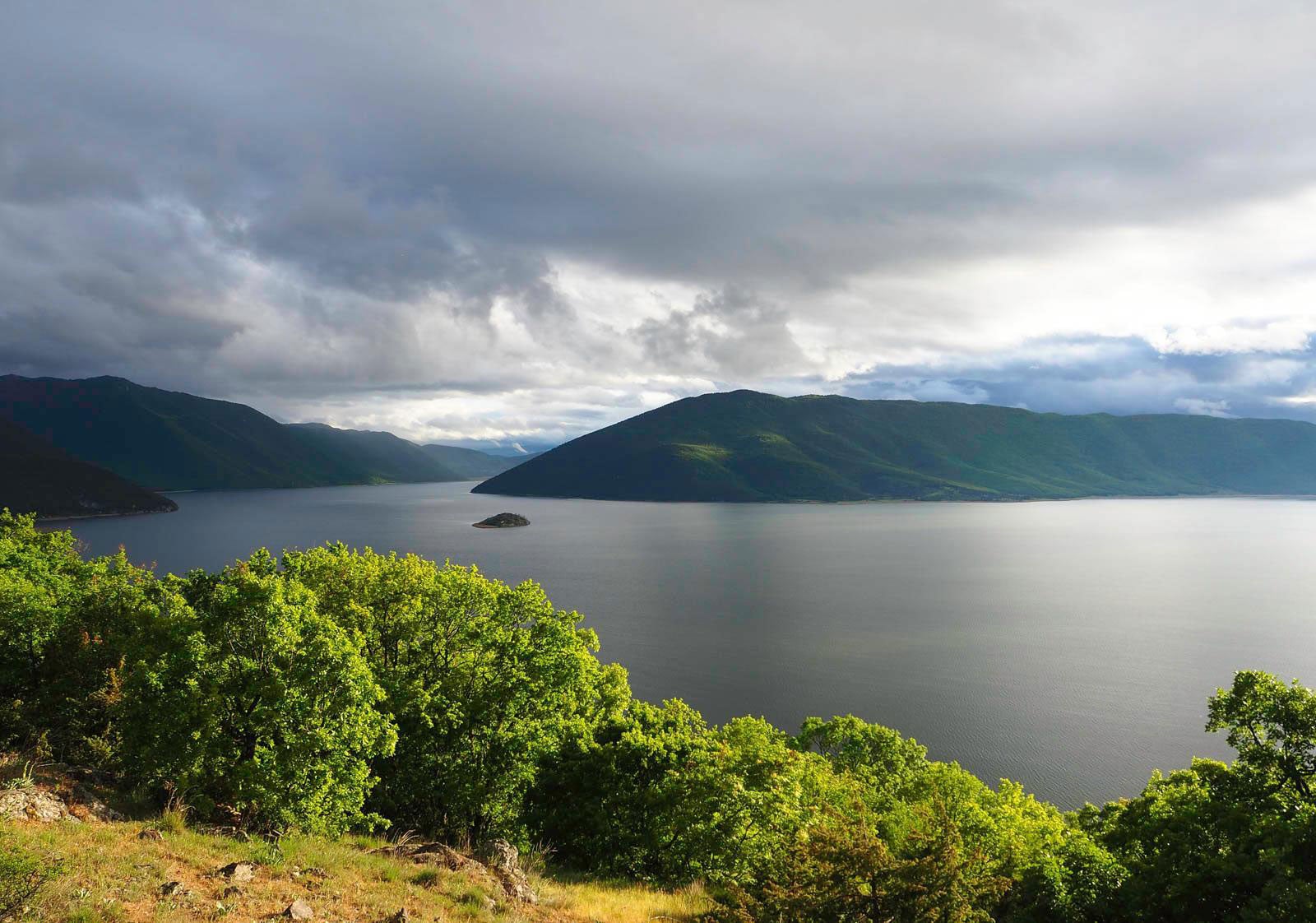
For over a quarter of a century now my home place has been the mountains and lakes of Prespa in northern Greece. At the crossroads of three countries—Greece, Albania, and North Macedonia—the Prespa watershed holds stories that are necessarily complex, invariably rich, and sometimes conflicting. It is the meeting place of different nations, ethnicities, geologies, habitats, religions, ecosystems, ideologies, and languages. It is a place on a map that is separated by lines. But many of the wild species inhabiting these borderlands regularly cross those lines—mammals, fish, butterflies, birds—as they naturally range through that far greater home of theirs. Reimagining Prespa through their eyes is an act of perceptual and emotional expansion, a way of understanding some of the other stories that are layered across these lands and waters, frequently invisible or unnoticed. To see the catchment not as divided but entire, a shared and interconnected place where climate change—easily discernable in the dramatically reduced water levels of the two ancient lakes at the heart of the basin—affects us all. Our lifelines aren’t ours alone.
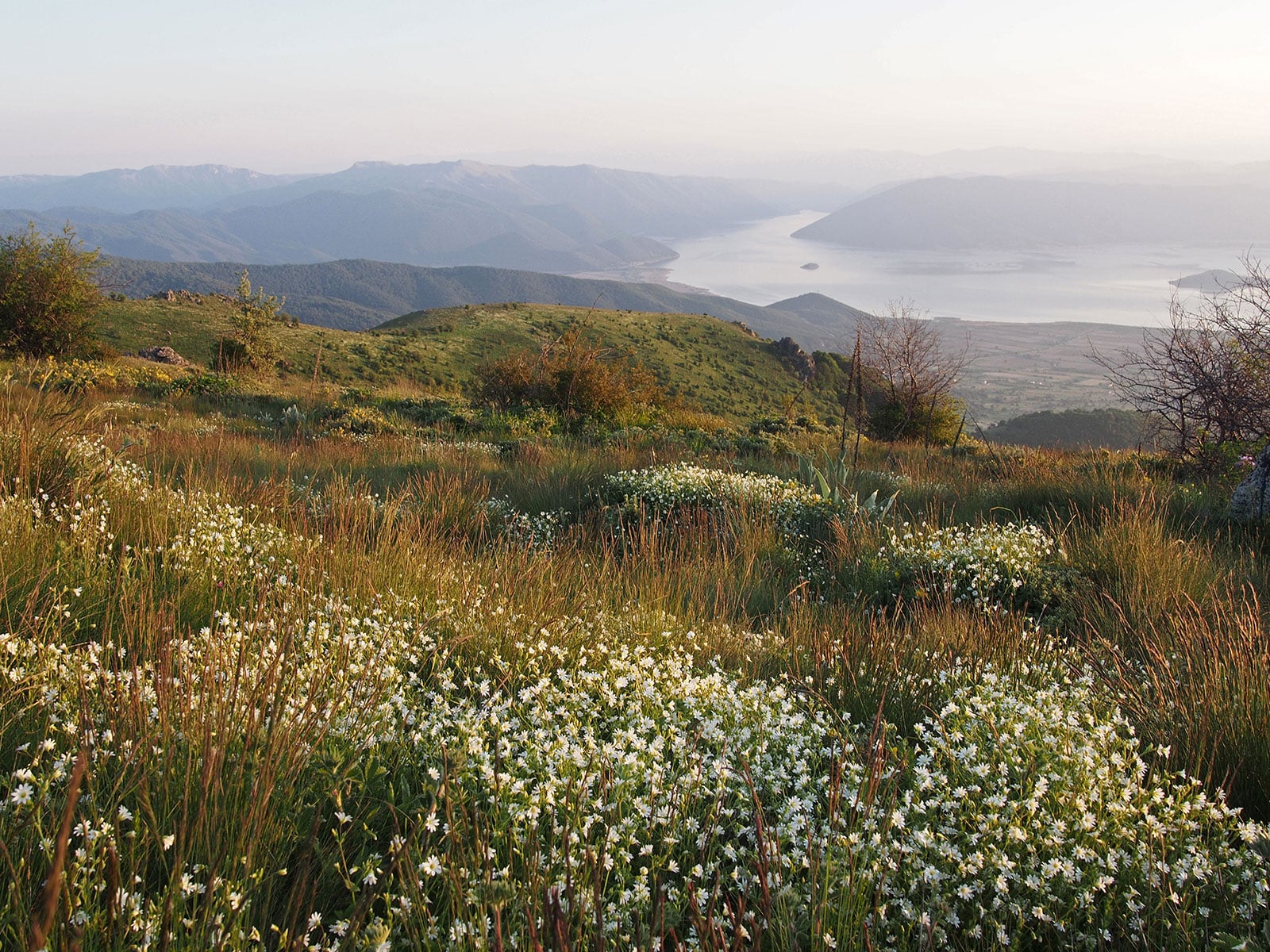
One June afternoon, Chris and I pulled over below a small church and its sacred grove of junipers. On the other side of the road and downslope of the towering trees, we pushed through a forest of mixed oak and juniper for about 50 meters to the spot where we’d set our camera a couple of weeks earlier. The path had looked promising when we’d first found it—worn in, we believed, by animals descending to drink from the lakes as summer evaporated any lingering forest pools.
“Brilliant,” said Chris, bunched up on a rock, his laptop balanced on his knees, “we have a hundred videos.” I sat down beside him to see what had passed by in our absence, thrilled, as always, by the mystery that brought us out each time. The first minute-long video was of waving wildflowers and grasses, the camera sensors triggered by their near motion. The second clip the same. Third and fourth, no different.
“Shit,” both of us muttered. What we’d failed to consider was the explosive growth of vegetation at that time of year, which had swiftly risen within range of the camera. We skimmed through more of the footage, increasingly frustrated. No. 40, 60, 80—all empty except for the sway of stems. I’d walked away by then, pissed off that we hadn’t thought more carefully about our camera positioning. As was sometimes the case, there was to be no magic to follow the mystery that time.
“Shit,” said Chris again from behind me.
“More grasses?”
“You’ll want to get back here.”
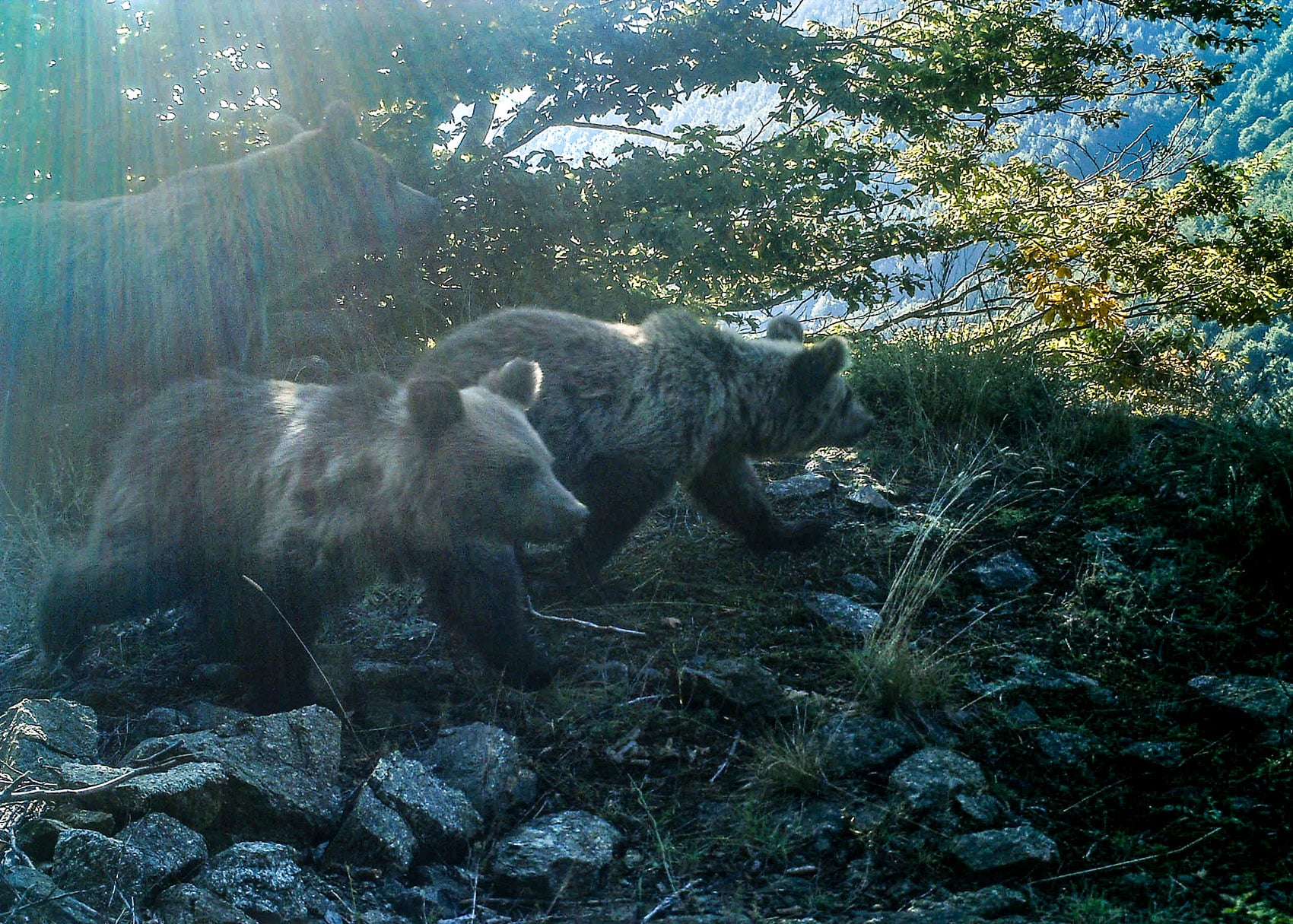
No. 99. A massive female brown bear passes directly in front of the rock we’re sitting on, her shaggy coat glowing with summer light. She turns her head so that we can see her black eyes; they’re so clear that it feels like she’s looking into us. Her dark, doglike nose gathers the air and all that it tells her of what’s been this way and when. She’s so close to the camera that she fills nearly half its frame. All energy and attentiveness. Sentience. Her muscles ripple through her legs and flanks as she shakes her body, pausing and panting in the heat. And then she moves out of view to our left. But, as she does, the footage is shaky and unfocused. Shuddering. Something, it seems, is pressing against the camera, flicking it upwards so that we get swift, oscillating visions of sky and trees, a whirling blur until everything goes black. Strange scrapings are heard through the darkness, then loud slappings and cracks as the camera gets knocked against the tree. Finally, the light returns, opening wide onto something else: a snout, an eye, an ear. The camera lens clouds with breath as a bear cub peers back at us on the laptop screen.
Chris let out a deep breath, as though he’d been holding it the whole time. “I’ve just seen the time stamp of the video,” he said. “This was just half an hour ago.”
With tingling skin, I rose from the stone, thinking of all that passes so close sometimes. I tried to work out where the mother bear had gone after she’d drifted out of view while her cub played with the camera. I estimated her paces, her angle of leaving. And then I saw it: the limestone boulder torn from its socket of earth and pushed to one side. In the hollow where it had been, a nest smashed open. Hundreds of ants still massed around the breached shelter, carrying away eggs to safety, excavating collapsed chambers and shoring up slumped tunnels. They must have been as oblivious as us when an earthquake rocks our homes.
I still remember the extraordinary degree of humility I felt as we stood in the presence of bears that weren’t there. It was breathtaking, unnerving, astonishing. The swaying grasses, the glowing light—everything seemed so vivid and charged. It was the middle of a summer’s afternoon, merely 50 meters from a well-used road connecting Prespa villages. Standing there, with the shared world so viscerally revealed, I was reminded of how I’d once felt looking at those images of Earth from a distance. Or at those illustrations of the planets and nebulae in the book I pored over as a child, when I first began to realize how much more there was out there and beyond us. But on that limestone ridge above the lakes, and in the story of a mother and cub so at home in this place that I love, it was clear just how much more there is in here—within the world that we’re held by.
 Julian Hoffman is an award-winning author living beside the Prespa lakes in northern Greece. His lastest book, Lifelines: Searching for Home in the Mountains of Greece, was a Financial Times Best of Summer Books in 2025 and won the Anglo-Hellenic Runciman Award in 2026. Irreplaceable: The Fight to Save our Wild Places was the Highly Commended Finalist for the 2020 Wainwright Prize for Writing on Global Conservation and a Royal Geographical Society Book of the Year. His debut, The Small Heart of Things, was chosen by Terry Tempest Williams as the winner of the 2012 AWP Creative Nonfiction Prize and won a National Outdoor Book Award for Natural History Literature. His next book, The Last Wild River, about the unique Aoos-Vjosa river basin spanning Greece and Albania, will be published in July 2027.
Read an interview with Julian Hoffman in Terrain.org, “Murmurs at Every Turn,” Julian’s recommended reads, and essays including “The Spiral Windings,” “Time in the Karst Country: Essay and Photographs,” and “Faith in a Forgotten Place,” winner of the 2011 Terrain.org Nonfiction Content, plus his short story, “Pelicans.”
Header photo of bears caught on camera trap by Chris Mounsey and Julian Hoffman.