

It’s time for a more discerning perspective that recognizes why we need industry, just as we need more housing and new transportation links and updated commercial centers.
The Last Black Man in San Francisco opens with a shot of a little girl innocently staring up at a man wearing a hazmat suit. The man, now joined by a team of hazmat-suited workers, turns away to continue his cleanup efforts. The girl skips along down the street, with the ruins of the Hunters Point Naval Shipyards looming in the background. A sidewalk preacher standing nearby proclaims, “Why do they have on these suits and we don’t? They’re here to clean up this water. Man, this water’s been dirtier than the devil’s mouth for 50 years.”
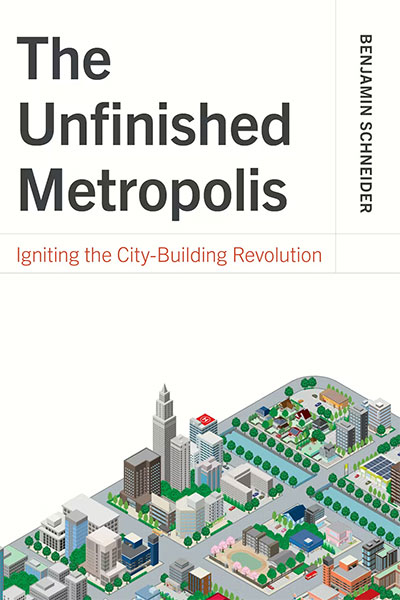
In The Unfinished Metropolis, Benjamin Schneider argues that city-building is a lost art. In this insightful and entertaining tour of the built environment, Schneider explores common urban designs that shape our lives and color our cultural imagination: office parks, apartments, single family homes, and transit systems. He explains how these forms came to be, why they no longer function as promised, and introduces readers to the advocates and professionals around the country who are working on transformative new solutions. Learning from past mistakes, we can remake our cities and create better lives for ourselves and future generations.
In the 1950s, Hunters Point was home to the Naval Radiological Defense Laboratory, which contaminated the soil and groundwater with radioactive material and other toxins like asbestos and PCBs. Power plants, wastewater plants, and other noxious industrial uses were sited nearby. The greater Hunters Point neighborhood became San Francisco’s poorest district, with its largest concentration of public housing and the largest proportion of Black people. Residents felt as if their neighborhood was the city’s “dumping ground.” Significantly elevated cancer rates underscored their point. The name for this phenomenon—poor people of color living amid the dirtiest infrastructure—is environmental racism. People living within a mile of a Superfund site are considerably more likely to be minorities and below the poverty line. Cancer-causing pollutants are about 40 percent more prevalent in census tracts where the majority of residents are people of color.
As in Hunters Point, the military has historically been a major source of these invisible killers. Chemical plants producing fire retardants and fuels for the military effectively poisoned neighborhoods in Anniston, Alabama, and Bloomington, Indiana. Agent Orange production contaminated the Passaic River in Newark and Saginaw Bay in Michigan. The Manhattan Project left a long-lasting radioactive legacy in Los Alamos, New Mexico; Hanford, Washington; and Oak Ridge, Tennessee. The fossil fuel industry continues to rack up a similar debt. The residents of Baytown, Texas, a majority Latino and Black city on the shores of Galveston Bay, breathe particles of nickel, cobalt, and zinc from the nearby ExxonMobil refinery, one of the largest in the world. A 2021 ProPublica story profiled Brittany Madison, a Baytown resident who lives three miles from the refinery with her sister and her sister’s children. Madison’s three-year-old niece needs to be rushed to the hospital once a month for severe asthma. Madison has increasingly refrained from taking the kids to the playground out of fear of pollution. Her father, who worked at nearby chemical plants, died at age 43 of a heart attack. Several friends and family members have died of cancer. “You wonder what causes it,” Madison told ProPublica. “Is it the air we breathe?”
Not all industry is created equal in terms of its impacts, or its outputs. That became clear in recent years as the U.S. began to seriously reckon with climate change. Reducing the nation’s greenhouse gas emissions won’t simply require shutting down every oil refinery. It will demand a new industrial infrastructure of clean energy. The trio of big bills passed during the Biden administration—the Infrastructure Investment and Jobs Act, the Inflation Reduction Act, and the CHIPS and Sciences Act—collectively amount to a new industrial order for the U.S. Manufacturing construction spending increased nearly threefold between 2019 and 2024, creating about 800,000 additional jobs. Many more jobs are on the way as those new factories producing electric vehicles, batteries, hydrogen fuel cells, solar panels, and computer chips come online. These products will play an important role in the decarbonization of the U.S. economy. And, thanks to labor standards built into the bills, they’re providing good jobs to American workers. President Donald Trump has vowed to stop all this investment. Though he surely will be able to gum up the gears, he won’t be able to completely turn off the machine. A significant number of projects have already received subsidies and have broken ground. And many of the industries in question will continue to grow with or without future subsidies. Computer chips, renewable energy, and electric vehicles are the high-value industries of the future. Sneakers and dolls, the kinds of products Trump seems to want made in America, don’t quite have the same world-changing potential.
Geostrategic competition was a major reason President Joe Biden was able to get his industrial policy bills through a narrowly divided Congress. That same competitive drive has fueled a new military-industrial manufacturing boom that has enjoyed near-unanimous political support. Since 2010, Congress has quietly passed a series of bills to update the nation’s nuclear arsenal to keep pace with China and Russia. In the coming decades, the U.S. is poised to spend $1.7 trillion constructing new warheads, new missile silos, and new nuclear submarines. Plutonium refining is ramping up at Oak Ridge and Los Alamos, nuclear submarines are under construction in Rhode Island, and bunkers are being redug in Montana.
Just as America’s reindustrialization will have uneven impacts on the health and safety of the planet, so will its impact be unevenly distributed across the country. This new industrial boom is overwhelmingly taking place in the South and the Mountain West. The top three states for electric vehicle and battery investment following the passage of the Inflation Reduction Act are South Carolina, North Carolina, and Georgia. This emerging battery belt in the former textile capital of the Piedmont South is the only deindustrialized region that is getting thoroughly reindustrialized by recent industrial policies. A 2024 Bloomberg analysis found that more than three-fourths of green tech manufacturing investment in recent years has gone to Republican congressional districts, whose representatives mostly did not support the laws that made that investment possible. These tend to be rural or exurban places where land is cheap, regulations are light, and labor organizing isn’t particularly strong. These areas deserve good jobs, too, of course. But do they have the housing and infrastructure to handle all of that growth?
Most of the big investments from the CHIPS Act are bound for small towns in the South and already booming big cities. Towns like Siler City, North Carolina; Sherman, Texas; and Taylor, Texas are playing host to multi-billion-dollar semiconductor factories that will bring thousands of jobs. A handful of economically thriving metro areas will also see giant new chip plants, including Salt Lake City, Portland, Phoenix, Silicon Valley, and Columbus. The main exception to these geographic trends among the biggest CHIPS Act grant winners is the Micron plant in Clay, New York, just outside of Syracuse. Though residents are excited about the investment and the 9,000 new jobs it will bring, housing affordability is already a big concern in this small city. Syracuse is squarely in the Rust Belt, with a population well below its historical peak, but its namesake university gives it a powerful economic engine. It is not nearly as economically depressed or desperate for jobs as many of its Rust Belt peers.
Syracuse is no Akron or Buffalo, Cleveland or Detroit, Youngstown or Gary. These cities have block after block of abandoned houses and factories, sometimes called the “urban prairie,” and no major federally backed manufacturing investments on the horizon as of the end of 2024. Toledo and long-beleaguered Flint are getting big investments to retool old auto factories thanks to recent legislation, but they are the exceptions among Rust Belt cities. This urban prairie would seem to be an excellent place to direct new industrial activity: Water and power infrastructure are already in place, and there’s plenty of cheap housing nearby. But deindustrialized Rust Belt cities were not targeted by recent industrial policy bills for reinvestment. The few place-specific provisions in these bills targeted the Appalachian region (thank West Virginia Senator Joe Manchin), and the vast majority of loans and grants are geography agnostic. Rust Belt cities may not have space for a full-fledged chip factory or auto plant, but there’s plenty of room for anything smaller. In fact, many manufacturers don’t need as much land as they once did.
Smaller manufacturing concerns are more likely than bigger ones to have remained in cities. Federal policymakers—and the larger narrative in the media—have long overlooked ongoing industrial activity that continues to happen in cities. These urban industrial businesses tend to make somewhat more specialized or boutique products, like foods, furniture, or electronic components; or else they service ultralocal needs, like auto repair and silkscreen printing. Self-storage is another ubiquitous urban industrial land use. And urban agriculture is a growing category of central city industrial business. These outfits tend to mix more successfully with their residential neighbors than the industries of yore, producing relatively little noise and pollution. Some cities have begun to recognize the value of these light-industrial, or “production, design, and repair” businesses, and have instituted policies to retain them within city limits. The most sophisticated industrial protection zoning rules, like San Francisco’s, allow industrial buildings to be redeveloped as housing as long as production space is retained on the ground floor of the new apartment buildings.If industry continues to get greener and lighter, as it has been in recent years, more mixing of land uses becomes not only possible, but desirable.
If industry continues to get greener and lighter, as it has been in recent years, more mixing of land uses becomes not only possible, but desirable. Centrally located neighborhoods could use more small-scale distribution centers, where truckloads of deliveries can be sorted before being loaded onto cargo bikes for the final mile of their journey. A world with more bikes and scooters will require more bike and scooter repair shops. A world with more rooftop solar arrays and electric vehicle superchargers will require more manufacturing facilities for these components. A world with more housing construction will need more modular housing factories close to the sites where the modules will eventually be assembled. In many cases, these new industrial facilities can retool old ones. Factory OS, a modular housing factory in Vallejo, California [that has since changed its name to Harbinger], took over a space that built aircraft carriers during World War II.
When conversion to housing is not possible, empty downtown office buildings or suburban office parks can also be adapted for certain industrial uses. Many downtowns already have landline exchange hubs or telephone buildings, like 33 Thomas Street in Lower Manhattan or the Southern Bell Telephone Company Building in Atlanta, where telecoms once routed phone calls. These buildings, often brutalist and windowless, show that the industrial backstage can have a place in downtowns without making much of a fuss. Most historic telephone buildings have seamlessly transitioned to the digital age, with servers and fiber-optic cables replacing switchboards and copper wire. Other buildings can be retooled in the same way. In downtown Los Angeles and Chicago, outdated office towers have recently been converted to data centers. Perhaps someday, high-rises can double as vertical batteries, storing potential energy in a weight at their crown. These buildings ought to be convertible back into offices or housing in the future. “The greenest building is the one we already have,” said Kathryn Holliday, the architectural historian. “Our infrastructure is more flexible than we sometimes think it is.”
The architecture of purpose-built industrial buildings can be made more flexible by design. One-story warehouses, the norm for much of the past century, are finally starting to become passé. Amazon has multiple five-story fulfillment centers in the works, more on the scale of the old Sears plants than the sprawling fast-fashion warehouses of recent years. One under-construction warehouse in Queens will rise 11 stories, or about 200 feet; another warehouse project proposed in San Francisco would rise about 100 feet. These buildings allow more storage and manufacturing to happen in higher-density neighborhoods, bringing goods closer to consumers and workers closer to their jobs. They’re still a far cry from SoHo’s cast iron beauties, but they’re easier on the environment than multiacre rectangles on the exurban edge.
Many of the negative externalities of urban industry can be ameliorated with good insulation, clean energy sources, and zero-emissions electric trucks—or, better yet, substituting trucks for smaller vehicles like vans and cargo bikes. Old freight technologies, like barges and railroads, are proving to be a valuable solution for the present day. New York City, for instance, has increasingly turned to barges for moving cargo and reducing truck traffic. As previously discussed, railroad electrification could be a boon for the freight industry as well, allowing much faster, more efficient, and less polluting operations. The future of industrial activity is not all roses, though. As the Trump administration promotes fossil fuel consumption and rolls back environmental standards, it’s quite possible that industry will only get dirtier in the near term. Even with the most enlightened policies, there will always be unpleasantries associated with certain industrial activities.
Meatpacking is by definition an unsavory business. Steel and concrete manufacturing require heating raw materials to hellish temperatures. Pungent sewage treatment plants, noisy recycling facilities, unsightly electrical transformers and transmission lines: these and other forms of industrial infrastructure are necessary to sustain the functioning of modern life.
The trade-offs inherent to urban industry are in some ways a microcosm of the broader challenges of city-building. All forms of growth and change come with negative externalities; they please certain people and anger others; they produce benefits as well as harms. In recent decades, the default stance in many cities has been to slot virtually all urban development with industry, to treat housing and transit like noxious factories. But the nation’s refusal to build up its cities has consequences, too. It’s time for a more discerning perspective that recognizes why we need industry, just as we need more housing and new transportation links and updated commercial centers. The harmful dimensions of these city-building projects, to the extent that they exist, can be ameliorated. Compromises can be reached. Growth and change don’t have to be as hard as they seem. But threading this needle takes political leadership. It requires a different kind of regulatory machinery, a different cultural orientation toward city-building.
 Benjamin Schneider is a freelance writer covering housing, transportation, and urban policy. His book The Unfinished Metropolis: Igniting the City-Building Revolution was published by Island Press (Princeton University Press) in October 2025. Find him on his website or on Substack at The Urban Condition.
Header photo of Queens, New York City, by Andrew Scozzari, courtesy Pixabay.