
The One in Philipsburg, Montana
After his brother goes west
to Oregon, taking his half
of their jokes and running
routines, my youngest son
is left with the apartment looking out
over the Pintlers, the moraines
of grassland that stretch below
zippered with gravel roads
against the lavender mountains
cut out against the sky.
It’s the kind of address the post office
won’t recognize when I want to mail things,
a place where cell service cuts out,
where in winter you’d better have
four-wheel drive to get back up the hill to the slab
of cement your rental rests on.
~
But they already wrecked the pick-up
one night on the snowy interstate
coming back from Missoula.
An older couple from the church
gave them a van their daughter used
to get back and forth to school before
she crashed it, though it will still drive
if you don’t mind the burning smell.
In this balance of sky and peaks and hollow,
in warm, forgiving June, I visit,
while the youngest son considers his future.
The friendly neighbors with the baby
and the husky pup have moved away
to build a house. The brother
has moved to his new job in Oregon.
The old miner who comments on the ladies
and wants to throttle millionaires
keeps watch from his barstool on East Broadway
and, like Hugo’s prisoner,
isn’t going anywhere, ever.
~
If you don’t want to chance the van’s
smoldering brakes, you can walk
to town, easier going down
than coming back, of course.
The deer roam the side streets
grazing the yards and vacant lots
and the dogs lie on the sidewalk
waiting for their owners to come back.
~
The brothers have worked the ski resort,
the dude ranch, the dive bar,
and, finally, the bee yards.
The youngest son will miss that most,
even scraping hives in the freezing shed.
He didn’t mind the bees crawling
on his sleeves and veil, it made him happy
to feed them, lift out the frames
to make sure all was well. He didn’t mind
the stings, even the one that made his lip
as big as a plum, or the rages
of the manager whose wife
drove off and left the kids
and hasn’t been heard from since.
The manager drank Jack Daniels from his thermos,
shot AK-47s after work to let off steam.
~
If you want to know empty, live here,
in Philipsburg, though it’s a holy kind
of empty: cold that will kill you if you sit
in your truck too long on a winter midnight
waiting for the tow. In town,
people keep warm in bars. At closing,
the roads are empty enough
to skid across,
and sometimes you don’t hurt anyone.
The tow is coming.
Meanwhile, beyond the white road
and the white fields,
the mountains glow white
against the black and starry sky
and the animals dig in deep to live,
knowing how.
The One in Garibaldi, Oregon
My middle son lives alone
on a paint-peeled boat, the Dolomi Bay,
diving for clams—butters,
cockles, and gapers. He gets rocked to sleep
under an arc of coastal mountains surrounding
the marina, and some mornings
wakes to a barking seal. It’s true
he’s more alone than he would like,
although there is something tender
and mortal about being so still
with yourself. He rambles through tidepools,
sits on the Dolomi’s deck at sunset
with a book and—he swears his last—
cigarette, the blue twist winding up
through the golden light. By day,
he breaks the surface of the glassy sun,
descending through ringing silence,
drifting rockfish,
thick twilight,
to walk the ocean floor. He turns
his face mask in a slow survey
before bending to rifle the sea grass,
plucking clams for his bag, breathing
evenly through his umbilical air hose, sending
up the crystalline tower of bubbles.
The work is heavy slow, measured
in the snailed coil of his inner ear,
pressure and vibration.
Bag full, he’ll scissor back to light
and hunger, and a life on pause,
though never so full. The seal sniffs above the waterline
but won’t come near, although my son calls out.
 Suzanne Matson is the author of two volumes of poetry from Alice James Books, Sea Level and Durable Goods, and the forthcoming volume, As Creatures, from Cloudbank Books. Her most recent novel is Ultraviolet. and she has a book of nonfiction, Winnowing, forthcoming in November 2026. Her poems have appeared in American Poetry Review, Poetry, Harvard Review, Boston Review, Shenandoah, Poetry Northwest, New England Review, Southern Review, Threepenny Review, and many other journals.
Read more poetry by Suzanne Matson appearing in Terrain.org: the Letter to America poem “Dear America,” plus three poems.
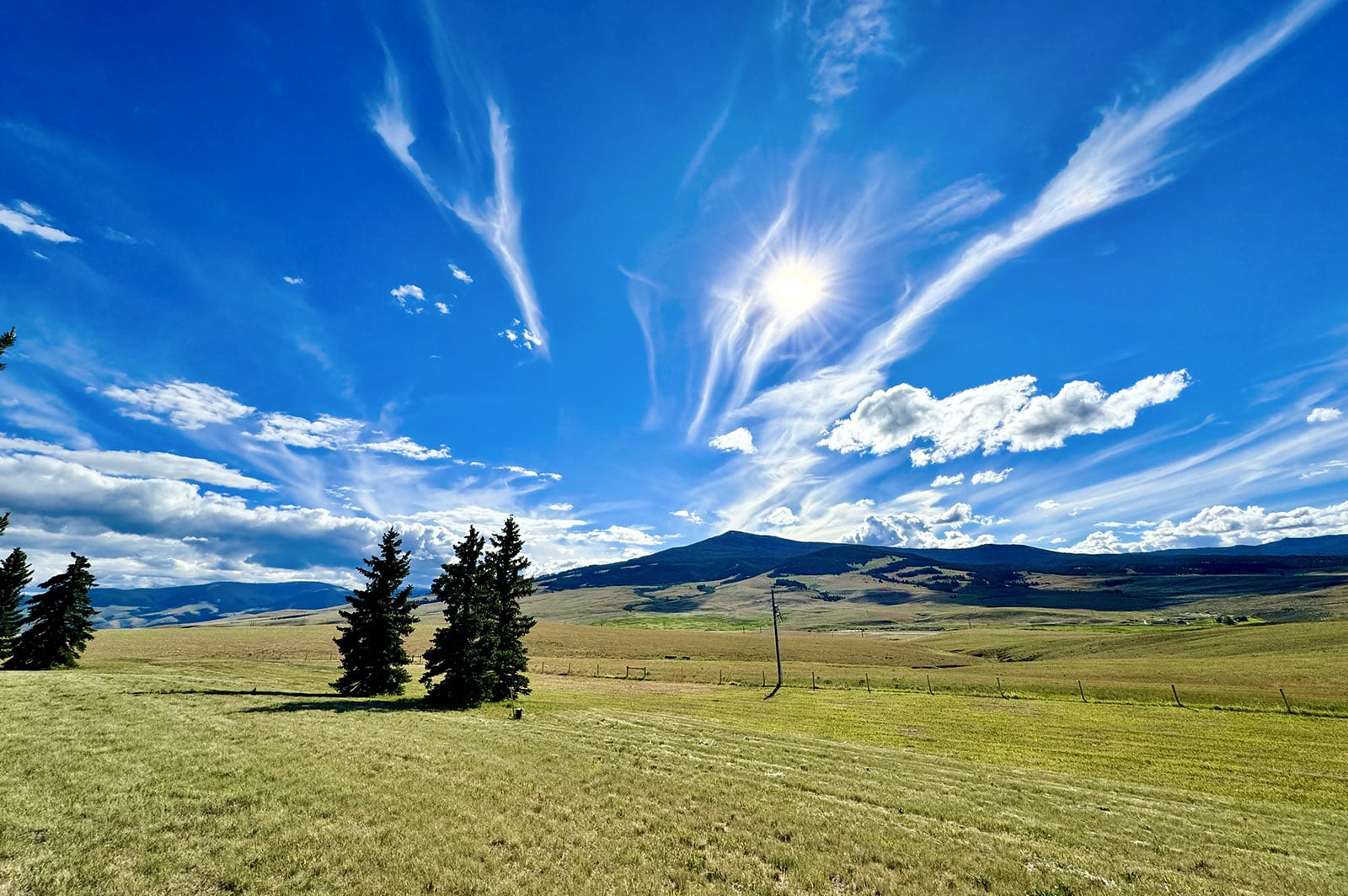
Header photo of Montana landscape by Simmons Buntin.