
There are places that are destined to seem like gates. One can’t avoid the sensation of being sucked through a portal.
– Lawrence Osborne, The Forgiven
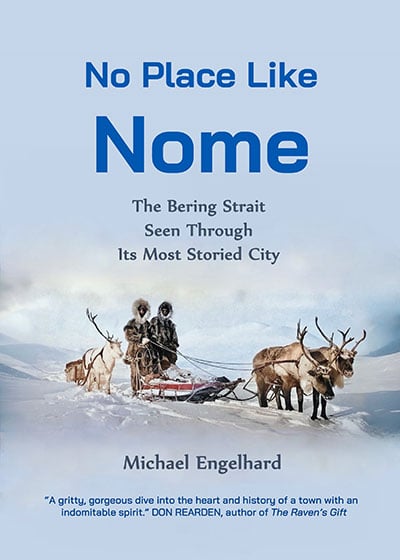
Somewhere between myths and hard facts you find Nome, poised also between yesterday and tomorrow. Drawing on his background in anthropology and an equal passion for history, Michael Engelhard surveys the seam that links two neighboring continents through the lens of one pivotal city. The region’s legacy of millennia shines on pages enriched by this writer’s recollections—from mammoths to Cold War monuments, from a spa turned orphanage to cyclist miners and shaman hoards. Meet the explorers and adventurers, reindeer herders and hustlers, the dancers, drummers, dreamers, warriors, walrus-tusk carvers, and whalers, clergy, foragers, and photographers who shaped a place of conflicting visions as thoroughly as it shaped them.
That is our, science-based, story. The Kaweramiut, having lived on the peninsula for centuries, have their own take on how Serpentine, Pilgrim, and other local hot spots came into being.
In their accounts, compiled in People of Kauwerak: Legends of the Northern Eskimo, Ekeuhnick, a larger-than-life figure credited with the origins of certain technologies—the first boat, fire, etcetera—one day felt the ground underfoot shaking. This was followed by a deafening rumble. When he turned, he saw a great mountain about to blow up, with a red tongue of fire licking up from the smoke and glowing embers advancing down its slopes. Many kinds of birds and animals fled the confusion, creating a cacophony that drowned out that of the mountain. Ekeuhnick jumped onto the back of a panicky bear and held on tight to its neck ruff. When he was reunited with the people of his settlement, they all heard a “terrible bellow” accompanying “a great spear of fire” lancing upward from the mountaintop, and “red-orange color rolling all the way down” to the bottom. Ekeuhnick had foretold all this. Days after the eruption, the plains lay dead, inert: “black rock, like water frozen, everywhere.”
Once again, modern science corroborates Indigenous oral testimony. A mere 1,605 years ago, the earth indeed split wide open, giving birth to the Lost Jim Lava Flow in the Imuruk Basin, the peninsula’s fiery souterrain oozing and spreading from a cone now cooled, barren for the time being. Few of Earth’s active volcanic regions are cold enough to support permafrost, and this subarctic field of ropy pahoehoe lava holds clues for volcano-ice interactions on Mars. Twenty thousand years earlier, eruptions thick with steam had quarried the largest known maars on Earth near Deering—the Devil Mountain Lakes, five shallow craters now drowned—when lava tunneled through frozen ground. The Estonian circumnavigator Otto von Kotzebue named the adjacent small shield volcano Teufelsberg (“Devil’s Mountain”), projecting more Manichaean views onto a sundered landscape.
When I touched down at Serpentine with my clients, centuries after the cataclysm, the National Park Service, charged with maintaining its facilities, occupied half the bunkhouse, working on them. The crew was fixing the bathhouse, but the pipe that should have siphoned cold creek water into the tub didn’t pipe. It dribbled. The hot water spigot, however, worked fine. The only way to make the temperature bearable was to haul five-gallon buckets—about twenty—from the creek. I couldn’t just wait for the hot tub to cool, because it leaked faster through cracks between the floorboards than it mellowed with cold influx from the pipe. My clients retired early, so, after laboring with my coolant like Mickey, the sorcerer’s apprentice in Disney’s Fantasia, I had the bathhouse to myself. Arms wearied by heavy buckets turned into Jell-O in Serpentine’s silky embrace. The warmth spawned dim memories of the womb.
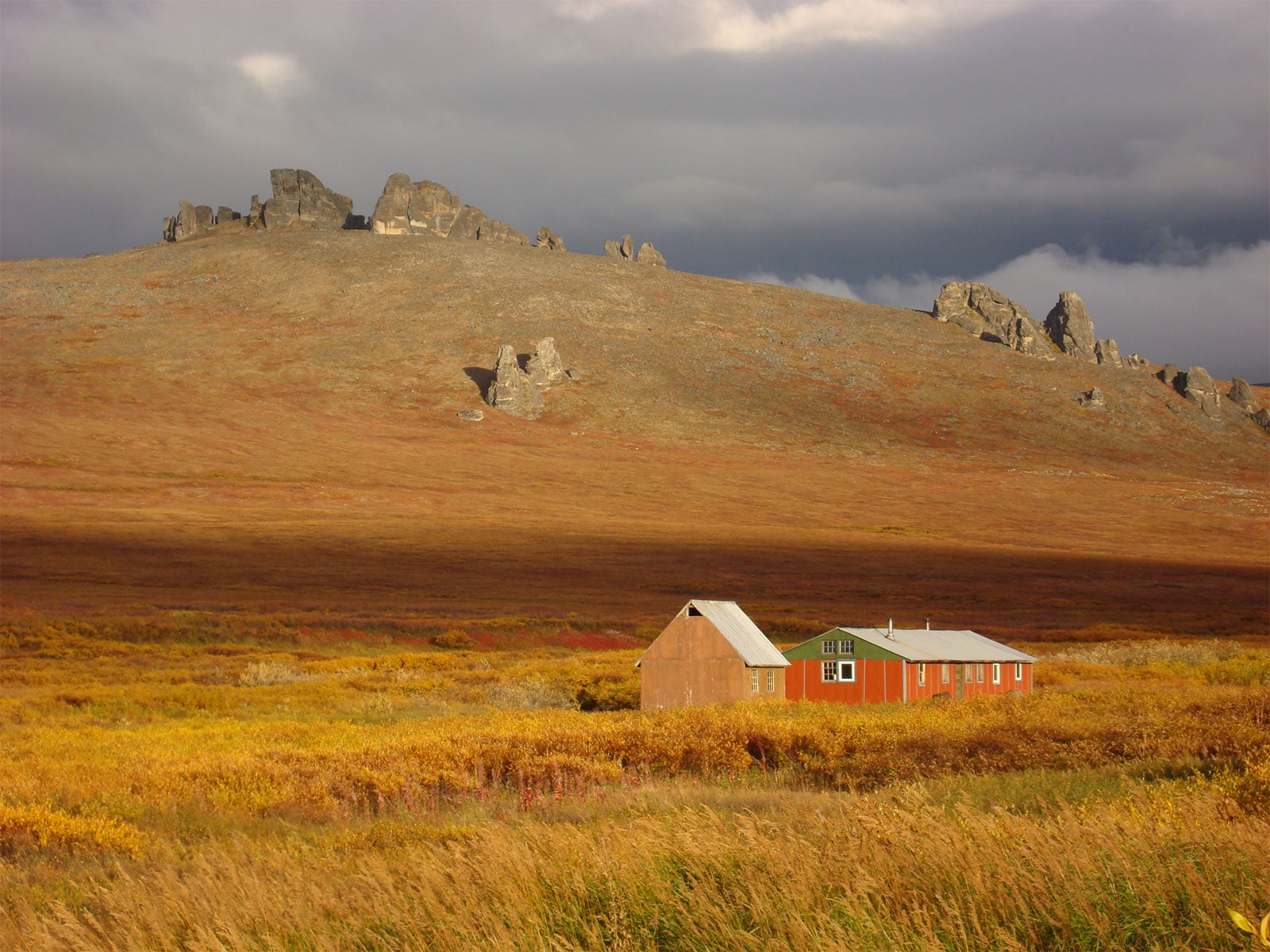
Bald hills, stark granite tors scabbed with lichen, and steam curling from the stream beyond the fogged windowpanes harked back to a bygone, primordial world. I half expected mammoths to come lumbering through. As it happens, archaeologists have found fluted stone spear tips in the Clovis style on one of the hills crowding around. They’ve also troweled up charcoal 12,000 years old, possibly from the fires Pleistocene hunters built while camped there.
The Inupiat of Shishmaref, on the coast, maintain close ties to Serpentine Hot Springs. They call their Blue Lagoon Iyat, “Cooking Pot,” or “A Site for Cooking.” This is a shamanistic training ground, a numinous boot camp; in the old days non-shamans shunned it until called upon. According to one legend, the mushrooming tors, jointed, suggestive of remnants of the Great Wall of Cuzco, are Deering women who got petrified as punishment when they approached the forbidden location. The setting, to borrow from Kierkegaard, “looks like a legend made visible” but with Inupiaq figures in place of Lot’s anonymous wife. You can easily pick out another figure, The Drummer, seated, beating the skin of his wood-hoop qilaun—perhaps it was he who cast that spell. In the quiet, if you stay long enough, the air around him throbs. Each of these stone sentinels is said to exude specific healing powers. People in Shishmaref also told an anthropologist that each tor near the springs had a name and related story, though they could not provide either. Perhaps, that lore has been lost. Or, old taboos still hold sway.
A concept of “thin places” where the visible and the invisible world brushed against each other suffused European traditions as well. In Celtic and later Catholic beliefs, such places also often were pools and springs.
When Shishmaref residents plucked spear points or similar ancient artifacts from their crumbling beaches, spirits that dwelt at the Serpentine springs whisked the unsuspecting back here via out-of-body flight, or underground, for some harsh lessons. The initiates would enter Iyat, pulsing gateway to parallel planes of existence, diving through permafrost into the nether realm. Attesting to the numen of archetypal topographies, other cultures as well saw terrain that swallowed humans—“shifting landscapes of wet and dry, hanging mists, bubbling marsh gases,” in the broad brushstrokes of one environmental historian—as conduits to elusive dimensions. In places like Serpentine’s heath, we still “commune with the more-than-human forces.” We muted their voices when we walled off and roofed sacred space at springs, hilltops, groves, alcoves, and singular trees for shrines, temples, mosques, cloisters, and churches.
Those in the know not only consider the past at these springs, but also peek into their own future.
Shamanism no longer is practiced in Northwest Alaska, officially. But through its Tribal Doctor Program, the regional nonprofit Maniilaq Association has arranged visits to Serpentine Hot Springs more recently for Inupiaq healers who, arriving by small plane instead of trance flight, uphold this curing tradition. Despite its remoteness, the plunge pool rabbit-hole is the preserve’s most popular site.
Inupiat have taken the waters at thermal springs for generations. Mineralized baths promised relief for hip and back pain, for headaches, arthritis, skin rashes, and other ailments long before there were HMOs. Herbs for curing stomach problems, ulcers, and sores could be harvested year-round on snow-free ground close by. Tempering the body, people drank from the springs and consumed medicinal plants beforehand. Some collected spring water and herbal home remedies. Their pull made people travel hundreds of miles to frequent this spot. One elder recalled how in 1935, during the twilight days of western Alaska’s reindeer-herding industry, a man brought his sick cousin from Cape Espenberg to Serpentine. The cousin rode bundled up in a sled hitched to four reindeer, on a journey that lasted a week. The patient and his driver stayed for a month, until they ran out of food.
Hot springs provided mental as well as physical breaks. “It was way more complicated than they are doing now, just focusing on the physical body,” an Inupiaq man raised near Serpentine reminisced about the rites of immersion. Feeling the world’s gravity reduced, literally, or entirely lifted from them, people connected with their better selves and family, with their culture and the land. Such springs demarcated a neutral, even a sacred, zone; conflict was not tolerated.
Those in the know not only consider the past at these springs, but also peek into their own future. A mukluk’s leather ties dipped into the seething water augur either a long life or impending death for the wearer: if your laces curl up, make sure your will is in order. Serpentine was, and still is, a precarious portal. Avoid steeping while menstruating or with your mind or emotions on edge, elders advise—just when you need a soothing soak most. They caution against going alone or staying too long. A careless person may not make it back as him- or herself.
 Longtime wilderness guide Michael Engelhard was trained as an anthropologist and lived in Nome for several years. His most recent book is No Place Like Nome: The Bering Strait Seen Through Its Most Storied City.
Read “Arctic Wayfinders: Inuit Mental and Physical Maps” by Michael Engelhard, also appearing in Terrain.org.
Header photo of tors and bunkhouse at Serpentine Hot Springs, Bering Land Bridge National Preserve, Alaska, by Ralph Jones / National Park Service, courtesy Wikipedia.