
1. A Compass
Ethology: the study of animal behaviour in natural environments, from late 17c., ‘mimicry, art of depicting characters by mimic gestures,’ from Latin ethologia, from Greek ēthologia, from ēthos, ‘character’.
Poetics: of or pertaining to poetry or poets, from or influenced by French poetique (c. 1400), from Latin poeticus, from Greek poiētikos, ‘pertaining to poetry’, literally ‘creative, productive,’ from poiētos, ‘made’, verbal adjective of poiein, ‘to make’.

Photo by Imogen Warren, courtesy Shutterstock.
2. A Forest Opera
The Albert’s Lyrebird
If you’re walking through the rainforest of Lamington National Park in the early morning or late afternoon, if you’re blowing into your hands to keep them warm in that struggling, winter light, then you might have the rare fortune to come across an Albert’s lyrebird in display. As the land drops away into a fathomless gorge, you’ll probably hear it before you see it, those laser-chains of bell-birds, wheezing baby magpies, kookaburras, magpie warbles, mobile phones, king parrot screech, human feet, and bulbs of joolp-joolp-joolp squeezed in between—and then, at the source of it all: a patch of forest pulsing like an enormous, leafy heart. As the lyrebird moves through his score, it’s easy not to notice that the surrounding forest has fallen into silence, as if everything’s on pause while he voices it, like a spring bursting out of the ground, like a medium or a conductor channelling the field, giving it a center. He is both hidden and unmistakably singular, a node of local poetics: communal, fluid. But in coming closer you’ll probably scare him, and he’ll dart through the undergrowth like a sooty comet to wait somewhere, hidden again, until you’ve gone.
The Albert’s lyrebird (Menura alberti) is endemic to subtropical rainforest remnants in Yugambeh and Bundjalung country, on the border between New South Wales and Queensland, in eastern Australia.[1] Males spend much of their time rehearsing and, in winter, performing a song cycle that can last for more than an hour. As music, these cycles are, to put it mildly, highly complex, incorporating practically all the elements of musical composition,[2] including a diatonic character and a definite key, main and subordinate themes that use recapitulation and bridge passages, a rich metric texture, variations of tempo and volume, and counterpoint.[3] On top of that, the composers regularly weave together episodes of different time signatures and tempos: 2/4, 3/4, and 4/4 signatures abound, as well as arhythmic passages, but they are knitted together so seamlessly that it takes expertise well beyond my own to discern them.[4]
More widely known, perhaps, is the fact that Albert’s lyrebirds, like their superb lyrebird cousins, are exceptional mimics, and can imitate perfectly not only the melodies of other local bird species, but also beak tapping and snapping, wing beats and feather rustling, and human-produced sounds such as chainsaws, two-way radios, footsteps, and cars. Indeed, a large part of the lyrebird’s compositional practice consists of interspersing collaged arrangements of mimicry with his own original work, along with crackling and ‘gronking’ (or loud, short notes). Then, they will often improvise variations of these arrangements, too. Such improvisatory skills recall not only postmodern compositors of ‘pastiche’ but also the most canonical figures of human music.[5] Innumerable significant human composers—Bach, Ravel, Debussy, Stravinsky and so on, not to mention virtually every pop artist since James Brown—use borrowed melodies, sometimes to the extent of literal quotations. That the greater part of the lyrebird’s composition consists of borrowed items means he’s in fine company.
Borrowed or otherwise, the identification of these sound forms is crucial to understanding Albert’s lyrebird poetics—not only because the principle aesthetic mode is musical, but because a lyrebird’s music is to some degree a soundscape of his territory. This soundscape provides not an orderly catalogue of local flora and fauna, however, but something altogether livelier. In this way, ‘reading’ lyrebird poetics recalls the unsettling terrain of avant-garde sound poetries, where the nature of poetry—of language and the sounds used for it—is fluid and in a process of continual reformation. Sound poetry works along the fractures between sound and sight; if sight keeps things at a distance and in perspective, sound invades the self, transgressing the border of the self-contained subject, sometimes even driving the subject out of itself.[6] The lyrebird’s cacophonous song cycles are signal examples of sound exceeding any material or visual demarcation, of a non-logocentric system filling an environment with unruly affect. Indeed, in his territorial and display compositions, we will see that the lyrebird literally overflows with poetics so that the sound poem exceeds his body, if not completely erasing it. But such sonic excess is not simply indulgence or extravagance; rather, it articulates the composition of a local community—which is to say that it joins disparate parts together, and celebrates this joining.
Early in the morning, when it is still too dark for him to be safe on the ground, the male lyrebird will perform a series of songs from up in his roost. These early morning performances, or territorial songs, demonstrate the continued occupation of his home.[7] Rarely containing mimicry, territorial songs can be highly improvised and jam-packed with original material, unlike the display song, which he’ll perform on the ground later in the day. At dawn, the Albert’s lyrebird uses his own voice to advertise his originality and particularity, and to demarcate his territory.
This demonstration is followed, however, by the display song, in which he becomes the vocalization of his territory: he opens himself, is saturated with the sounds of his locale; he becomes the territory and, in doing so, obscures the borders around his body. The display song, used primarily to attract partners, is composed almost entirely of mimicry; it’s tightly structured and only about 40 to 50 seconds long, but it’s cycled over and over without pause. It seems, then, that the quest for a partner, for intimate relation, is a wholly unselfish affair—literally, a process in which the self must be decentred, if not momentarily extinguished, by the repetition of mimetic cycles.
The display song is a “voicepicture of the local scene,”[8] therefore, rather than of the bird’s self; in sourcing the song from anywhere but himself, the lyrebird transforms the I of cognition into an open-ended being whose existence is exposed, localized, and vulnerable. Indeed, the lyrebird’s dissolution into forest is illustrated visually, too: on typical display platforms—which I address further below—the bird is concealed by a screen of surrounding vegetation, which itself might not even be visible in the rainforest’s dim light.[9] And if we are lucky enough to hear more than one lyrebird in the same locality, we might notice that each of the birds tends to use the same suite of mimicked sounds:[10] the lyrebird is embedded in a melodic landscape of many, and it erupts through him as it erupts through each of them.
On a musical level, the thematic and sonic structures of lyrebird music are orchestral, coming from a wide variety of sampled and original sounds.[11] However, there is an extra, material dimension to this array: the Albert’s lyrebird is one of the few bird species known to use instrumentation.[12] Typically, his performance occurs on a platform of thin vines and fallen branches that he has interwoven across the ground; some of the vines will be a few centimeters above the ground so he can depress them into the soil.[13] These platforms are hard to see because they are usually concealed by a screen of vegetation, but thanks to ornithologists like Sidney Curtis we know that in certain sections of his performance the bird will grasp the vines and branches with his feet and use them as rhythm sticks. In a rocking, muscular movement that could only be described as dancing, he will shift the vines in perfect synchrony with the rhythm of the music.[14]
Clapping the vines and sticks together, the lyrebird can produce an impressive variety of additional sounds. But the vines also act like puppet strings for an entire section of the surrounding forest: the movement generated by his depressing and releasing is transmitted from one vine to another and then through all the vines into the surrounding, screening vegetation. A meter or so away in one direction, a small branch of a shrub will shimmy; a meter or so above it, a cluster of leaves will shake like a cheerleader’s pompom; three meters off in another direction, a large leaf will oscillate as if caught in a breeze; and so on. From the act of rhythmically depressing and releasing the vines, the lyrebird sends flutters, shimmers and wobbles over an area approaching the size of a human stage.[15]
So the Albert’s lyrebird’s performance is not only orchestral but, in its complicated assortment of visual and sonic forms, operatic. Here we have an artwork that draws on, and acts as a nexus for, an entire material-semiotic field, and which is also a sophisticated response to the dark, dense undergrowth of a subtropical rainforest—where one’s bodily gestures on their own are ineffective forms of expression. Supplementing his elaborate choreography with a vast prosthetic system, then, the lyrebird can translate his bodily expression into a much grander visual display.a href=”#_ftn16″ name=”_ftnref16″>[16]
Amidst such grandiosity and tumult, we only demean the lyrebird’s art by pretending that it’s the expression of a single artist. And we can’t shrink such opera to concepts like ‘territorial display’ or ‘mating ritual’, either, unless we decide that all human art of similar complexity is similarly collapsible. So much of what the bird does—so much of what makes him unique—is about more than him: sourced from so many companions, often the work submerges his very body beneath the wonders of stage and sound. Such an entangled, communal poetics is what we could call a ‘cosmo-aesthetics’, or aesthetics which acknowledges that composition calls on—no, needs—the worlds of many things. In this sense, Albert’s lyrebirds are the supreme ‘cosmo-artists’: they pair their personal, territorial songs with the sonic territories of myriad others, and let the mixtures erupt into glorious, operatic flourishes in which almost all corporeal demarcation is dissolved in a shimmering field of forest.
After all, male lyrebirds spend their lives trying to perfect their art, which is only successful if it can form compelling, meaningful relations with others—with lovers, most obviously, but, prior to this, with the myriad sounds and materials that are necessary for the work’s assembly. By the same token, female lyrebirds are not only vital to the completion of the work, but they drive the musical and material experimentation. For female lyrebirds are the most erudite of critics (and, we are slowly realizing, they can also be accomplished composers): they hear thousands upon thousands of hours of music in their lifetimes, but they need to be highly discerning in order to select the finest composers for mating, and for making more composers.
Granted, it probably remains the case that at heart these artists are driven by desire, but in this they would be just like us. As for many human artists, the stakes are high for lyrebirds, too: others need to like his work! So lyrebirds have to be bold and brilliant but, unlike many humans, also completely deferential to their sources: “Look how I can speak this forest!” a male will cry, “In speaking this forest so beautifully, I can become it!” The female, therefore, seems to be attracted to a self that is perfectly many—not a dominant or transcendent self, but one whose desirability is determined by how well it’s integrated with the forest’s sound-world. Here, too, the poetics of the composition are crucial: note that the lyrebird uses the many to become unique, rather than to appropriate another’s identity. Similarly, his sampling is always provisional (rarely more than a few bars of anything), so he doesn’t simply cut and paste the entire song of another creature; he never ‘becomes’ another species, then, or uses all of their music as if it were his own. His composition is open, fragmented, and spliced with forest: no poem of my relationship to the earth, but an opera of swarms or multispecies communities; an ecological ontology.
For Albert’s lyrebirds as for humans, poetry, despite the media we use to house it, remains rooted in sounds produced by the voice. For the lyrebird, however, a syrinx, as opposed to our larynx, allows the bird to sing multiple parts at a rate that humans need to record and then replay slowly to identify. Nevertheless, for human as for lyrebird, the conflation of poetry with sound and gesture leads into practices more closely aligned with body or performance art. As with any bricolage, these are compositions of hybrid materials; the bird’s poetics is always connected to—and relies on—these miscellaneous components. The result is a markedly polysemous work, in which the relationships between phrasal units can be many-sided, allowing them to jostle and intermingle in ever-different ways: not only is the lyrebird capable of rapid improvisations, where new materials can be inserted into older structures, or entirely new structures can immediately replace older ones, but the presence of his ‘audience’—whether a potential mate, rival, or musical partner—can lead him to drastically, and instantaneously, alter the form of his work.
If we accept without question the assumptions about poetics that we have inherited from Western modernists—that poetry is text-based, silent (or notionally performative), notionally musical, and even ironic, ambivalent and free of practical ambition, we might find ourselves immersed in the alarming profusion of what Jacques Roubaud calls International Free Verse, or IFV, which seems to be predominant almost globally. “The absolute rule about what can be said in a poem written in IFV is accessibility,” Roubaud writes, “Not only must the poem in IFV contain no difficulties of comprehension or of linguistic construction, it must also avoid anything particularly striking, unless it’s lexical (and in a tone acceptable in a travel agency).”[17]
But poetics can be far more expansive, spanning many different media, not to mention species. Traditions of sound poetry provide links between human poetry’s ancient, oral heritage and the modernist poetics with which contemporary readers of English are most familiar. Sound, and sound poetry, entails a displacement of rational control; this, in turn, makes possible a more open and responsive reading, an acceptance of sounds in general, as opposed to meaningful sounds and non-meaningful noise. The implications are an ethical, even prophetic attitude toward sound as voice—an expansion of the possibilities of articulation, with hitherto ordinary sounds now aspiring to the condition of the voice; noise and dissonance need no longer suffer exclusion. The lyrebird shows us that sound is a sign of life, of things happening, whereas silence is of the void. Not listening, or tuning out, argues Gerald Bruns, “is a form of dying.”[18]
Of course, the work of Albert’s lyrebirds can’t be contained by the human category of ‘sound poetry’, and much less by that of ‘song’; beyond concerns of categorization, however, the important point is that lyrebird compositions compel us to open the borders of what we call ‘art’. For these are connective, transgressive arts of territorial relation: what is the territory? who lives there? how do they sound? Such questions are the preoccupations of ethological criticism, too, as it follows, and then departs from, more ecologically inflected critical objectives: not premade containers into which living things are placed, ethologists understand ecologies to be created and shaped by the communities living within them. The critic of ethological poetics recognizes that these communities are dynamic, artistic cultures, even if they make all kinds of shapes and signs that humans can’t see, hear, or understand. The underlying ethical motivation is less to do with policing the correct response to radical alterity, and more about how we might respond to, and care for, the lively, much-more-than-human relations that compose us.[19]
Nothing less than the semiosis of the world is at stake.

3. Voiceless Languages
Trees
To redraw the boundaries of art will involve an interrogation of what we mean by an artist’s (or artists’) ‘expression’. What does it mean to express or be expressive? What does it mean to speak or to have a voice, and will all expression be understood with ocular- and phono-centric terms? Speaking, as we have seen, might use signs that are invisible to the eye and unheard by the ear. But in acknowledging different kinds of speech, we should also take care not to collapse them into a familiar, reductive understanding of ‘voice’—for to erode the boundaries of ‘speech’ does not involve simply including beings that we have thought voiceless within an expanded notion of voice.[20] Doing this risks little for humans, but lots for every-one and -thing else: we maintain the centrality of the human voice, while constructing around it, like walls around a castle, circles composed of other, increasingly derivative voices.
Many species show us that it is not necessary to have a vocal organ in order to have language. It is erroneous to assume that having language equates with being able to speak (as I sit here, silently writing), and it is also unethical and anthropocentric, for it pairs all linguistic phenomena with the voice—which only verbal humans possess, of course, along with a select few, privileged non-human species. Further, it implies that other creatures have the right to speak only on the condition that they speak like us, or ventriloquize with “quasi-, proto-, or post-human voices.”[21]
To avoid these pitfalls, I prefer to use Michael Marder’s concept of ‘articulation,’ which indicates another kind of sculptural poetics: to articulate things might indeed be to render them into words, but it might also be to join them in space; language can express and vocalize, but it can also put things together and make them contiguous. Furthermore, just as units of speech destabilise the relations between abstract signs and their material referents, other sculptural articulations can also shimmer between abstract and concrete forms. By means of articulation, for example, trees can link the realms of earth and sky, mortal and divine. Thus, to ask, ‘Who speaks?’ elliptically implies, ‘—with what?’ Who articulates with a voice? And who uses a voiceless speech? In either case, we can find articulate and articulated possibilities.[22]
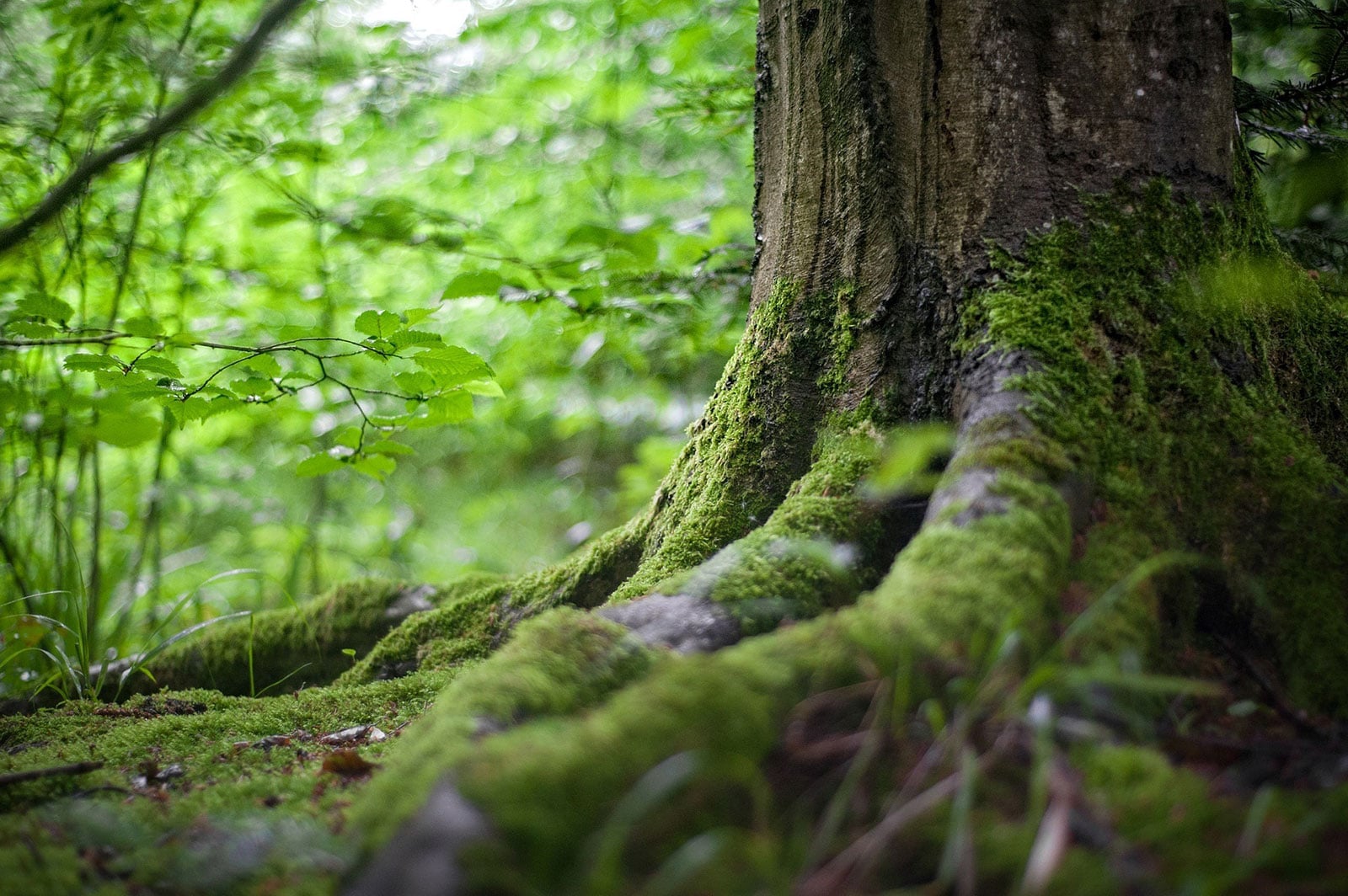
A tree speaks by articulating in response to others—sunlight, water, insects, herbivores—and it speaks by articulating itself from the place of its growth. Unlike most fauna, who are unable to alter their morphologies, a tree re-articulates itself constantly over the course of its life—through roots and branches; through open-ended and infinitely replicated multiplicities of morphological structures. Tree articulation isn’t necessarily to do with communication, or the gross transference of semantic packages from one body to another, but rather is closer to a form of embodied illustration, or singing. A tree speaks with and as its body, insofar as while it grows it maintains better, more constant, more thorough contact with the world around it than any animal can hope to achieve. This is why arboreal being constitutes non-logocentric logos, or speech without a voice.[23]
But a voiceless speech is not deficient, for an element of voicelessness is the most fundamental element of all speaking. No articulation—vocal, sculptural or otherwise—is in a position to articulate the entirety of what can be spoken;[24] all articulated forms occur within material and discursive limits, just as any subject is always limited by the content, tone, and rhythm of their speaking. Indeed, in the absence of such productive limits, there can be no speech whatsoever. In the tree’s logos without logos, then, we should not hear the deficiency and privation it has been linked to throughout the history of Western thought. Rather, to speak without voice is to touch on the positive limit of expression itself,[25] and to illuminate for those of us with voices a far broader range of expressive, sculptural, spatial articulations. The tree’s voiceless logos interweaves with phenomenal surfaces into an uninterrupted, unified coil of living, material expression, demonstrating how a being can enter the light, transform, and signify itself.[26]
In thinking about this voiceless speech, we are approaching the language of life itself, a biological poetics that transgresses the divisions of species, even as it produces them.[27] Bio-language is fundamentally natural—inevitable, even—being both of nature and productive of nature, emerging within organisms as they respond to their surroundings by engraving their identities and physicalities into the world.[28] Within the grammar and syntax of this original, worldly writing, the referent presents itself not as sign or syllable but as an articulated coupling of one state with another. In the tree’s voiceless logos we catch intimations of such presentment, of what Vicky Kirby calls “the energetics of an originary unfolding.”[29]
What does this silent, articulated speech do? Or, what conceptual, linguistic tools do we have available that might respond to it? We could begin with trees’ non-phonetic, multispecies inscriptions, or the marks they write in biochemical substances for other plants and animals.[30] Amidst the wide range of these diffuse transmissions, ‘multi’ becomes a pivotal prefix—think, too, of a tree’s multi-directionality, its branches bifurcating, trifurcating, x-furcating in every possible direction, their twisting and turning into every crevice of our four dimensions; these diffuse transmissions and directions are examples of the tree’s dispersed intentionalities, each shoot, root and branch pursuing its own trajectory in response to unevenly distributed resources. Rather than a limited, organismic model that privileges the coherence of an animal body, then, the tree is an exemplar of modular development, or an organism that is always undergoing some kind of construction. This feature is not merely physical, but is also evidence of the tree’s remarkable behavioral plasticity, its active meristems capable of growing into organs of undetermined characteristics and producing nourishing forms in concert with their dynamic surroundings.[31]
But these dispersed intentions should not indicate to us a state of permanently frenzied distraction. Instead, the tree’s is a hyper-attention, where each shoot, leaf and rootlet monitors the minutest variations proximate to it. Far from a deficiency, this is a multi-tasking, non-totalized intelligence, akin to models of parallel processing, with every vector of intention operating quasi-independently. Moreover, in contrast to the human organism, where the total aggregation of our parts is subjugated to the demands of our whole in a corporeal fascism, the tree’s dispersed, hyper-attentive intentions resonate with the wide-ranging dispersion of biological life itself.[32]
Consequently, the tree’s parallel intelligences disrupt a number of longstanding Western intellectual biases:
Firstly, as I’ve already mentioned, tree intelligence is not concentrated in a single organ; no cerebral mind or divinity pulls on the strings. For approximations of tree intelligence, we need models of distributed agencies and swarm formations. Even to talk about individual trees, as I do here, may be a problematic atomization of tree being: trees left to grow within their communities are commonly interconnected through their root systems, so that the forests they compose are interconnected superorganisms much like ant colonies.[33] Indeed, in their superorganismic collectives, entwined by multimodal, chemically mediated forms of communication, it might be most useful to think of forest, rather than tree, expression. If this is the case, then, as with leaf-cutter nests or the minds of our loved ones, the most important elements of tree ontology are invisible to us.
Secondly, tree behavior cannot be separated from its context. Unlike the presumably context-free, abstract rationality of Enlightenment thought, tree intelligence is an emergent property of sessile physiology. Its decentralized structure means that a tree’s thinking is non-hierarchical and, unlike our own organismic lives, does not radiate around, is not anchored by, a center of reference.[34] As a corollary, the tree does not unilaterally build or organize its milieu. Rather, its method for growth and transformation is constituted in part by a series of networks that communicate with the environment; the tree is an open system articulating dense, wooden ropes of expression that are inextricable from, embedded within, much larger webs of moist, fibrous, stringy, viscous, gaseous, smelly or sonorous filaments.
Thirdly, then, trees actively articulate—join—organic and inorganic facets of their milieus, forming ecosystems and micro-climates, and transforming their locales into receptacles for other kinds of life. Therefore, the self-affirmation of trees is also the affirmation of others.[35] But identifying ‘self’ and ‘other’ might be less important to the tree than recognizing kin in a shared world or, indeed, being prepared for what might come from other, possibly dangerous worlds.[36] We need to break open our most basic terms of reference to properly conceptualize this final point: as a dispersed, open-ended being of parallel intelligences, the tree is even more—far more—extraordinarily plural than any human. When we refer to a tree, rather than ‘it’, the more appropriate pronoun could be ‘they’.
The tree’s being moves outwards, leaks outwards, like solid liquid, always becoming. Unlike an animal, which carries its body from one place to the next, the tree extends their body, they reach. Where an animal might slide, shift or slip through space, then, the tree permeates space, weaves into and around it. Only within the narrow field of Western perception does the tree appear to frame space, to provide the vertical lines of a static grid within which we can organize our attentions. But rather than framing, the tree is constantly presenting themselves, taking part, being kin, and responding to the feedback from such presenting: the tree articulates like a slow, glacial flame.
When a tree flowers, the blossoms do not form part of branches of yet further articulations, but they accentuate, punctuate the tree’s articulations. A tree’s flowers are bold, extravagant wormholes for tree transformation: there, tree becomes bee and wasp, takes flight.
As for that other color, the tree’s particular shade of green, we should be careful about romanticizing it. Chlorophyll cannot use the greens of the color spectrum, so the tree reflects them back, unused. What we are seeing when we see green leaves is ‘waste light’, what the tree, a la John West, rejects.[37] To properly appreciate the green of a tree’s leaves, then, we would need an aesthetics of trash. The tree paints themselves in rubbish, perhaps.
But the brand of our aesthetics is of no immediate concern to the tree, whose relentless bi-/tri-furcations are part of a daily quest for meals of light. Not too far removed from the performer who yearns for the spotlight, the tree’s is a lifelong dance for the sun. Often, they will bowl out into space in order to make use of all the angles provided by a sphere. Within this green bowl, the tree’s trunk and branches are restlessly adjusting to collect every available drop of light. Light, of course, is everywhere; there’s no need to walk, to move through it, to hunt. What matters is increasing your surface area, the space for potential contact. This is a deeply sensual poetics of touch, permeation, transformation.
End Notes
[1] The rarer of the two species of lyrebirds, the Albert’s lyrebird does not have the elegant, lyre-shaped tail feathers of the superb lyrebird and has a much more restricted range.
[2] K. C. Halafoff, “Musical Analysis of the Lyrebird’s Song,” The Victorian Naturalist. No. 75 (1959). p. 171
[3] Ibid. p. 176
[4] Ibid. p. 174
[5] Ibid. p. 176
[6] Bruns, The Material of Poetry. p. 45
[7] Sydney Curtis and Hollis Taylor, “Olivier Messiaen and the Albert’s Lyrebird: From Tamborine Mountain to Éclairs sur l’au-delá,” in Olivier Messiaen: The Centenary Papers, ed. Judith Crispin (Newcastle upon Tyne: Cambridge Scholars, 2010). p. 56
[8] Ibid. p. 59
[9] H. S. Curtis, “The Albert Lyrebird in Display,” The Emu. 73 (1971). p. 83
[10] Curtis and Taylor, “Olivier Messiaen and the Albert’s Lyrebird.” p. 57
[11] Halafoff, “Musical Analysis of the Lyrebird’s Song.” p. 172
[12] Curtis and Taylor, “Olivier Messiaen and the Albert’s Lyrebird.” p. 58.
[13] Curtis, “The Albert Lyrebird in Display.” p. 83
[14] F. Norman Robinson and H. Sydney Curtis, “The Vocal Displays of the Lyrebirds (Menuridae),” EMU. 96 (1996). p. 272
[15] Curtis, “The Albert Lyrebird in Display.” p. 83
[16] Robinson and Curtis, “The Vocal Displays of the Lyrebirds (Menuridae).” p. 274
[17] Jacques Roubard, “Prelude: Poetry and Orality,” in The Sound of Poetry / The Poetry of Sound, ed. Marjorie Perloff and Craig Dworkin (Chicago & London: University of Chicago Press, 2009). p. 23
[18] Bruns, The Material of Poetry. p. 49
[19] Donna Haraway, When Species Meet (Minneapolis: University of Minnesota Press, 2008). p. 289
[20] Michael Marder, “Voiceless Speech, or Vegetal Logos without Logos,” Qui Parle. 26, no. 2 (2017). p. 368
[21] “To Hear Plants Speak,” in The Language of Plants: Science, Philosophy, Literature, ed. Monica Gagliano, John C. Ryan, and Patrícia Vieira (Minneapolis: University of Minnesota Press, 2017). p. 113
[22] “Voiceless Speech.” p. 368
[23] Ibid. p. 368
[24] Ibid. pp. 368-9
[25] Ibid. p. 369
[26] Marder, “To Hear Plants Speak.” pp. 121-2
[27] Kirby, Quantum Anthropologies. p. 41
[28] Monica Gagliano, “Breaking the Silence: Green Mudras and the Faculty of Language in Plants,” in The Language of Plants: Science, Philosophy, Literature, ed. Monica Gagliano, John C. Ryan, and Patrícia Vieira (Minneapolis: University of Minnesota Press, 2017). p. 94
[29] Kirby, Quantum Anthropologies. p. 46
[30] Marder, “To Hear Plants Speak.” p. 119
[31] “Plant Intentionality and the Phenomenological Framework of Plant Intelligence,” Plant Signalling & Behavior. 7, No. 11 (2012). p. 1370
[32] Ibid. p. 1370
[33] Peter Wohlleben, The Hidden Life of Trees: What They Feel, How They Communicate: Discoveries from a Secret World, trans. Jane Billinghurst (Vancouver & Berkeley: Greystone Books, 2016). pp. 3, 14–8.
[34] Marder, “Plant Intentionality and the Phenomenological Framework of Plant Intelligence.” p. 1370
[35] “To Hear Plants Speak.” p. 121
[36] “Plant Intentionality and the Phenomenological Framework of Plant Intelligence.” p. 1370
[37] Wohlleben, The Hidden Life of Trees. p. 228
 Stuart Cooke is a poet, essayist, and translator. His books include the poetry collections The Grass is Greener over Your Grave (2023) and Lyre (2019), and a collection of essays, Apples & Oranges: Adventures in Poetics (2025). He lives in Brisbane, Australia, where he is associate professor of creative writing and literary studies at Griffith University.
Header photo by StockSnap, courtesy Pixabay