

Old Roads, New Stories: A Literary Series
The Scene
Back in February 2024, I learned a new word: “onboarding.” It means pre-publication legwork: doing things for the typesetter, for the cover designer, for the PR person to distribute to librarians, book reviewers, book groups, local media, the internet bots controlling search results, and to the Angels of Hope and Good Fortune in case they’re up there somewhere. Onboarding.
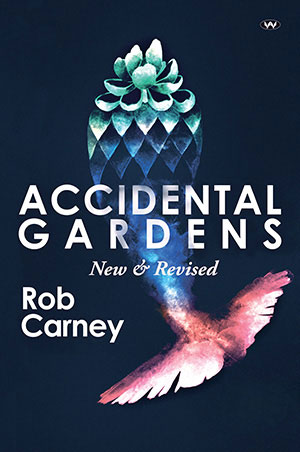
The Book of Drought wasn’t the first book I’d published, but it was the first time I’d ever been asked to build an ark out of various bios, excerpts, key words, pitches, content synopses, pull quotes, topic questions, and artist’s statements. And more recently, for Accidental Gardens: New & Revised, I’ve done it all again, plus a 700-word origin story about the book, something for the publisher to send around to bookstore owners. But I also want to share that story with you because it’s about Terrain.org and its editor-in-chief, Simmons Buntin. This book would’ve never been written if it weren’t for him.
Act 1
 SIMMONS: Hey, I want you to write me a guest blog.
ME: No.
SIMMONS: Why not?
ME: Because I don’t know how. I mean, I don’t know what a blog is supposed to be.
SIMMONS: Don’t worry about the definitions. Just write me something and send it.
So I did. And I also I wrote a second piece in case he didn’t like the first one.
SIMMONS: I like them both. I’ll run the first one this month and the other one next month. Now, what do you think we should call your new series?
Crafty man. He’d turned my initial “No” into an ongoing project, a project that’s lasted for over a decade and now become this book. Those pieces I sent to Simmons every month are what I selected from, shaped, and shifted into a collection of 42 flash essays. Then I sent it to Donna Mulvenna, the editor at Stormbird Press in South Australia, and she accepted it.
Act 2
But the book almost didn’t make it off the presses because one of the world’s worst wildfires (this is Earth’s routine now) burned so much of Australia. Still, my publisher, Margi Prideaux, wrote to tell me that we weren’t done yet, that Accidental Gardens would still be happening, just delayed until 2021, which was incredibly generous of her and one of the reasons I added this preface to the book:
May 2020
Dear Australia,
I’m sorry. Those words aren’t big enough, I know—not nearly—not in response to a continental firestorm. They’d need to be able to stretch and widen, like a river from Perth to Sydney, but I’m saying I’m sorry anyway because I am.
One of the places destroyed was Parndana, home to Stormbird Press. They lost their offices. The publisher, Margi Prideaux, lost her house. And so many animals, so many trees, so much of so much. We’d planned for this book to be out today, but instead there’s been devastation. Stack on a global pandemic, and the release date got delayed.
You and I are different—bits of lingo, the views out our windows, dingoes and kangaroos instead of pronghorn and coyotes—but I think you’ll get what I’m saying in these pages. And hopefully you’ll laugh, maybe nod in agreement, maybe ask someone to sit for a second and listen while you read a bit out loud. I like those possibilities.
In this book, I focus on landscapes, on cherries and herons and salmon, on orcas and hawks and Australia, on stories and memories and rain because the best things deserve our attention more than the worst. Also, of course, because the best things need it. That way we’ll remember to protect them before they’re gone.
Best wishes,
Rob Carney
Act 3
Although Stormbird rose from those literal ashes, it couldn’t beat time. Time will retire us all. And a couple years after the book came out, Margi and Donna decided to close up shop, but not before they’d transferred my book’s ownership rights to Wakefield Press in Adelaide (another generosity). They didn’t have to, but they did.
Seeing as this was a new beginning, I asked my new editor, Maddy Sexton, if Wakefield would be interested in having a New & Revised edition, and she gave me the go-ahead, so here it is: Ten of the original essays are gone, replaced by 16 new ones. The other original 32 have been revised on a scale from “A-Little-but-Invisibly” to “Here’s-How-It-Should’ve-Been-Written-in-the-First-Place.” The table of contents is shuffled and re-balanced, arranged into four thematic sections, each of them having the ghost-arc of a plot or a cumulative trajectory. And along the way there are prompts and suggestions for people who want to write poems.
Hopefully that’s not the final curtain, though,
because the whole point of an origin story—it’s right there in the name—is to begin, and then to keep on going…
maybe carried along in a backpack and then read for a while where the sunlight skims along the river,
maybe read out front beneath the porchlight, surrounded by the nightsong of crickets,
maybe started by someone on an airplane and then finished at a coffee shop in New York City. But even then not finished yet, the book going on in the bones of feeling…
Who knows if that’s what really happens. But hopefully so.
 Rob Carney is the author of nine books of poems, including The Book of Drought (Texas Review Press, 2024), winner of the X.J. Kennedy Poetry Prize, and Call and Response (Black Lawrence Press, 2021), and his collection of creative nonfiction, Accidental Gardens: New & Revised (Wakefield Press, 2026). His work has appeared in Cave Wall, The Dark Mountain Project, Sugar House Review, and many other journals, as well as the Norton anthology Flash Fiction Forward (2006). In 2013 he won the Terrain.org Poetry Award and in 2014 he received the Robinson Jeffers/Tor House Prize for Poetry. He is a Professor of English at Utah Valley University and lives in Salt Lake City. Follow his Terrain.org series Old Roads, New Stories.
Read an interview with Rob Carney appearing in Terrain.org: “The Ocean is Full of Questions.”
Read Rob Carney’s Letter to America in Dear America: Letters of Hope, Habitat, Defiance, and Democracy, published by Terrain.org and Trinity University Press.
Read poetry by Rob Carney appearing in Terrain.org: 6th Annual Contest Finalist, 4th Annual Contest Winner, and Issue 30. And listen to an interview on Montana Public Radio about The Book of Sharks.
Header photo by Engin Akyurt, courtesy Pixabay.