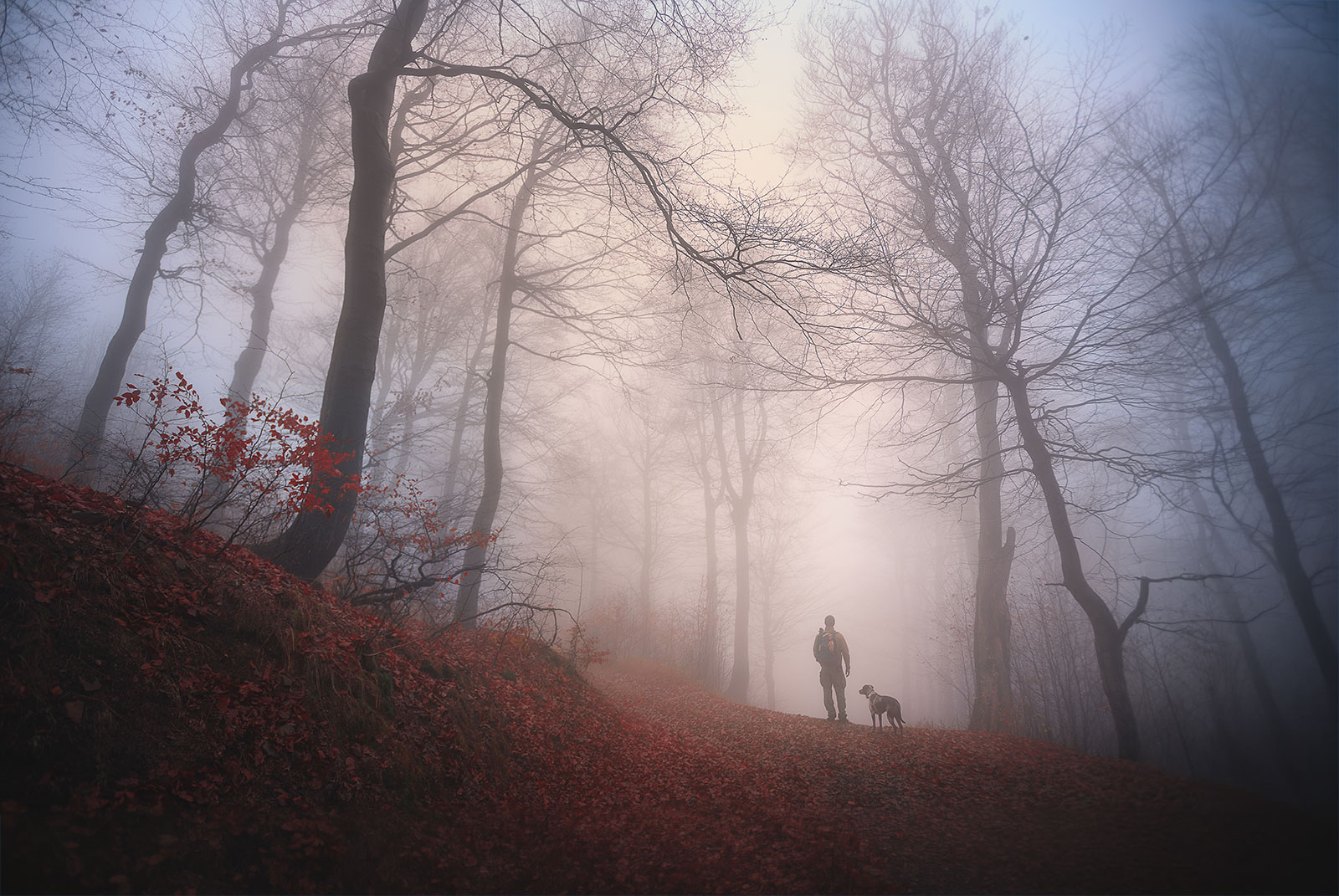

Grounded
The moon is a scar on the lip of a clarinet player
who hunts mushrooms in the cool of the morning,
tucking gilled flesh into a basket.
He is two hours from a road.
His dog pads at his side so quietly
she reminds him of smoke. Her name is Puerta
because as a puppy he had plucked her
from a door riding a flooded river.
Crows caw, titmice flute, and squirrels squiggle
in the maze of trees overhead, tracking the intruders.
The broadcast is mown into by the loud burry
chortle of an airplane, invisible in gray sheet of sky,
maybe crammed with people sipping coffee,
or loaded with baby grand pianos, kidneys
in cold boxes, French pistols, blood oranges, meteors
that landed in wheat fields. Anything could be up there.
He bends down to stroke Puerta’s ear
and catches the smell of forest dirt on his fingers,
ancient recipe, fresh brew, boogie-woogie
with notes of leaf and root, stone and dew.
Mud Sparrows
after the heretical Gospel of Saint Thomas
As willow strands drifted in the river,
braiding and unbraiding the light,
a shirtless boy molded mud into sparrows
and breathed into their beaks. He was trying
to make whistles. The birds opened their eyes,
to the surprise of the kid, known as Hey Zeus
to his buddies. The sparrows shook
their wings and darted into the reeds.
Today the offspring wander the earth,
glimpsed but never caught. A mud-colored
sparrow with asymmetrical eyes
drops into a neighborhood or by a lone house
in the desert, perches on a windowsill, and trills
with raucous tenderness, like a honey-noted
thrush crossed with a gossipy crow.
Only the half-healed stop what they’re doing
to listen to the mud sparrow, someone who
has been forgiven yet waits to be loved,
and someone whose heart secretly cracks
when a certain name gets mentioned,
and those whose once-broken bones ache
when rain lurks in the air for hours, for days,
until finally glints of water appear mid-air,
needles of light as startling as distant laughter
which becomes lavender with a tongue curl
and extra puff of breath. A whiff of lavender.
On the old turnpike, thinking about what we make in this world
Morning light glistens in the windows
of a brick warehouse, the rows of panes
glossy with moving shadows as if drawn
from the river that runs by the road, hauling
its silk through the mountains, a few hours
from where I grew up. I drive by a bowling alley,
Galaxy Lanes, Where the Good Times Roll,
boarded up. Trees drunk on July tilt and weave
around houses. Sidewalks are edged by marigolds,
tiny cauliflowers of distilled sunlight, frills
on parade floats. A spotted hound prances ahead
of a guy in a Clash t-shirt. A Skylark
in a dirt yard flashes polished fins. Then this speck
of a town is gone. But just before the road
opens to sloped pastures dotted with inky cows
and winds up into the Monongahela forest,
a three-story house appears that is painted
such ripe green I hear my mother—the mother
of my childhood—cry out, “Why would
anyone paint a house that color?”
I want to swing on the swing
on that deep bright porch and become a pea
in a pod, or a stalk in a field of corn
flaunting my tassels to the sky and the larks.
One rainy morning, I pushed a blue crayon
across the top of a piece of paper while my dad,
who rarely sang, sang, “You get a line, I’ll get a pole,
honey. You get a line, I’ll get a pole, babe.”
When I let my mind go quiet,
I hear his long-gone voice soften into lilt,
“You get a line, I’ll get a pole, we’ll go fishin’
at the crawdad ho-ole, honey, baby, of mine.”
The tune rearranged everything
even the numbers on the calendar
and the rain pearled on the window and that’s why
that house is painted so green.
 Laura Long is the author of the novel Out of Peel Tree and two poetry collections, The Eye of Caroline Herschel and Imagine a Door, and co-editor of Eyes Glowing in the Dark: Fiction and Poetry from West Virginia. She is writing a second novel and more poems, and lives near Charlottesville, Virginia.
Header photo by martival, courtesy Shutterstock.