
Old Roads, New Stories: A Literary Series
Before April was “National Poetry Month”—when it was still just weeks between March and May—I was reading a xeroxed flyer tacked to a bulletin board. This was at Occidental College, coincidentally celebrating their Centennial year, so they were spotlighting various alums who’d gone on to fame, and Robinson Jeffers was one of them. Not that I knew who Jeffers was, but the flyer said William Everson (Who?) and Gary Snyder (I might’ve read “Riprap” in high school) would be doing a reading of Jeffers’ poetry at 7 p.m. in the campus chapel.
It was one of those times when you don’t just blow things off, one of those times (too rare, for sure) when you follow through on curiosity. Meaning, I went. I attended that reading, and Jeffers’ poems became a place on my map of Lucky-I-Decided-to-Do-That.
Take “Carmel Point,” for example. It was one the poems that Synder recited:
The extraordinary patience of things!
This beautiful place defaced with a crop of suburban houses—
How beautiful when we first beheld it,
Unbroken field of poppy and lupin walled with clean cliffs;
No intrusion but two or three horses pasturing,
Or a few milch cows rubbing their flanks on the outcrop rockheads—
Now the spoiler has come: does it care?
Not faintly. It has all time. It knows the people are a tide
That swells and in time will ebb, and all
Their works dissolve. Meanwhile the image of the pristine beauty
Lives in the very grain of the granite,
Safe as the endless ocean that climbs our cliff.—As for us:
We must uncenter our minds from ourselves;
We must unhumanize our views a little, and become confident
As the rock and ocean that we were made from.
I knew what it was like to lose the landscape. Or to have, at least, the uneasy feeling that a loss like this was on the way, ever more parts of my hometown traded for another four Homes of the Whopper. Not that Jeffers would’ve used the word “whopper”; his language was more elemental, and in “Carmel Point,” it’s also like a well-built bridge to two of his earlier poems, “The Purse-Seine” and “Shine, Perishing Republic”. But about “Carmel Point”: like a sonnet, it’s constructed in three parts: thesis / antithesis / synthesis. It establishes the scene and idea, then turns, and then ends by refuting that turn and reconnecting with the top half. And like a sonnet, the poem is compact, just 15 lines.
More important than its style, however, is the subject. Jeffers gives us his philosophy of “inhumanism” and how we’re “not man apart.” He says—and this shouldn’t be controversial—he says, “We must uncenter our minds from ourselves; / We must unhumanize our views a little” because not doing so is what’s ruining the land, air, and oceans, ruining the everything we rely on for survival and also need if we want to find meaning. Not uncentering our minds from ourselves is what makes us “The Spoiler,” whereas “it” is the natural world: rock, wind, ocean, our solar system in this galaxy in this spiraling Milky Way, and “it” has been here for billions of years, eons longer than people with our Bronze Age, Iron Age, Age of Steel and Progress, and now, unless we act to prevent it, possibly the Age of Extinction.
Or take “Hurt Hawks,” for example. First, Jeffers has the line, “The wild God of the world,” which doesn’t mean he’s an atheist or unaware of Judeo-Christianity. Jeffers’ father was a Presbyterian minister and a professor of religious studies, so Jeffers understood all of that, as well as Greek, Latin, Hebrew, German, and French (plus, he started college at the age of 15 and graduated when he was 18). It’s just that Jeffers’ own understanding of God is closer to something like Animism. Second, “Hurt Hawks” is stacked with imagery—visual, auditory, tactile—along with some wicked-good figurative language. And because of this figurative language, we understand that the body is just a sheath. Our spirit, and the hawk’s spirit too, is the knife or the blade.
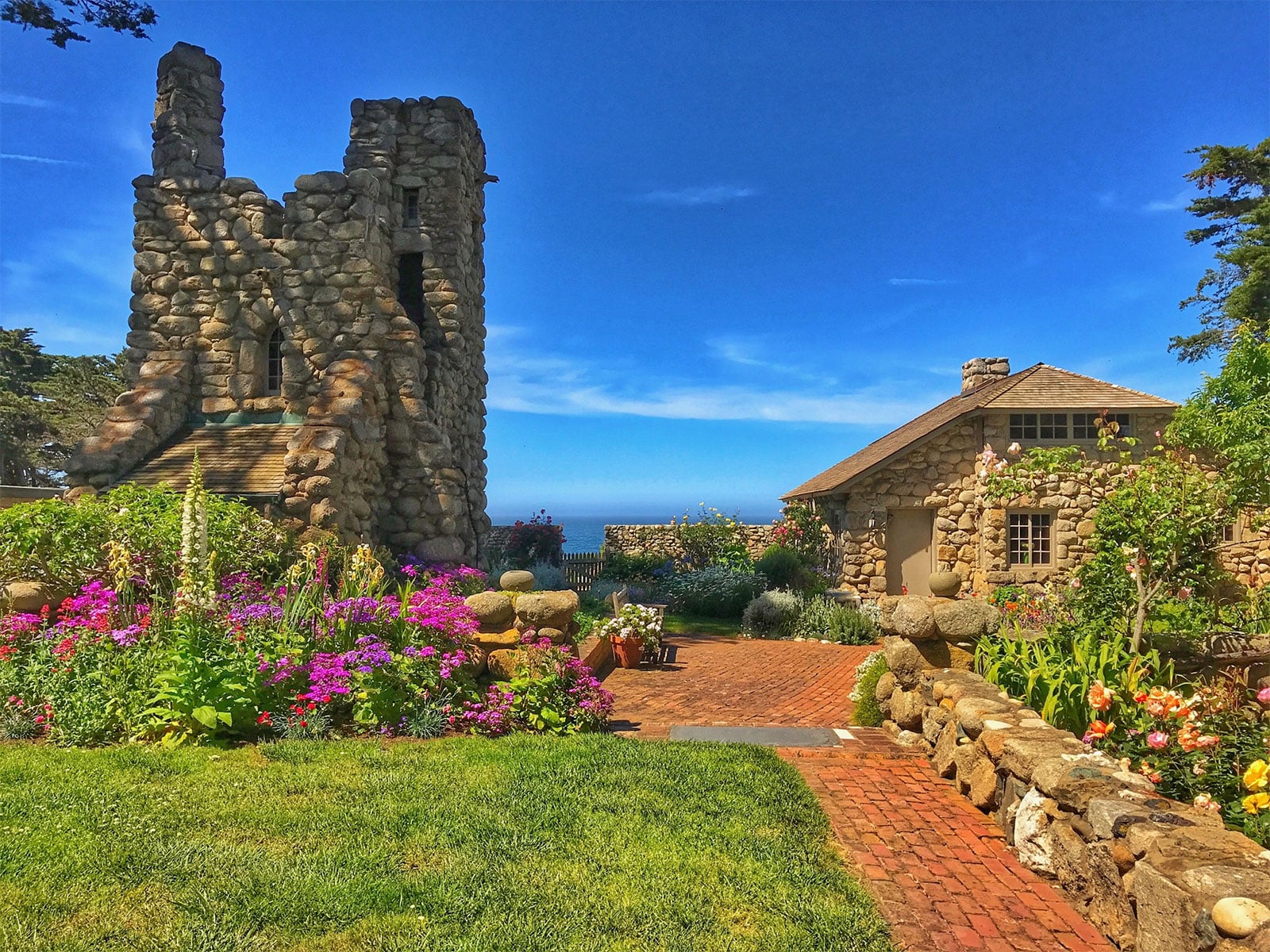
Or take me, for example. That reading wasn’t the reason I decided to major in English, but it was part of the reason. And being a poet myself—never what anyone told me was a good idea—wasn’t a direct result, but it led to this highlight: 28 years later, I got to do a reading at Jeffers’ Tor House. My wife and I got to climb to the top of Hawk Tower, look out, and believe the Pacific Ocean is the front porch of the universe. One of the poems I started with was my favorite by Robinson Jeffers:
And none of this would’ve happened if I’d just ignored that thumbtacked flyer.
So happy Poetry Month, and here’s another gift for you to open. Not a poem this time, more like Poetry’s sister, but I think it spins us full-circle back to “Carmel Point.”
 Rob Carney is the author of nine books of poems, including The Book of Drought (Texas Review Press, 2024), winner of the X.J. Kennedy Poetry Prize, and Call and Response (Black Lawrence Press, 2021), and his collection of creative nonfiction, Accidental Gardens: New & Revised (Wakefield Press, 2026). His work has appeared in Cave Wall, The Dark Mountain Project, Sugar House Review, and many other journals, as well as the Norton anthology Flash Fiction Forward (2006). In 2013 he won the Terrain.org Poetry Award and in 2014 he received the Robinson Jeffers/Tor House Prize for Poetry. He is a Professor of English at Utah Valley University and lives in Salt Lake City. Follow his Terrain.org series Old Roads, New Stories.
Read an interview with Rob Carney appearing in Terrain.org: “The Ocean is Full of Questions.”
Read Rob Carney’s Letter to America in Dear America: Letters of Hope, Habitat, Defiance, and Democracy, published by Terrain.org and Trinity University Press.
Read poetry by Rob Carney appearing in Terrain.org: 6th Annual Contest Finalist, 4th Annual Contest Winner, and Issue 30. And listen to an interview on Montana Public Radio about The Book of Sharks.
Header photo photo of Hawk House and Tor House courtesy Robinson Jeffers Tor House Foundation.