
If only every disaster were an oxymoron, bad but somehow good.
1.
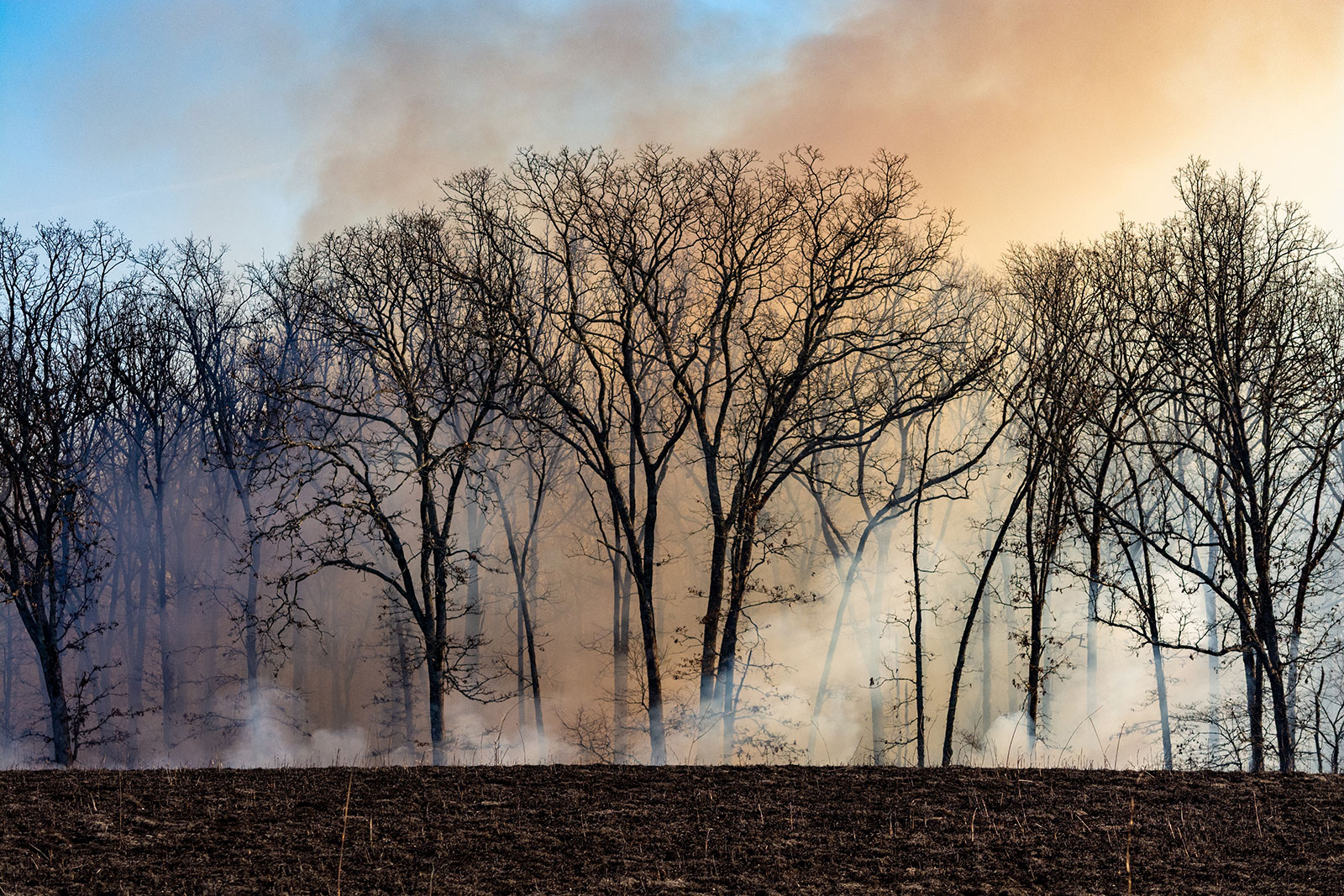
We are burning the fields today, something we do annually to encourage the native plants and discourage the weeds. Keith will light the fires with a propane torch; I will beat down any flames that escape. If the fields are reasonably dry and the wind is blowing at the right speed, we can finish an acre in 15 minutes.
First, though, I zigzag through the field to flush out the nesting and resting animals, like the meadowlarks I’ve been seeing today, their yellow scruffs bright as lemons. When I hear a scuffle and a squeal, I jump back to the firebreak: a bald eagle rises out of the field, the meatier parts of the rabbit he just killed dangling from his talons. He flaps his wings a few times to correct his balance and disappears over the treetops.
I should have started work a little sooner this morning.
We’ll burn 30 acres today. Mostly I’ll stand on the sidelines, a swatter propped next to me. (A swatter is a rubber mudflap affixed to a broom handle, something a farmer jury-rigged in the barn one winter when he had nothing else to do.) I’ll also fill and refill the buckets of pond water, just in case. Keith, my darling arsonist, will gauge the wind, crank up the propane, light last year’s partridge peas, goldenrod, and sneezeweed, and then step back to evaluate his work. Test the wind again. Adjust. Burn. Sometimes several acres will explode, crackling and flaming, flattened to ash before I can get there. Sometimes he’ll have to relight the same acre three or four dozen times.
As he is right now.
The best part of any chore is this part: I stand still, waiting my turn. The natural world comes close enough to make sure I have a heartbeat. I can smell birdshit and leaf mold, see the red maple buds stuck between her teeth, hear the spring peepers she put in her pocket and forgot. But her mothering makes me think of my own child, who recently asked me if I had an evacuation plan.
“For me,” she said. “To get me out of the city when the time comes. Like when Trump tweets that he’s going to launch a nuclear attack to prove that his missiles are bigger than Kim Jong Un’s.”
I do have a plan. I have three children in Chicago, and I have triangulated their locations and identified the fastest route to get them out of Illinois and onto less conspicuous roads in Indiana. But I didn’t want my daughter to know I’d been worrying about this, too.
“Did you read that Trump is raising tariffs on tiny Australian islands where no one but penguins live?”
“Motherrr,” she said, imitating her favorite character from the IT Crowd. “I’m serious!”
She spit out a litany of things she was afraid of besides the current hack in the White House and the potential end of the world.
I put my hands on her shoulders and turned her toward me. “I didn’t know you had so many worries,” I said, taking a deep, inaudible breath. “Do you think it’s time for you to talk to a therapist?”
She said yes with no hesitation, the way adult children do when a parent finally says what they’ve wanted to hear for a long time. And then she added, “What about you?”
Me?
I like the smell of burnt fields. Ash, sure, but from plants and so somewhere between peat and coffee grounds. It lingers in my nose. What’s left in the field is a base of black charcoal beneath fine white tendrils. But not everything burns, including some of the tender plants like Foxglove penstemon, which is reduced to bloody circles of basal leaves. That’s okay. They’ll gorge on the minerals and shoot up later, showing off the pale pink gloves the fire bought them. For native plants, fire is a welcome disaster.
If only every disaster were an oxymoron, bad but somehow good.
2.
My daughter has forgotten this fact: I started seeing a therapist five years ago, hoping to resolve a lifelong problem.
I can’t sleep.
True story: I’m awake in a crib I’m too old for, the mattress lowered and the rail raised to keep me corralled. No one comes when I cry, so I keep crying, not because I’m cold or thirsty but because there’s a hand floating in the air over my head.
I think it’s God’s hand, and I think he’s going to get me, because I’m three or four and that’s all I know about men who are bigger than I am. In the oil painting in our living room—which I can touch if I jump up and down on the couch—God’s hand looks just like this one, upturned, balls of fire sliding off his fingers into a blue-black sky.
It will be 50 years before I understand what I really was seeing: my mother’s hand splayed out on the rail, the rest of her asleep on a chair she’d pushed up to the crib. She’d come to comfort me when she heard me cry, but she fell asleep or passed out.
The woman in my head has a crabby British accent: “The childish desire for comfort that can never be fulfilled turns sinister if you don’t outgrow it.” (She is not my mother, even though she always orders a full pint, but I get tired of her being right.) Once I could count, I learned to comfort myself: I’d curl up with a blanket on a shelf in my closet and count my fingers from pinky to pinky, one through ten, and then from ring finger to pinky, one through nine, and so on. By first grade, I’d learned to multiply by adding numbers—eight, 6, 32, 64, all the way to 256. While it was still light enough for me to see (I wasn’t tall enough to reach the string that turned the closet light on), I’d connect the imperfections on the plaster walls to make pictures. A sharp-eared rabbit with a lumpy cottontail. A pig with a bulbous nose. And once, a rendition of my older cousin Garry—who’d done something to make me cry—another pig, but this one drawn in blue ink. When we packed up the house a few years later, on our way to The Worst Mistake My Parents Ever Made, I marveled at how big the drawing looked in the empty room, and I wondered why my mother never bothered to sand it down. It hadn’t occurred to me that she’d never noticed it, right there, scratched in the pink paint in the middle of the wall at Mary height. But I would never have drawn her attention to it, since I’d get in trouble. And Garry wouldn’t have mentioned it either, for the same reason. Détente was our shared best interest.
Eventually, I’d fall asleep, my little body striped by the cedar laths on the shelf I was lying on.
3.
Past the pond, we discover a tree limb hidden in a tangle of head-high cup plants, their yellow, daisy-like flowers long gone, their opposite leaves brittle and brown but still clasped together at the base of their square stem, creating a “cup” that holds water for visiting insects and animals. We know by looking that the limb is too large for us to move, so Keith goes back to the barn to get the tractor and chains.
When the wind kicks up, rattling the dead leaves on the beech trees, I walk through the already burnt fields looking for hotspots, stomping out little fires with my thick-soled boots. Along the way, I see two quail eggs, roasted in their spotted shells. I see half a dozen four-inch mud turrets constructed by crayfish as they tunneled up out of the groundwater. (Crayfish are crustaceans, but they can move on land as long as their gills stay moist.) I see a vole run, a series of tunnels created by voles, roofless thanks to the fire that burned the thatch. It meanders across the field like the tributary of a great river.
When my father, who was an inflictor of pain, screamed at night, whatever was hurting him had to be too horrible to imagine.
When I was eight, we moved to a rental house in the country. In Illinois. According to my maternal grandmother, Illinois would be destroyed in the Second Coming, since it was where the Prophet Joseph Smith had been murdered. (This was the subject of serious conversation around her breakfast table.) In any case, something was wrong in the Illinois we moved to. The river up the hill was deep and dark and full of giant carp and water moccasins. The woods were so dense that an immature bald eagle once mistook me for its dinner. There were forgotten places on the property, too—neglected bee hives, fire-blighted orchards, crumbling outbuildings—like remnants of a village after a war. And there were oil pump jacks up the lane, big steel dinosaurs screeching in pain as they pulled the oil to the surface and pumped it into tarry pools lit by sulphury, yellow-eyed torches.
Not an auspicious beginning for a little insomniac.
My new bedroom was smaller than the one in Indiana. The closet was small, too, and the only shelf was too high for me to reach. But there was a window seat with a hinged lid, and it looked promising. It wasn’t: the interior was all rough wood and electrical conduit, and there was no place for me to sleep. Maybe that’s why my mother bought the lavender bedspread with a ruffled skirt and matching ruffled curtains and the bedside lamp covered with little white pom poms. So I’d stay put, I mean. I’d leave the lamp on so that I could see the figures in the ruffles. A whole parade of them, every other face right side up. Dignified but unattractive people with long noses and sharp chins and ruffled shirts and nightcaps. They spoke to each other in whispers I could never quite make out, which was the way I liked it when adults were involved. But just as I’d drift off in their white noise, the oil pump jacks up the lane would shriek as they strained to pull up the oil.
On the best nights, my father, a truck driver, would be away on a long haul. My brothers would be in their basement bedrooms, which I avoided because I didn’t like walking past the sump pump swirling at the foot of the stairs, ready to suck me in. My mother would be away, too, earning a little extra money by making pies for the Amana Truckstop. I was as good as alone. I was good alone. I would rather sit on the couch on Friday nights watching Sammy Terry from WTTV’s Nightmare Theatre pretend to frighten me than deal with the real thing. When the feature horror film started, what I heard was Sammy cooing behind the screen, “Sleep, Mary, sleep.”
But some nights, my father was home.
4.
This is how it goes at the farm. We can’t move the tree limb without using the tractor. The tractor has a dead battery, so Keith goes to find the jumper cables which, along with the tow chain, have disappeared in the tangle of tools hanging on the barn wall. While I wait here on the east side of the pond, the wind begins to run its fingers through the burnt field, raising whirlpools of black ash.
If I knew you better, I’d tell you why I can’t sleep. For now, I’ll share one of my symptoms.
I am hyper-sensitive to noise. Maybe because I have a congenital defect in my brain. Maybe because I had so many ear infections as a child. Maybe because I slipped on the gym floor (mea culpa—I was wearing street shoes) and knocked myself unconscious.
Or maybe because there was too much noise at home.
I hear everything, even out here where the population density is 18 inhabitants per square mile. I hear myself breathing, one nostril always a pin drop louder than the other. I hear others breathing. I hear each black walnut that falls, throwing off tannins like a censer. Bass shuddering the water over the dam. Leopard frogs that rattle like Krylon spray paint cans. Rabbits rustling the Indian grass. Barred owls calling, Where-the-hell-are-you? Grain dryers roaring, gobbling up the pennies they save. The freight train hitting the crossing too lightly, proof that car sales are down. Jets flying over from Indy. Maybe even the fallout from Halley’s Comet. Certainly the moon rising, popping clouds like Super Elastic Bubble Plastic, and the coyotes haunched beneath it, using the light to read the dinner menu out loud.
And back then?
I’d hear my father pissing away his bedtime six-pack, the frenzied whoosh of water followed by half a dozen plops. Shoes off, belted pants clanking to the floor. Sock feet stepping down the hall, moving away from where I was supposed to be sleeping. A shimmy of bedsprings as he fell into bed wearing boxer shorts and a vee-neck tee shirt stained yellow with sweat or Right Guard or both. He’d been awake for most of the last 48 hours, having driven to Florida with a load of melons and returning to Indiana with a truckful of oranges. He’d downed bennies with his coffee that morning to stay alert, a habit he picked up in the army with General Eisenhower’s blessing. Sixteen hours later he was back home. For the first hour or so, I’d hear him roll from his side to his back as he punched and repositioned his pillow. Eventually he’d pitch headfirst into a well of sleep or something like it, his elbows squeezed to his waist, his fists clenched like a baby’s.
When I heard my father cry out in his sleep, I knew nothing about his mother dying when he was four, courtesy of the flu pandemic World War I soldiers brought home. I knew nothing about him being tagged and put on a train that traveled 600 miles to his grandmother’s house in Illinois, the grandmother who read the bible aloud each morning and thwocked him with her thimble if he didn’t pay attention. I knew nothing about his father’s search for work during the Depression, his visit to a whorehouse in Oklahoma, or his brief marriage to the proprietress who, my dad told me once, had an arm like Max Schmeling’s. I knew nothing about what it was like for him to grow up with eight siblings, five of them the children of his father’s third wife, 20 years his junior, children their father could seldom afford to feed. I knew nothing about him drunk-driving the car that killed his best friend on the Westfield curve. I knew nothing about what it was like to be thrown into battle at Kasserine Pass after only six weeks of training, or what it was like to fight for 800 consecutive days, from North Africa through Sicily and Italy, all the way to the foot of the Alps.
But I did know this: when my father, who was an inflictor of pain, screamed at night, whatever was hurting him had to be too horrible to imagine. But I did imagine it, and I imagined it coming for me next. My mother was still at work. My brothers weren’t the kind of brothers I’d go to for help. (It wasn’t their fault: in our family, we stayed safe by taking no side but our own.) I wasn’t small enough to escape to the closet shelves anymore, so I’d curl up in bed next to the wall, ready to slip onto the floor if that thing came. That thing that wanted to get me.
“Get you” has a such bright and shiny meaning these days. To “get” someone is to understand them, to connect to them.
“Who?” my therapist asked me once, tapping on her clipboard. “Who was going to get you?”
I didn’t know then. I’m not sure I do yet. And if I never let my guard down, I’ll never have to know.
5.
I find a patch of roasted ground cherries at the edge of the burnt field, their orange skins cracked and glazed. Ground cherries—which look like small tomatillos—are members of the nightshade family, but once they’re ripe, they’re no longer poisonous. Yet when Keith sees that I am about to take a bite, he waggles a gloved finger at me, and I drop the fruit.
We have one more section to burn today, here between the bee yard and the woods. Last week we mowed an eight-foot firebreak around the field to contain the fire and keep it from mobilizing the bees, who are unpredictable. One minute a bee will be tickling the hair on my arm while she sucks my sweat, and the next minute she’ll be calling 14 of her sisters to join the kamikaze squadron aimed at my backside. So I keep my distance. Keith, meanwhile, has ignited only one corner of this field, but the wind is blowing from the northwest now, and the flames shatter and flatten the goldenrod and ironweed so quickly that he jogs to keep up.
“Avoid stress,” the doctor said. “And keep a dream journal—whatever is troubling you when you dream may be something you can address when you’re awake.”
Keith reminds me of my father in small, innocuous ways. Sometimes he’ll run his hand through his thinning hair the way my father did or lean forward to tie his black leather dress shoes or tremolo whistle the same two notes or call out “Who dat?” when he sees or hears something he can’t identify. Otherwise, they have nothing in common. The man I love is kind and even-tempered. He would never hurt anyone.
Except when he sleeps.
Keith has REM sleep behavior disorder, a neurological condition that disrupts the temporary paralysis most of us experience while in REM sleep, causing him to act out whatever he’s dreaming. Sharing a bed with a person who has REM sleep behavior disorder is like trying to sleep on a six-inch ledge a mile in the air: possible but impractical. Someone—usually Agent Orange, my husband’s nickname for the current American idiot—will threaten him in a dream, and to defend himself, he’ll scream and curse, punch and kick, and throw whatever is within reach—a book, a glass of water, the bedside lamp—at… me.
On some nights he does nothing more than sing a few notes or have a long conversation about replacing cracked field tiles or going to the FFA convention in 1967. Once he dreamed he was a juror in an important case, and I watched him move his crooked index finger through the air as if he were taking notes. But on other nights, Agent Orange does terrible things to my gentle husband, and he screams “Fuck you!” or “Call 9-1-1!” On those nights, I pin his arms to his sides to keep him from hitting me.
“What were you dreaming?” I’ll ask him when he wakes.
His eyes will relax to their normal shade of blue. “The usual.”
The “usual” is that one or another member of the Agent Orange cabal is up to no good. One of them commandeered our spare bedroom for two Russian hookers he wanted kept out of the public eye. Another stationed troops in the east 40 to keep illegal farm workers from entering the state. A third rolled up to the farm in a tank armed with nuclear missiles and forced him to shine them with a chamois.
The good news, a neurologist told us, is that his sleep disorder is idiopathic, not a symptom of Parkinson’s disease or something worse, a diagnosis he based on watching Keith walk ten paces down the hallway. The bad news was that there was nothing he could do to help. “Avoid stress,” the doctor said. “And keep a dream journal—whatever is troubling you when you dream may be something you can address when you’re awake.”
We began to laugh. The doctor tilted his shiny bald head and asked, “What’s so funny?”
We decided to be practical. We bought a king-sized bed. At night, we remove anything he might use as a weapon, and I lay down out of his reach wearing earbuds that play white noise to soften the noise my husband makes. Yes, I could sleep in another bedroom, but since I’d have to get up to wake him when he cries out, what would be the point?
One more thing: when he’s especially terrified, he wails. It’s an unearthly sound, as if he’s singing the chorus of Dolores O’Riordan’s song “Zombie.”
In Irish tenor style. The way my father would have.
6.
I’d never paid attention to “Zombie’s” lyrics—Dolores’ voice, which melded a cacophony of wails, keens, and yodels to her lilting Irish accent, was all I ever heard. But recently I discovered that the song was about the impact of war on bystanders, people who, long after the violence ended, could still hear “their tanks and their bombs and their bombs and their guns.” My father was one of these people, though not just because of what he witnessed. He was a combat engineer, which meant that part of his job was to clear German minefields. So Bud Herrington saved lives, yes. But he also rigged explosives to bridges, sometimes detonating them while Axis soldiers were crossing. The only thing my father ever said to me about the war was that 30 years later, he didn’t just remember the smell of burning human flesh—he could still smell it.
When the wind shifts direction again, it rips off Keith’s cap, which keeps rolling until it’s out of sight. I run to retrieve it before it hits the creek, finding it snagged on a swath of mayapples spiraling up out of the leaf litter like furled, green umbrellas. By the time I scramble back up the hill, I discover that the same gust of wind has caused the fire to leap the eight-foot break. It already has devoured the dead leaves piled up against the trees and is now licking its way up the first row of hawthorns and dogwoods. March winds have evaporated much of the moisture the rains brought, and the woods—especially the quarter of them already killed by the emerald ash borer—will be ash, too, if we don’t work quickly.
I toss the cap into the truck cab and grab my fire swatter. Keith is already dumping buckets of pond water on the base of the first phalanx of trees. I follow behind him, smothering the smaller fires while he douses the larger ones, and then leap ahead to stop the fire from reaching the neighbor’s cornfield.
We lose the battle but not the war: two wild cherry trees already riddled with cankers will not recover, but four singed gray dogwoods probably will. The good news? The fire cleaned out the litter under the trees, which will make it less of a hazard the next time we burn. It also will recharge the natives—leeks, morels, hen-of-the woods—that live under the canopy.
We stay on the qui vive for a while longer, chugging water and wiping ashes off each other’s face. When I relax against the truck, I notice something walking along the north edge of the first field we burned today.
“Who dat?” I say out loud, so that Keith turns to look, too.
At first I think it’s the neighbor’s young Australian cattle dog, pointy-eared and golden brown. But it has an unusual gait: it oversteps as it moves, its hind feet landing slightly ahead of its front feet.
“Bobcat!” we say in unison.
We’ve never seen a bobcat out here, except for a second-hand sighting on a trail cam years ago. But there he goes, patrolling the field, sniffing the ash for barbecue.
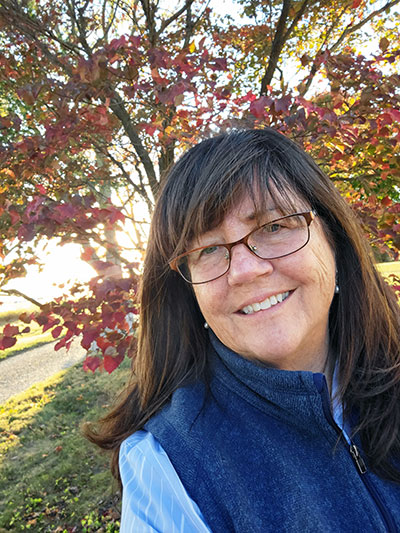 M. H. Perry’s work recently has appeared or will soon appear in The Rappahannock Review, The Sewanee Review, and Boulevard. “Sleep or Something Like It” is a chapter from The Area of Disturbance,” her memoir-in-progress. She currently is master naturalist in residence at The Perry Farm, where she and her husband grow-to-share organic fruits and vegetables and tend a hundred acres of native plants.
Header photo by sawardPhotography, courtesy Shutterstock.