
March 14, 1838
Let ours be like the meeting of two planets, not hastening to confound their jarring spheres, but drawn together by the influence of a subtile attraction, soon to roll diverse in their respective orbits, from this their perigee, or point of nearest approach.
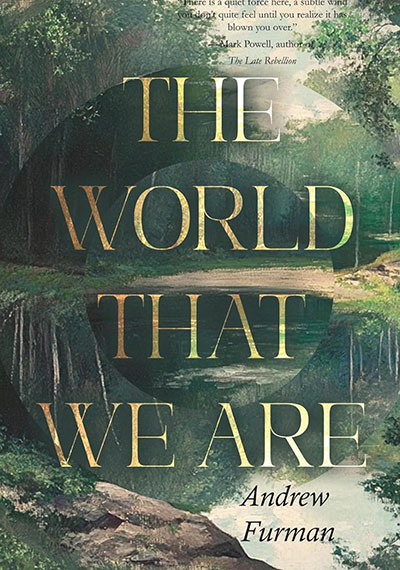
Alternating between the timelines of Henry David Thoreau setting out to lead an extraordinary life in Concord, Massachusetts in 1837 and David Hertzog, a Thoreau scholar in present-day Maine, The World That We Are delves into enduring themes of love, family, the quest for meaningful work, and the search for a true home in the spinning cosmos.
Writing and reading take up the lion’s share of his daylight hours. Goethe has much to teach—his exact and unadorned description of objects and natural phenomena precisely as he sees them. The thing in itself! H.’s own fledgling efforts to express himself in poetry and prose seem impossibly bloated by comparison. He would fain build a garret against the world to sanctify his reading and writing hours. Meanwhile, not a few noblest boys of New England find themselves consigned to actual garrets in the sun-scorched wilds of Georgia and Florida, driving the poor Seminoles to the swampiest redoubts. While H. saunters about and contemplates the manifold impressions of snowfall upon individual trees, the sombre Nobscot fog, the brave notes of year-round birds, the impetuousness of wood ducks in the pond.
Today, he saunters toward Mr. E.’s grand white house so that they might share their well-trod amble. Upon his approach, he spies his mentor outdoors in the orchard, his sleeves rolled, worrying the earth about one of his young peach trees with a shovel. The sweet, strong aroma of animal manure spices the air. H. loves to see the great man so employed, physical labor outdoors the better of our manifold inclinations, as the sage himself has exhorted in a recent address. Mr. E. has taken to calling his home “The Bush,” he has planted so many fruiting trees, shrubs, and vines since purchasing the house and its sprawling environs. Even so, it is yet to be determined whether he will prove a capable husbandman. He wears a pair of black leather shoes too dear for the task, better suited for his lectures.
“It looks like you’re preparing for a fine harvest,” H. utters by way of greeting, which provokes the great man to rise from his labors, the inside of his elbow balancing his weight against the shovel handle, his hand opposite braced at his waist. Was there ever so manly a posture?
“Mr. Wilder of Bolton recommends a greater proportion of lime and ash with the hog manure,” Mr. E. launches into pedagogical matters straight away.
“The Irish farmers,” H. replies, “favor ample parings of horn and bones from their oxen.”
“The Irish,” the sage utters neutrally, leaving it to H. to infer the mild insult. However ramshackle their dwellings rising from the pond outside town, these poor railroad workers, it seems to him, have much to teach regarding the practical arts.
H., spitting into his palms, asks his friend whether he might help him with his trench, but the great man demurs.
“I’m nearly done,” he says. “Shall we walk?”
“We shall.”
“Let me tell Liddie.”
Liddie. Lydia her given name, changed to Lidian upon her betrothal to affect finer poetry with her new surname. The utterance of her nickname pricks H.’s insides. Will H. ever enjoy such intimate relations?
H. wonders whether Mr. E. will take advantage of the occasion to exchange his shoes for his stiffer-soled boots of a coarser grain, yet he returns in an instant clod in the same shoes. He considers warning the great man of the wet trail, then reconsiders. They forge a path behind the house on the still winter-burnt grass between the orchard trees—mostly apple, but also peach and plum and berberry and cherry and currant—head down the slope toward Mill Brook and the woods. The unfrozen ground brook-side, as H. feared, is sopped with snowmelt. They must carry on for a quarter-mile or so before the wooden footbridge. They walk single-file, seeking out the untrod earth atop joe-pye weed with its leaf whorls up and down each stem and jewelweed just starting to advertise its blood-orange trumpet blooms beside the trail proper to keep the muck from swallowing them whole. The thawed earth emits a fecal and mushroomy stench H. savors. He listens for frogs and birds, but all he can hear are the distant strokes of a wood-chopper, the great man’s labored breath, and the mild brook beside them, licking its ancient pebbles new. The fluted song of the thrush and the chippier notes of smaller yellowthroats with their black-mask and other warblers will soon fill the air, but their fair-weathered birds have yet to arrive. H. slows his pace in deference to his elder.
“I daresay I’ve worn the wrong shoes for the occasion,” Mr. E. says.
“I feared the path would be wet. I might have warned you.”
“Oh, we wouldn’t want to deprive our dear Liddie of something to chafe against in her husband.”
H. laughs to convey his agreement, appreciates the intimacy implied by the “our Liddie.” He asks the great man after his thoughts over the past few days since they’ve enjoyed each other’s company.
“I’ve been looking in greater earnestness toward the ancients, convinced evermore by their example that the Whole is in every man, in every age. Don’t you agree, H.?”
“I do. And in woman too, yes?”
“Oh yes. Woman too.” The sage clears his throat. H. awaits his next words, but they don’t come right away. The wood-chopper’s notes have also faded. They reach the footbridge and cross into more open land rising from the brook, the rolling stubble-fields of Stratton Farm. They walk side-by-side now.
“Lucy boasted over the warmth of your sentiments expressed in a recent letter.”
“Oh?” H. feels the blood rise to his face. For whatever reason, he didn’t anticipate that Lucy would share the contents of his letter with her sister, Lidian.
“Are you sure you are not merely practicing lovemaking on her? She’s nearly twenty years your senior.”
“They were true sentiments. But I might not have paid close enough attention to how they would be received. Perhaps I have been cruel.”
“Oh, Lucy admires your youthful enthusiasms. She’s well past the age of pining. Never fear.”
He might have more tenderly regarded dear Lucy’s emotions. He scans the hillside of mixed woods, can see the earth beneath the mostly winter-bare scaffolding of branches, the tender buds of sumach and maple and grape just beginning to assert themselves. He scans the vista for his fox. He regards the creature in the singular, as if it were the same one he spies traces of hither and thither.
“Are you keeping to your reading and writing?” Mr. E. jolts him from his reverie.
“Oh yes. When I’m not working on father’s pencils.”
“And?”
“I still labor toward a form to best express myself. Prose or verse. It hasn’t announced itself yet.”
“Well if you’re waiting for that…”
The great man lets his words trail off and gathers his breath. H. loves his elder for the mild rebuke. Perhaps this is what defines a true friend. Not so much outward kindness, but sincerity, which might smack of severity time to time. You must plant your feet even more firmly before your friend than your rival, it occurs to H. Yes. He hopes to retain this thought so that he might preserve it in his journal for possible use at his upcoming lecture at the lyceum. You must plant your feet firmly before your friend.
They pass over Hugh Cargill’s ditch and enter the drier woodland as willow gradually cedes to poplar, maple and fully-clothed pines and hemlocks—the air tree-spiced now and rich with birdsong on account of the evergreens and their hardy fruits. H. admires the brave stoical essence of their winter chicadees and titmouses.
He considers remarking upon the birdsong to his companion, but Mr. E. surely hears the notes, as well. He savors the intimacy of their human silence shared. His elder soon bursts the silence by asking after his teaching plans, whether he might attempt to open a school with his brother, as mentioned, or seek employment elsewhere for a time to gain experience. He tells Mr. E. about his plans to take a ship from Boston to Maine to explore the possibilities, if only to visit with dear cousins Rebecca and Mary and treat his eyes to new vistas—the sea, the strange towns, the craggy coastline and primeval woods. His elder doesn’t respond with words but makes listening noises to convey his approval.
H. can no longer hear the chips and wheezes of the chicadees and tits behind them, busy with their own affairs. But the sight of a nuthatch creeping head-first down a poplar trunk up ahead and just off their trail halts him in his tracks, causing his companion to brush up against him before pausing.
“You see something?”
“The nuthatch. Up ahead.” He points just as the bird scurries around the backside of the trunk, but then it thankfully reappears, bobbing its head as it continues its upside-down creep. Then the creature alights on a branch and laughs, as nuthatches do, boastful of its life. Life! Life! Life!
“Oh, yes. Of course.”
There’s something dismissive in his companion’s words. As if to confirm H.’s suspicion, the great man walks on, leading the way now for H. to follow. Mr. E. is not as interested in the nuthatch, or in most of the natural phenomena that occupy H.’s more concerted attention. Their angle of vision outdoors often seems to diverge, the wide open distant views more amenable to his elder’s imagination, or simply more soothing to his poor eyes, which plague him.
H. watches the way his mentor clasps his hands behind his back as he walks up ahead. H. keeps his own hands free at his sides, by contrast, ever “on hand,” so to speak, to gather what fruits might present themselves.
“Mark the nuthatch of yours,” the sage calls behind him without turning his head or slowing his gait, “the unusual trajectory of its amblings.”
“Yes, ’tis rather distinctive. Only the creepers and black-and-white warblers move in quite the same manner.”
“They follow the path of their genius, you see. Headlong.” Mr. E. nearly shouts now to be heard. “They don’t hem and haw over prose or verse. They don’t wait for the proper path to announce itself or some such nonsense. You must forge ahead. The art is in the doing. What did your bravest Indians do when they exhausted their arrows? Did they retreat? No. They threw themselves at the mark.”
It was just like the great man. Just as H. doubted his companion’s sympathies, his lungs and mouth form these perfect words. When he thinks upon their saunter today, their saunterings most days, what he prizes is the way their thoughts and words tend to circle about the same topics—love, friendship, work, courage—yet follow their strange trajectories, not unlike the strange flight-trajectories distinguishing sapsuckers from swallows. He ponders additional analogues, as the great man has advised, following his elder toward Hubbard’s shady swamp, Brister’s spring, and the pond.
The planets. Yes. Their minds orbit about the same concerns in their own fashion, drawing close at intervals, not unlike planets or, looking about, not unlike these fir and oak and maple trees whose branches seek their own space and light, yet whose roots surely intermingle beneath the earth’s crust. Planets. Trees. Branches. Roots. Friendship. Love.
“You’re awfully quiet,” the great man says as he strides downslope toward the swampland. “Even for you.”
H. tells his companion that he was only thinking on his inspired revelations. They pause at the swampy meadow, side-by-side now, seeking out the driest footpath across the unripe berrying shrubs to the hill. His companion’s next words surprise H. yet again.
“I’m certain you’ll find a soulmate in due time, dear friend, if a wife is what you seek.”
 Andrew Furman is the author of the novels Goldens are Here (Green Writers Press, 2018), Jewfish (Little Curlew Press, 2020), and The World That We Are (Regal House Publishing, 2025), recently announced as a Finalist for the Foreword INDIE Award in Literary Fiction. He has also published the nonfiction books Bitten: My Unexpected Love Affair with Florida (University Press of Florida, 2014) and Of Slash Pines and Manatees: A Highly Selective Guide to My Suburban Wilderness (University Press of Florida, 2025), winner of the Stetson Kennedy Award and Florida Book Award (Honorable Mention). His stories and essays have appeared in various literary magazines, including Prairie Schooner, Ecotone, The Southern Review, and Oxford American. He is professor of English at Florida Atlantic University and teaches in its MFA program in creative writing.
Read an excerpt of Andrew Furman’s Goldens are Here plus his story “What I Remember About Captain Horace Holtkamp,” as well as nonfiction appearing in Terrain.org: “The Problem with Pretty Birds,” “Slashed,” “Fox,” and “What Would Thoreau Do?”, a Letter to America.
Header photo by Kathy Büscher, courtesy Pixabay.