
Yellow-Crowned Night Heron
It’s 6 a.m. and B is gently shaking me awake. The Houston summer light is already keen in our small, white bedroom, ready to scorch through the day on a wave of humidity and smog. “I’m sorry—I know it’s early, but there’s something you have to see.” Eyes and mouth gummy, I drag my bathrobe over my shoulders and follow him down the wonky hallway of our rented bungalow to the mudroom, a term I’d never heard of before moving in with him. Being voluntarily awake at this hour is equally foreign to me. The dogs squeeze excitedly around our legs as we stand in the narrow space between the wall and the washing machine and dryer, their thick otter tails drumming against the warped metal. B points out the window of the back door. “Look.”
On long, deep-gold legs, a three-foot-tall bird is stalking through the backyard. It seems to be assessing the beds of rose bushes, towering ginger flowers, and sprawling four o’clocks with the eye of a hard-to-please horticultural judge. The previous tenant had skipped out on his last few months of rent, leaving the house a dusty mess, but had inexplicably installed this robust tropical garden, which we were ill-equipped to manage beyond basic weeding and mowing.
The bird’s body is sturdy and pearl gray, with gray and black wings draped behind it like an aristocratic cape. The length of its head is marked with thick, aerodynamic stripes of black and white, and several long, light-colored feathers project from the back like sharp lines underscoring a signature. I lean in closer to B as it passes by the door. “Its eyes are red,” I whisper, squeezing his arm. He leans his chin against the top of my head.
Aside from a brief summer sublet with a college boyfriend, B is the first romantic partner I’ve ever lived with. The landlord gave us our first month’s rent free for cleaning out Garden Guy’s mess, and we repainted all the rooms before we moved in. We chose a dark terra cotta for the dining room, but the paint we bought was thin and watery, and took at least four coats to look right, engendering our first fight somewhere around the third. After nearly a year together, we were probably due.
I have no idea what kind of bird this is. I hadn’t even known that such a bird could be possible in a backyard in this polluted, audacious city where both B and I are transplants. I love the strip clubs sitting cheek-and-jowl with churches, the wild mishmash of Southern, Texan, and global cultures populating the urban sprawl. I hate the sprawl. I love the icehouses, cold beer drunk at picnic tables, cowboy boots scuffing gravel and dust. I love and dread the pack of wild dogs that roams the campus where we teach. After living my whole life in the orbit of New York City, it took moving to Houston for me to realize how little I really knew or noticed about the world. I should have expected this weird stranger.
We watch it march around for a few more minutes before it stops, spreads its wings, and, like a nonchalant miracle, leaps into the air and glides away, past the yards of our neighbors and out of view. I wrap an arm around B’s waist. I already know that this is the person I will marry, but I still don’t know much about birds.

House Wren
We hadn’t been planning on buying a house, but finding someone in this Missouri college town that would rent to a couple with two large dogs was impossible—despite the fact that they were likely to do less damage than the average drunken undergrad. To our surprise, B and I learn that buying would be easier and cheaper, and so less than two months after getting married, we become first-time homeowners.
The move from a city to a small town quickly teaches us that we’ll need to cook at lot more, no longer able to depend on the myriad of cheap take-out options that fed us before. I’m starting my Ph.D., and my husband—that word like a new coffee table that I like but am constantly tripping over—takes an office job while studying for the comprehensive exams of the doctorate he was pursuing in Houston. This means he’ll work from nine to five, come home, eat dinner, and spend the rest of the evening at the campus library. It takes a few weeks of this arrangement to set in before I realize that—despite being an inexpert cook at best—I am now a Wife Who Needs to Have Her Husband’s Dinner Waiting for Him When He Gets Home. We have a mortgage. We have over a hundred wedding pictures taken by a guy who was cheap, but neither of us really liked. My wedding bouquet was pink, despite this being the one color I told the florist I didn’t want anywhere near me. We have a large ornamental bowl from our registry that neither of us knows what to do with. We are now residents of the country called Marriage.
After we move in, I put up a feeder outside the windows of my study, a sunroom extension at the back of our tiny house whose plywood floor I cover with a plastic outdoor rug. It’s the early 2000s, and I discover the Cornell Lab of Ornithology has a website. I become acquainted with hairy and downy woodpeckers, chickadees, and house finches, getting close enough to see that their eyes are usually clotted with dried mucus due to a disease lately infecting the Midwestern populations. I spot white-breasted nuthatches and brown creepers by their spiraling progress up and down the trunks of trees. I identify kingbirds perching on the tall stalks of grass in the nature preserve where we walk the dogs. I fall in love with the blue jewels of indigo buntings and learn they navigate by the movement of the stars.
For our first anniversary, B buys me a dried, hollowed-out gourd with the word “Wren” painted over the hole drilled in its front. An oval of wire runs through its stem. We hang it up on the front porch, and it’s not long before we see a male house wren periodically ducking into the opening with twigs clamped in his beak. We joke about charging him and his future mate rent. Then, for a week, then two, nothing—no sign of any birds entering or exiting the gourd. I learn that male house wrens will set up multiple sites for a future nest, bringing the female to each one and letting her choose. The gourd starts to look dusty. We feel rejected.
I wonder if the birds are put off by B smoking on the front porch. I quit a few years ago, and he hasn’t, and I find myself fretting about this endlessly. At one point we’re arguing about it in the car, and I try to guilt him by reminding him that both my parents died of cancer. It’s a low blow, and we both know it. I’m a nagging wife now.
One morning that same summer, as I tip the long snout of a watering can forward, a bird explodes out of the white plastic hanging basket swinging from the eaves of the front porch. It holds a shaggy philodendron that I’d inherited from someone leaving town, and I’d managed to keep it alive despite having no real interest in houseplants. After I shake off my confusion, I grab a flashlight from inside, along with a chair. I climb on the chair and shine the light into the plant. There, tucked into the dark emerald shadows of the heart-shaped leaves, I find a nest holding four small oval eggs, cream-colored and spattered tan.
I laugh. I can’t wait to show B when he gets home.
Starlings
B says he can feel the temperature change in the car when my depression spikes, even if I’m not saying a word. The wonderful and terrible thing about living closely with someone for years is being seen so clearly, but the person I want to protect from my misery most is the one from whom it is impossible to hide. The temperature changes a lot these days.
We’re renting a ranch house on an acre of land on the outskirts of small town in Kentucky where B has his first academic job—an area referred to by locals as “out in the county.” The fields of soy, corn, and tobacco turn so deeply green in the summer my eyes struggle to understand it, and the sunsets sprawl across the horizon in a carnival of pink, orange, and purple. Orioles the color of traffic cones visit the yard, and hummingbirds perch on our clothesline and dive-bomb our heads. All our neighbors have horses, and they gleam with a gorgeous indifference as they graze. It’s the most beautiful place I have ever lived. I am also finding being alive to be a very difficult thing.
B is gentle with me, and looks for ways to make things bright. We take ballroom dancing lessons, practicing at night in one of the empty garages on the property, its door rolled up and the moths animating its ceiling. We’re proud when we finally get the hang of the cha-cha. He plans a surprise anniversary trip to Louisville, and we stay at a romantic hotel and see a band we love in concert. He cheers me on as I cautiously expand my limited cooking repertoire; I’m shocked when following a simple set of directions results in pizza dough rising. And none of this removes the massive stone that has settled on my chest.
The winters are awful, not because of any metrological extremes—though there was once a devastating ice storm that knocked out power and potable water for days. The season is simply relentlessly gray, like an overcast lid has slammed over us. I spend hours in an armchair, staring out at the fields that have turned to miles of flat mud and stubble. Flocks of starlings land, lift and settle again on the fields and the bare trees. Once, the movements of such flocks would have seized me with reverence. I’d be agog at the sight of these individual animals moving as one massive body, like a drop of ink uncurling in a glass of water. But now their stippled current is inextricable from the weather of my own depression—even as it annoys me that the symbolism at work here is so embarrassingly obvious. Land. Lift. Settle. Land. Lift. Settle.
I have been depressed and anxious at other times in my life, but never has depression been so deep-seated and—for lack of a better term—self-sufficient before. It requires no fuel other than me being conscious; it’s doesn’t take much to raise the volume on my self-hatred. I barely recognize myself, and I can’t imagine what B must see when he looks at the person he married. Or how it feels to know that all the love he has for me can’t protect me from myself. No, I can imagine how that feels, because of how well I know him. That’s one of the worst parts of this.
It’s my therapist’s use of the word suffering that will finally convince to me to try antidepressants. I won’t magically return to being the person I was before I started staring at those flocks in the desolate fields, but the self I become will have balance, calm, and joy enough for the life she wants. The starlings will go back to being birds, and my face will feel sore from smiling in a way I’d nearly forgotten how to do.
Cooper’s Hawk
We fall in love with Denver in a way that’s reminiscent of falling in love with each other. For our first few months together, we’d lie in bed after sex, and one of us would turn to the other and say, “One thing.” This meant the other person had to share one thing about themselves that the other didn’t know. “The mayor of my town was also the town’s mortician.” “Here’s how I got this scar on my knee.” “My parents almost named me [X].” We’d go back and forth, sharing drags on the same American Spirit, trying to make a dent in all the years we hadn’t been in each other’s lives. As soon as we move to Denver, we make long lists of restaurants and Colorado attractions to visit. We swoon over local bands on college radio, hustle to weekend festivals, try to learn all kinds of cultural tidbits about our new city. I read about pioneer Jews in the West. B gets a book about day hikes. We hear western meadlowlarks on the trails. We have good jobs. We make friends. We feel like we can finally get rid of our stockpile of just-in-case cardboard moving boxes.
We’re here because of Jake. Jake fought for us to get hired together, virtually impossible for spouses in the same discipline in academia. He and I talked about cormorants during the job interview. He has a shaved head that turns pink in the sun and loves barbecue and bourbon and jazz and has a slow smile that always feels good to see. He’s a great poet and one of the smartest people we’ve ever met. He’s a workaholic and stubborn and drives us crazy. He has more passion than seems possible to fit inside a human body. One night a few months after his 40th birthday, he’s hit with something that isn’t a stroke, but acts like one. We get to hold his hand before they take him off life support.
∗
It’s the first full semester after Jake dies, and mostly I’m just trying to get through it, counting the months to a summer where I can sit on my porch and stare into space for a while. Normally I keep my head down as I approach the building where my classroom is, avoiding any small talk that will slow me up, itemizing my usual anxieties in anticipation of the teaching day. It’s only because I glance to my side at the right moment that I see the hawk.
It’s common to see raptors in the city, especially near where Cherry Creek runs through downtown, but this is the first time that I’ve ever seen one on campus. He’s on the lawn right outside of the building, holding down the carcass of a squirrel with one talon, pulling out its innards like bloody ramen with his dark, precise beak. I stop on the path to stare at him, about 15 away. He’s got the thick sturdiness of a bulldog, and that calm, don’t-fuck-with-me look all raptors seem to share. White feathers with brown speckles droop over his yellow legs like old-timey pantalets.
Other people begin stopping, too. “Is that—?” “Yeah, man.” “Whoa—sick!” The hawk occasionally looks up from the guts to glare at us, making it clear that he’s not in the mood to share. The bright midday sun cuts the building’s shadow into a sharp line behind him. The half-hour window I have before class is narrowing. I have an email I need to send to my chair. I have to pick up a library book from my office. I have to get to the classroom early to rearrange the desks. I don’t leave. Nothing seems as important as watching the hawk do its slow, brutal work. It’s like I’m being reminded that there are other forms of time outside of the one I’m living in, ones that work on a completely different set of priorities. Ones that are driven by light, water, and hunger.
Eventually, the hawk decides he’s had enough of his audience, and launches himself into the air, the remains of the squirrel dangling in his grip. He soars across the six-lane parkway before dipping down into the recessed creek bed on the other side of the traffic, disappearing from view.
I’m five minutes late to class.
I tell B about the hawk when I get home. “It’s Jake.” “Yeah, it’s Jake.” Not was. Is.
For months afterwards, all the hawks we see will be Jake. Eagles and falcons, too. We don’t talk about reincarnation or messages from the beyond. The birds are just Jake, and we’re glad to see him.
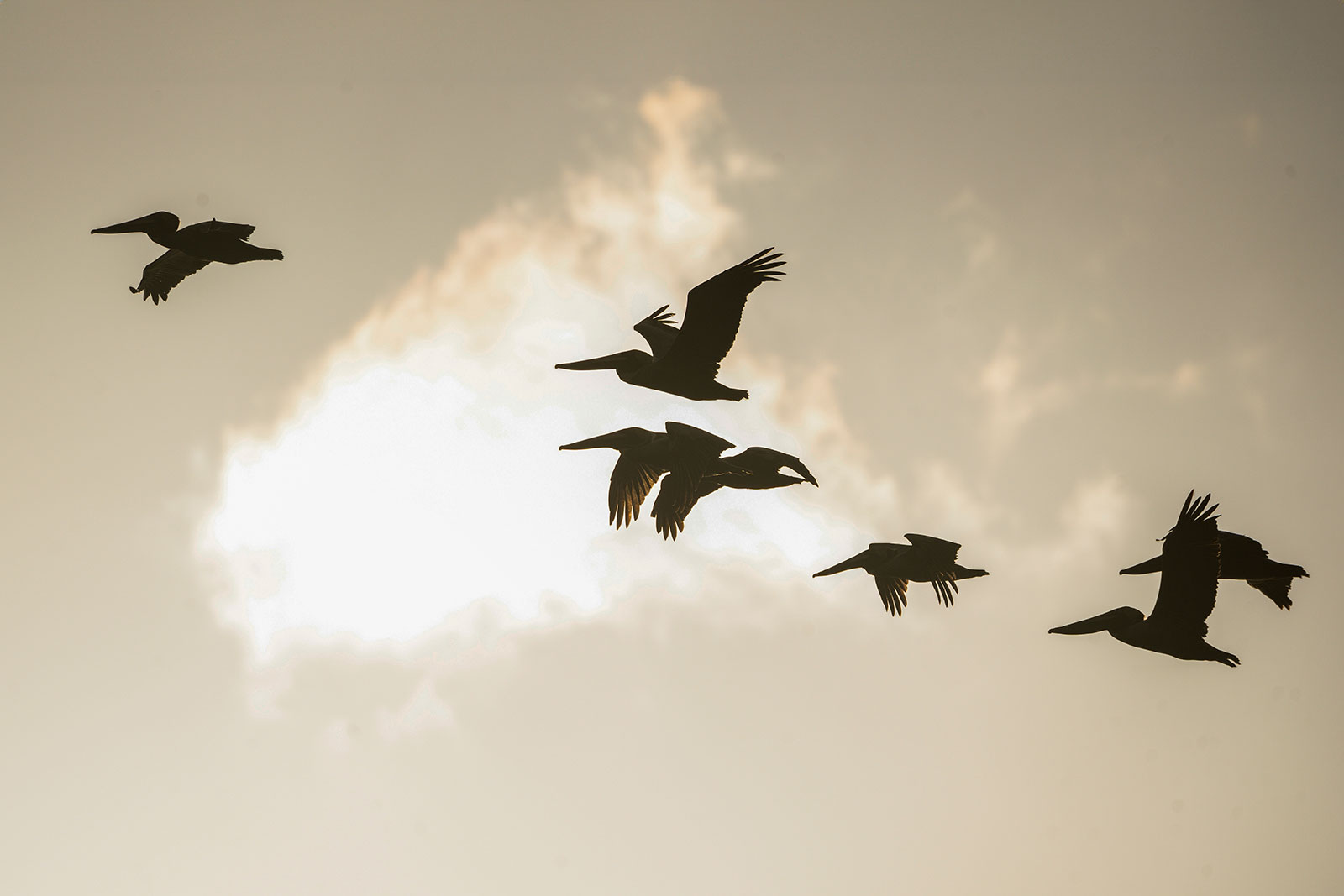
Brown Pelicans
B and I are bobbing in the Gulf of Mexico off the coast of Alabama’s Dauphin Island. White light snaps and flattens on the water. One of us exclaims and points, and the other turns: seven brown pelicans flying single-file pass about ten yards away from us, skimming over the tops of the waves. They move with the inevitability of a home run baseball, a lofting arc that carries my breath with it as might turns to will. I can hardly believe these are the same goofy-looking birds that perch on pilings, pouched beaks slopping over their torpedo bodies.
It’s the summer of 2021, and we’ve joined B’s family for a vacation in a rented house just steps from the shore. When the virus first hit, I wondered if I’d ever see a beach again. I’m so exhilarated to be close the sound of the ocean, the thick salt air, and the somnolent, baking sunshine that I want to crack open my chest to have enough room to let everything in. We’re in the sliver of time between the vaccines and the variants.
The Cornell Lab of Ornithology website notes that brown pelicans are “an excellent example of a species’ recovery from pesticide pollution that once placed them at the brink of extinction…. In the mid-20th century the pesticide DDT caused pelicans to lay thinner eggs that cracked under the weight of incubating parents. After nearly disappearing from North America in the 1960s and 1970s, brown pelicans made a full comeback thanks to pesticide regulations.” These days, I try to hang on to any examples of human beings successfully turning our own ruinous stupidity around.
For the past year, every day has felt like some awful new edge of history. Our life shrank to the walls of our house and the borders of our screens. We hoarded and wept and tried to love each other and everyone else better. I took countless walks around the neighborhood that kept me from going off the deep end, but didn’t comfort me much. Even now, everything still seems contingent. It’s hard to imagine very deeply into the future—at best, I let my thoughts hover cautiously over it.
We watch as the squadron pushes further away from us, parallel to the beach. B’s goggles hang around his neck, intermittently scooping up little sips of water in their plastic cups. He once said that if he ever got a tattoo, it would likely be of a brown pelican. I try to picture the Audubon print we have in our living room superimposed on his bicep, dripping and a little blotchy from the sun. It would look so safe there. The thought makes me want to believe that Someday isn’t just a weak little wish. That a path back to the world the pandemic erased is still out there. Where other people’s bodies could be something besides matrices of danger.
We keep watching that line of birds, buoyant and absurd, receding to smudges in the distance. They don’t seem as though they’re capable of contemplating calamity. They go on rowing smoothly through the air, believing in the water and the horizon.
 Nicky Beer is a bi/queer writer, and the author of Real Phonies and Genuine Fakes (Milkweed Editions, 2022), winner of the 2023 Lambda Literary Award for Bisexual Poetry. She has received honors from the Guggenheim Foundation, the National Endowment for the Arts, MacDowell, the Poetry Foundation, Ragdale, and the Bread Loaf Writers’ Conference. She is a professor at the University of Colorado Denver, where she is a poetry editor for Copper Nickel.
Header photo by PIC Femke Ketelaar, courtesy Shutterstock.