
When you don’t belong anywhere, you belong to the others who don’t belong.
Sixth grade, everything changing, as everything always is, as my mom used to say, but morphing on speed, hyper lapse. That’s when I discovered Therians on YouTube. Yes— YouTube, Tik Tok, the eye roll-i-ness of that, but think again. Think of the influence. I was never interested in social media and online stuff, any more than I was for makeup and high heels, fashionistas— even as my best friend, Esme, took to wearing her long brown hair shiny and straight, brushing a thousand times before bed, smudging a smoky blue eye pencil along her lash line and a pink gloss across her lips (that to me looked like glue), and, once inside the school doors, squirting, from a teeny spritzer she kept in a Ziploc baggie, something scented. Something ick. Well. “I like the way you smell,” I’d said, when she showed me, extending a delicate wrist for my sniff. “All the time,” I’d stuffed in, quickly, because who was I to reject an arm stretching towards me? Now, when so much of her, so much of life, was pulling away? Esme’s parents toying with a move to Boise, my body stubbornly the same-ing—as everyone else shot like cannons into places beyond, leaving only smoke. I liked Esme better without it all. I liked us better before it all.
But on YouTube, I found this life, other others, as Esme began spending more time with the non-innocent layered-hair girls, with their exposed baby-belly midriffs and the pillows I heard they molested with smushed faces, training to kiss. I found this: Community. Therians. Therianthropy. Go on, google it: People, kids, who feel animal in their identity, who connect to animals in spirit and non-physically—psychologically. You can’t choose it. You are, or you aren’t, one of us: kids who make animal masks, and, with their linked animal spirit guiding their hands, craft ears, attach fur, tie tails to waists, and leap in the grass on all fours.
You can laugh. Now. Just laugh.
Do it.
Or flinch. I get it. You’re not believing, you’re looking at me, these words with their spiky strange air, repellant in flavor, the kind your anthro brain evolved to sense and steer from, dangerous. I get it. You want sugar. Normal. Safe. Not “Therian.” Your mind runs off to sexual kinks. Furries, you think.
When I found Therians online, I found where I fit. What can I say to explain it, but—when you don’t belong anywhere, you belong to the others who don’t belong. God, before then I thought Esme and I were the only ones in the universe, and honestly, Esme seemed to be turning her back on it—if it ever was truly in her. I thought I was wrong, the only wrong one in the world, and God that smacks of narcissism, but I mean in the worst way, I thought I was wrong in every way, I thought my body a farce, my face a strange applique. I was a sound no one wants to hear.
They called me an “innocent.” The cool kids. Or—the cool-er kids. It was a small Boulder private school, after all, so kind of hard to clique off with sharp dividing lines; it was more like ombre shading, the way the seven girls in the class went from dark purply adult to in-between watercolor berry, washing all the way down to my pale, pastel lavender youth. Wasn’t sure if that was bad, being an “innocent,” but it seemed so; even the non-innocents got called that sometimes too, so that made me feel a smidge better, maybe? Was it a dig or a collective joke, I wasn’t sure. To be honest, I lied to myself then, just as I lie to myself still, just as we lie all the time, to keep the peace within ourselves, I guess. When I think back to the dark violet Vanessa pointing at her best bud, Maeve, cackling that word—Come on. It was an epithet, an accusation, a crime to be guilty of: Innocence. I was still a child. I only played at being a teenager; I could still reach back, connected as if on belay, I could follow the switchbacks all the way back to my still elastic childhood imagination, face up, there, a dead man’s float in its amniotic sac. I kept a smidge of the fontanelle; I was not yet hardened. I could rub it like chalk: Access. I had access.
Esme, though—my raft between human and animal DNA—we could head to our favorite spot, a clearing hidden by a copse of trees, a snake of a tiny creek, out of sight from the rest of the park. We needed open space. We needed privacy. Boulder gave us both, but not necessarily together. But oh! This spot. Our secret space, off the trail. Not dumb, I didn’t want to be mocked. We wanted to don our true wildness, but alone, together, masks and tails, genus—me, a wolf, Esme, a fox—and lope and jump and snarl on all fours, leap hands forward, fly, feral. Mark our territory. Sweaty, bruised, and riotous: it was love.
Looking back, we’d stunk of alive-ness. We stunk, the way this 1800s New England college campus wakes frosted in notes of maple syrup and stiff-collared colonists on horseback. Here, there would be no domination of social media and Threads, Twitter, or X or whatever, nothing like that could stop this crushing on low ceiling-ed old buildings, church-y wood floors—ah, that nostalgic yet dystopian allure of buildings from before the ADA, the thrill of paper you could crumple in your hands and inhale, along with ancient smoke from the wood burning stove (still there). The air here: it holds onto wet. The conditions, ever ready for new. Oldness, for sure, but nothing like this place ever felt so open to now: analog and paper, yes, but with pronouns and pansexuality. As if by owning history here they never felt the need to hold on to it tight.
So, before I go on, know this: When you can’t be who you are everywhere, you fight for where you can. Furries, you think. But no.
That’s what he called us, by the way. That day.
“FURRIES!”
Esme and I were thumping around, paws first, all fours-style, in the sport we called “quadrobics.” Go on. Giggle. Doubt. Wrinkle that nose, but videos abound online. We filmed, but never posted. My mom, a mindfulness teacher and writer, did not allow it, even as she tolerated this exploration. “Invite it to tea,” she would say, like a stormy mind state. Perhaps it would change, like the weather, this animal endeavor. She would never say, “phase.” Not when there was a Buddhist term to say the same thing.
Just a few weeks before, at the doctor for annual shots, they’d asked me—God it hurts my ears to write it—they asked me:
“Have you started your monthly—”
“No!” I said.
“Well,” my mother said, “you are changing. I remember when I was…”
“I’m NOT you,” I said, eyes to my shoelaces, undone and charcoal with dirt. I would have said it, no matter what she’d said. “And anyway, I don’t have a chest or any of those things.”
“You’re right, you’re not me. You’re you. But Wren,” she said, “you are different. You don’t look like a kid anymore.”
“FREAKS!” he hollered, his face splotchy red, his hair milquetoasty, all skinny limbs and scabbed knees, like a puppet of mismatched bones.
I didn’t look like a kid that day, near the park, with Esme. I was full wolf, Canis lupus, furred fingerless gloves, a tail, a mask—
“FUHHHHHeeeeeerrrrrrrrrIES!”
Esme and I turned, still in our animalian, crouched stance.
Scotty, seventh grade. Same school. Scotty was new, though, moved from San Diego shortly before the end of the school year. There was something rocky about seeing him here, in our spot—like the power cut out. He broke through our trees. Hooted. Pointed.
“FurrrrrrrrrEEEEEEEEEEAAAKKS!”
“I think he followed us!” I whispered. Emse made a face, like she was happy? Then her eyes widened, mortified. She ripped the mask off her face. No more orange button nose.
“Oh god,” she said. “I don’t want him to see me like this.”
“Who cares what he sees?” I let loose a “HOWooooooooWUL,” clawing the air with my fuzzed paws.
“Stop!!” she whisper-hissed. “I think I do,” she said, slowing her words. “I do,” she said again. Standing up, now, on two legs. Mask off, stuffing the tail wound round her waist up into the back of her hoodie.
Too late.
Scotty materialized, across the skinny wind of creek, further down along the row of trees.
“FURRRRRREEEEEEEZ!”
“Let’s go,” I said to Esme, standing myself, reluctantly. “We’re not furries!” I shouted, back over my shoulder to Scotty. It’s a common charge, a pedestrian misconception. Furries—that’s something different. A sexual kink community of some sort. Therianthropy is about identity and spirit, not cosplay for sexual kicks. I scrunched my nose in a snarl, clawed a paw in the air. “God, if only we could find a moose to hunt, not this—bullshit.” I gestured to Esme, cocking my head towards Scotty’s tics. Then Scotty, laughing, loped towards us—poorly, by quadrobics standards—exaggeratedly and unevenly, his baby teenage limbs not fully under his power, wagging his tongue at us—no, at Esme, really—casting an arm towards her, from across the teeny stretch of the shallow creek.
Esme flipped her hair, dramatically, then rolled her eyes at me, but more at him and said, “Let’s go, Wren.” Another flip.
“FREAKS!” he hollered, his face splotchy red, his hair milquetoasty, all skinny limbs and scabbed knees, like a puppet of mismatched bones; his skin emitted a foul, moldy stink to my canine nose—ugh! He began lunging closer, and I felt it, God, my human self winding up to kick his peachy butt, but—then. Oh then. It hit me. Heat. My ears pricked: a threat bubbled, leaping through me. I saw something sail through the air, towards Esme, towards our everything, and that—that was it. A switch, flipped.
Animals, we think, obey order. We forget the order doesn’t start with us. Animals do not answer to a manager at the theme park who can fire them for poor behavior such as eating your azaleas or goring a selfie-aggressive influencer who really wanted a picture of her butt.
The moose you encounter does not want a muffin.
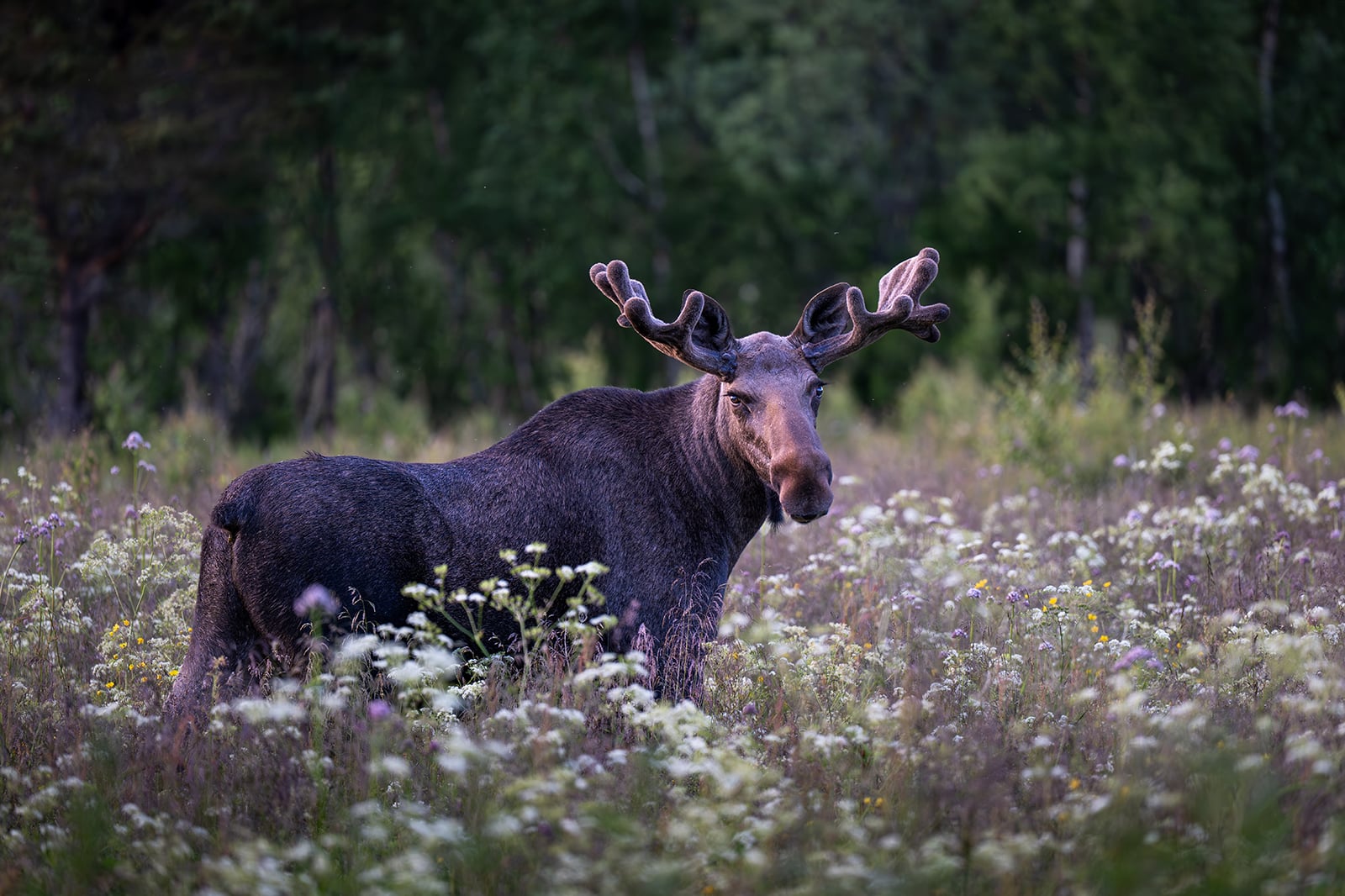
My tail. It swished. I knew it before I saw it. I knew this would happen; I called it. The moose, a bull, his antlers like a chandelier, appeared through the trees. For me. He came for me. The wolf’s natural prey. He came. He stood behind one of the branches, gnawing at leaves, unbothered, positioned on the same side of the creek as Scotty.
Esme saw the moose, looked at me. She knew. She knew. She knew. She knew it was me. All me.
Esme had looked at me like that years before, when we met, both age four, in Montessori school, the kind where little kids roamed outside and built things in the dirt with nails, the kind that parents think is sweet and progressive but also requires a huge waiver and likely violated building codes. Our lead teacher, an ageless, earthy woman full of fermented kombucha vigor and feminist theory, taught us about a Native American ritual to make the sun rise. European settlers, she’d said grimly, a long silvery braid trailing down her spine, they’d laughed when they saw it. Called it crazy. Esme and I had looked at each other then, dumpling-faced and solemn. And what they did, those Native people, is they recognized themselves in the smile of existence, they spoke to it, they brightened life somewhere like lightning bugs, all of them, even in each other, and—look at us now. Look at our sun. Are we so sure that those people didn’t make the sun rise, in a way we are not? Esme smiled, and I smiled back.
Yeah, so—Esme knew.
You don’t believe me. But I bet you believe a lot of things that you cannot possibly know. That the sun will be in the sky, that the moon will keep cycling and the water you dump into chemical-laden lawns will always run from the hose, that your mother is someone you can take for granted and ignore calls from, that when you pick up the phone to call her, she will still be there, instead of an endless ring or dial tone. You believe in best friends forever. You believe in yourself, in a world containing your mother. You believe in plans and pensions. You claim to know that you could die. But you don’t really know that. Not in your lungs.
So believe this.
Oh shit. I saw it all before it happened. I saw it before the moose stepped into our vision, I saw it all. And I didn’t stop it.
Scotty craned his neck to look at what we’d marked, the moose munching leaves, about a room’s length behind him. Oh Scotty.
He did the teenage boy version of what drunk non-local men do on videos posted online. He forgot his place. He forgot what he never knew. That moose owned him, I guess.
“HEYYYYYYYYY mooooooooooosie! You wanna muffin?”
Again, a stick sailed through the air. Oh Scotty. Hitting the bull’s back haunch. The moose looked up. Stopped mid-munch. The moose looked at me. He knew what I was. He looked at Scotty. He saw what he was, too.
Oh shit. I saw it all before it happened. I saw it before the moose stepped into our vision, I saw it all. And I didn’t stop it. I didn’t run, I didn’t leave, I didn’t do anything, even though I did it all. I believed that. I still do—a belief grandfathered in, before rationality straightedged the fuzziness of wonder, the way I just knew me and Esme would be me and Esme, the way I knew when my mom told me: I was already inside her ending. I can’t un-believe it. I can’t un-know. That day, I didn’t move; I let the wobbling scene find its teeth in our faces. But eventually, my other me, my Wren, wriggled to the surface, screaming:
“Scotty! RUN! Up that tree!”
I’ll never understand why a boy showing off is about making himself look as dumb as possible.
So Scotty, oh Scotty, stayed put: “Look,” he said, “he’s looking at me he’s—”
Another stick, air—
Charged. The electric current. Charged. The moose—
“Get him” is all I heard in my muzzle, like the local Montana guy heckling in that YouTube video I’d seen. He’d said it to the moose. Not the drunken men who’d messed with it.
I didn’t have to say it. The moose was already getting.
Fourteen hundred pounds. The animal is 1,400 pounds and can move at a speed of 35 miles per hour.
Scotty, the human, 92.1 pounds; in his dreams—more like 100. He could move at a speed of six miles per hour, if he tried— eally tried.
Scotty tripped and fell, limbs still running, a lassoed explosion. His legs looked like a Salvador Dali painting. I closed my eyes. I closed them to what they already knew.
I could tell you what was happening inside that boy. It’s something humans know, in death, in childbirth I guess, or gripped in a diagnosis or plane crash: the sharp knife of a nothing-but-this—that Now—held to your throat. I could tell you that in an instant, the tantrum ceased. Sticks, from the clutch in his fists, rained like eggshells into dirt, joining with creek water to run, Scotty’s breath dragging behind them—his body, a hunk of glacier held at gunpoint by ocean. The present moment there. There. There—the only thing there; him, inside each present because—that’s all. All. A burst of hot red drums and then: a succumb.
I could tell you because I was him.
I could tell you because I was also the animal above him.
I was—
I owned it, I guess.
I opened my eyes, looked over at Esme, frozen in her spot. “Run!” I mouthed. “Call for help!” Esme took off. And also, away. Away from what, I don’t know. Maybe me.
I stayed. I stayed to witness what I started. Glorious, afire, pickling with life: I stayed. Unafraid. My only power.
Don’t move, I told them, no more.
The moose stepped back. Most charges are bluffs.
Well. This was more than that.
I bounded to the ball of Scotty. “Don’t move,” I whispered. “We’re getting help.” God, if only my mom would’ve allowed me a phone, I could have texted her, I could—
If only I could text her now.
You still want to know. Was this fantastical or wishful—what category, really? You want to know. That’s the adult in you, whether you’re 15, 21, or 52. You want that moment in the woods calcified with taxa, rational explanation, crusted in anthro dust and mortgage payments, then sent back to play with a chirpy “You’re okay!”
But everything about that time is soft, clayey, shape-shifty; even under the weight of time, and now: letters, font, and punctuation. I cannot fire it into hardness, even today. Maybe I can’t tell the story like that because it would mean translating into solid things that only exist in liquid, a yank from the womb, something that floats in the amniotic sac. I do know this: I didn’t move from my spot, physically; to Scotty, I did nothing. But I believed, then and still—I can feel it: I did everything. When you know it’s not your fault, but also, it is. It is your fault.
Everything changed after that day. Esme moved into deep purple hues, and then away, to Boise, Idaho. I got a phone, but I could no longer text my mother. Not after the diagnosis and all that came with it. I sometimes think that was my fault too. But for this assignment:
That day. The bull, standing over Scotty. Well.
I never wore a tail again.
I left the Therians. I hardened. I no longer had access. So I started wearing lip gloss that looked like glue and brushing my hair, couth and kempt, a hundred times before bed. I kept a spritzer of perfume in a little Ziploc baggie.
I guess we all wear a mask.
A few years after that day, I had surgery on my tibia, and in the sticky butterscotch of anesthesia pulling up and away, I felt it—what my dad and stepmom later said was a soft, plush wolf stuffy pressed into in my hands by a nurse; in that moment I fathomed, in the fur of a waning chemical sleep, the bardo winking between lives, between species, between galaxy clusters and atomic nuclei. It reached for me, and who was I to turn away? Who was I? Who is anyone, really? Inside that peephole I roused, encircled by my den, my mother’s warm body pressed near my head, electrodes still on my chest, hooked up to monitors, nuzzled by my pack, by breath, accepted, in that creamy, post-hunt nap, in that nothing-but-this, that now, that there; a moment when I belonged to all the worlds at once.
Do you know this? One day all—me, Esme, Scotty, my mother, those kids throwing a frisbee outside my dorm window—all of us down to the moose and the first amoeba in the muck, we’ll sink into the loam, folded in and in, all the worlds furred together, Russian dolled into oblivion. That day with the moose, oh, believe me, I got it: The power you own. The void, nipping at your scruff. That’s the moment I lost it. The fontanelle set, hardened. No access beyond this point. No more innocent.
 Jean Marie Hackett is a writer, yoga teacher, and recovering lawyer in Park City, Utah. She graduated with an MFA from Bennington, and her work has appeared in Passages North, Hobart, and CutBank. In 2022, she won the short fiction category of the Utah Original Writing Competition.
Header photo by xiSerge, courtesy Pixabay. Photo of Jean Marie Hackett by Tara Sylvester.