
How do we mourn the loss of creatures who exist outside living memory?
The avian news world fluttered alive a few years ago with the latest argument over the ivory-billed woodpecker—a large, charismatic bird found in old-growth longleaf pine forests—and whether it still exists. It survived, at least bureaucratically. Although the last agreed-upon sighting was in 1944, it remains officially “endangered” in the United States.
Lost in the news were another ten birds, however. Declared extinct in 2023, they are by far the largest group of birds to reach such a fate, delisted from protection under the Endangered Species Act. Like many now-extinct birds, they lived in remote places, confined by geography or specialized habitat.
I painted each bird alongside small objects inherited from my grandparents, and all perched atop my grandfather’s nightstand. These artifacts evoke both loss and displacement. My grandparents lived their lives in South Georgia, and when I was a child we’d drive down to visit every month from suburban Atlanta. I haven’t lived there for 30 years, though; my grandparents’ communities, and the South more generally, are places to which I feel pulled but no longer fully belong.
The incongruity between them—my grandparents’ things and these tropical birds—explores this tension between loss, belonging, and disconnection. What does it mean to bear witness to the death of these birds? I have struggled with how to tell their stories, not least because I’m not sure they’re mine to tell. What does it mean for me, or other North American birders, to mourn the loss of birds from other places—places connected to me, in Minnesota, largely through my country’s military and economic colonization?
I can imagine my distant relatives having seen only one of them, or at least heard it. The Bachman’s warbler, a secretive songbird, was native to river bottoms in the American South, having developed an apparent adaptation to southern Native American agricultural practices. With those practices largely destroyed, the warbler’s habitat became too fragmented for survival. Its last breeding area was perhaps a large swamp outside of Charleston, South Carolina, formed on an abandoned rice plantation fueled by the labor of enslaved people. I have painted it alongside my grandfather’s two clip-on bow ties, out of fashion before I was born, which he wore to the fundamentalist church he faithfully attended.
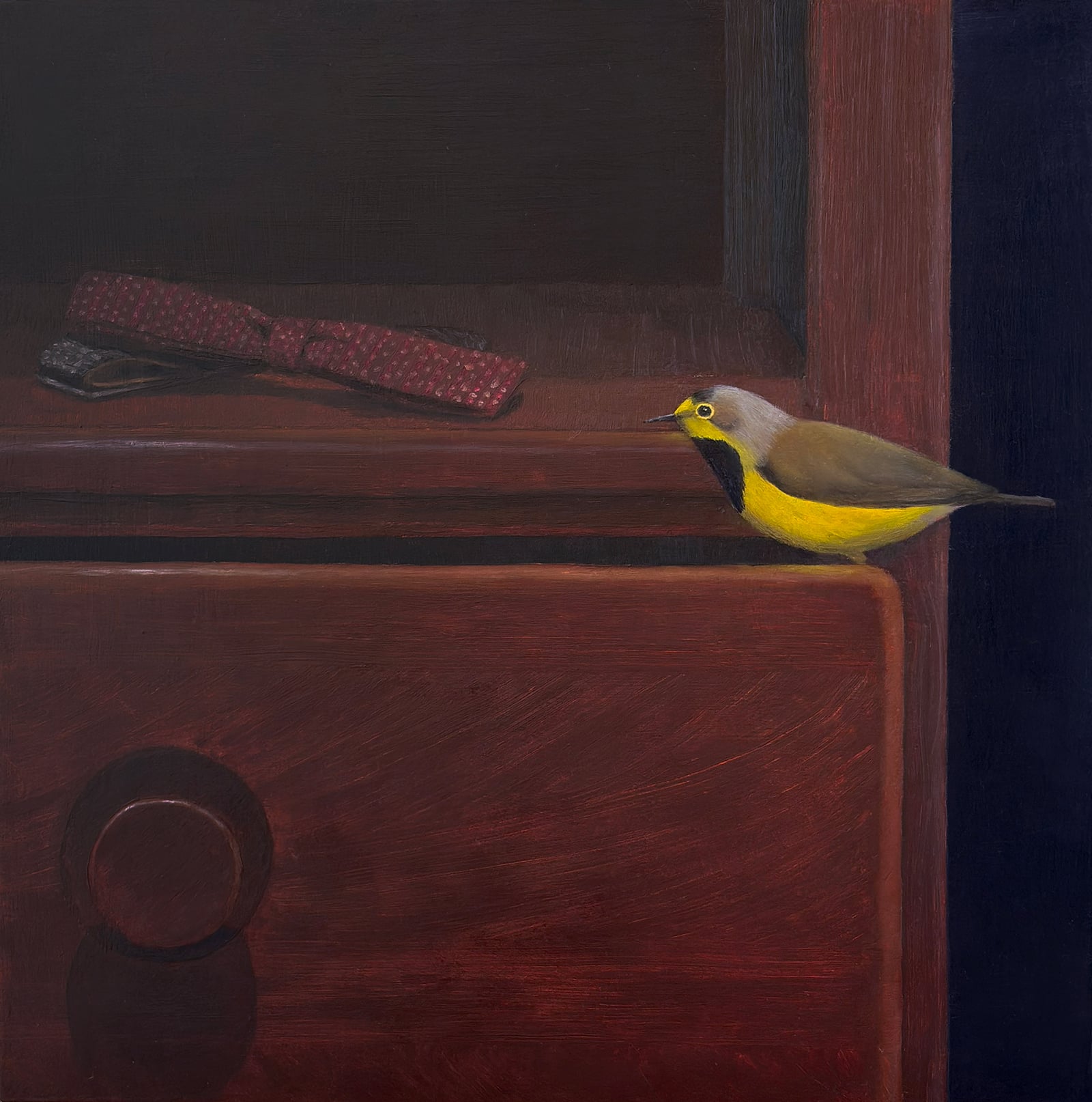
Vermivora bachmanii (Bachman’s warbler). Last confirmed sighting in Louisiana, 1988.
The remaining birds are from more recently colonized places, all islands. The bridled white-eye, or nosa’ in Chamorro, lived on Guam, a heavily militarized island and U.S. territory roughly between Japan and Australia. A few scattered shorebirds can still be seen there—white terns in the urbanized areas along Tumon Bay, reef herons and yellow bitterns where they can nest offshore. There are small groups of introduced, non-native birds—Philippine collared-doves, black drongos, Eurasian tree sparrows, and the ubiquitous feral chickens common across Pacific islands—but even they (with the exception of the omnipresent chicken) are quite rare.
To go birdwatching on Guam is simply to witness an absence. A nocturnal, invasive tree snake hitchhiked to Guam on a cargo ship in the 1950s and has destroyed all of the island’s native land-dwelling birds. There is no longer an evening or morning chorus of songbirds. They are gone: extinct, extinct-in-the-wild (only alive in captivity), or extirpated (gone from the island, but still living in other places).
I painted a bridled white-eye peering over the edge of my grandfather’s Underwood typewriter, on which he wrote weekly Sunday school lessons. By the time I was born, the typewriter sat largely unused in the laundry room.
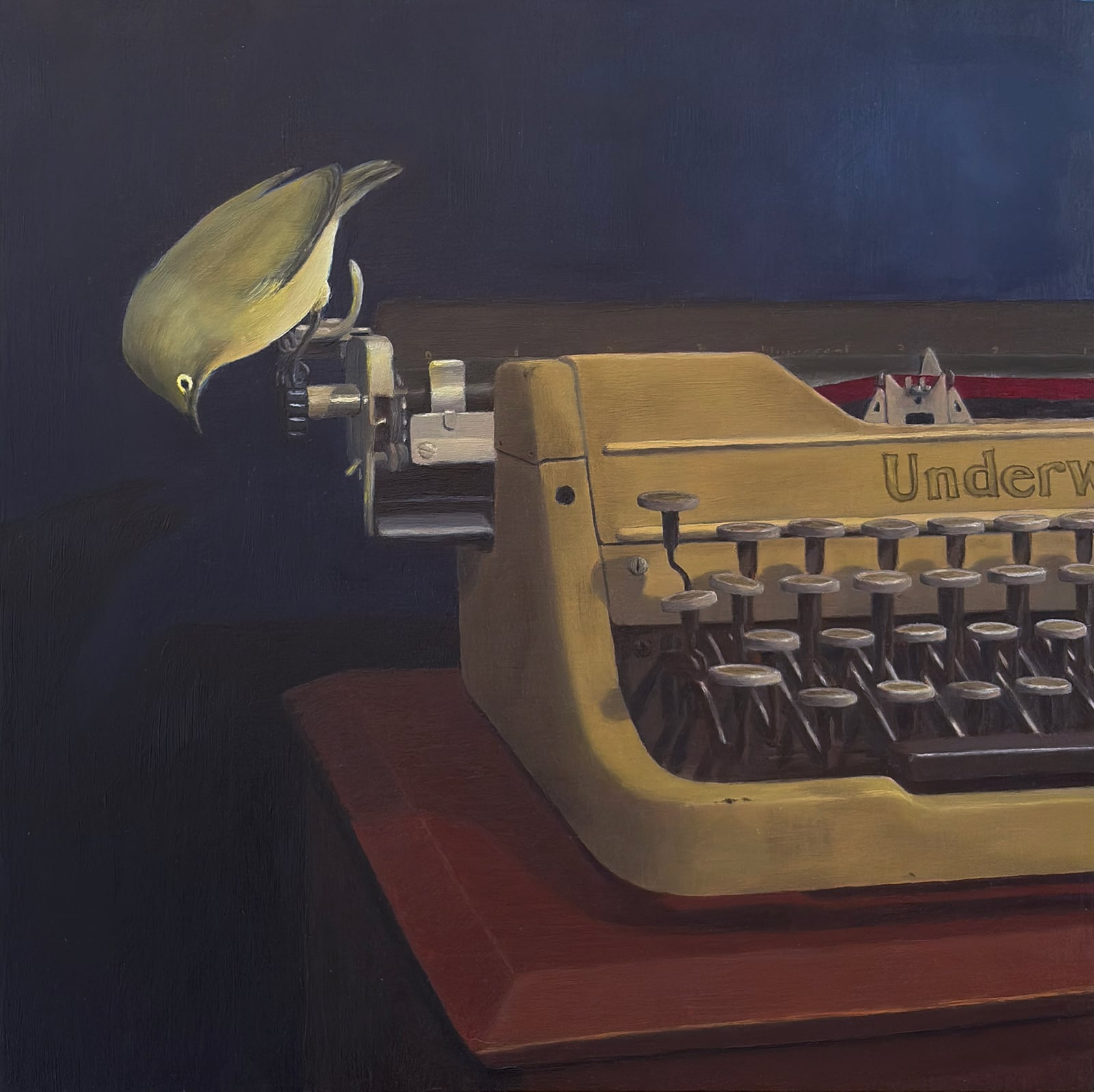
Zosterops conspicillatus conspicillatus (Bridled white-eye, or nosa’ in Chamorro).
Last seen at Guam’s Ritidian Point, in a cliffside forest beneath a U.S. Air Force base, in 1982.
The remaining eight were from Hawaiian Islands (Kauaʻi, Molokaʻi, and Maui), and are among the dozens of bird species to have disappeared from there in the last century.
Hawaiʻi’s birds are a textbook evolutionary example of adaptive radiation, where many species evolved from a few common ancestors blown in to the remote archipelago by ancient storms. New species evolved for specific foods, leading to a spectacle of various beak shapes and sizes, as well as by isolation from each other on separate islands.
A wave of extinction came after two introductions. Mosquitoes, not found before on the islands, arrived aboard a whaling ship in 1826; either then or perhaps later in the century, via non-native birds, the parasite Plasmodium relictum came as well, which causes avian malaria.
Human colonists from Asia and the Americas introduced the new bird species, which had evolved alongside avian malaria and are thus resistant to it. Native birds had no such resistance; the few remaining species are confined to increasingly narrow tracts of mountain rainforest above 5,000 feet—too cold for malaria-carrying mosquitoes, but not so high that the tree line dissipates. The result today is a tragically bizarre avian geography: tropical islands full of colorful birds, but almost none of them native.
All four from Kauaʻi, painted below, were last seen in the high-elevation rainforests of the Alaka’i Wilderness Preserve; the ʻōʻō in 1987, the ‘akialoa in 1965, the nukupu’u in 1899, and the kāmaʻo in 1987. Two are perched atop a small, decorative glass bowl that belonged to my grandmother, which had sat in her home in Jeff Davis County, Georgia (named after the confederate president).
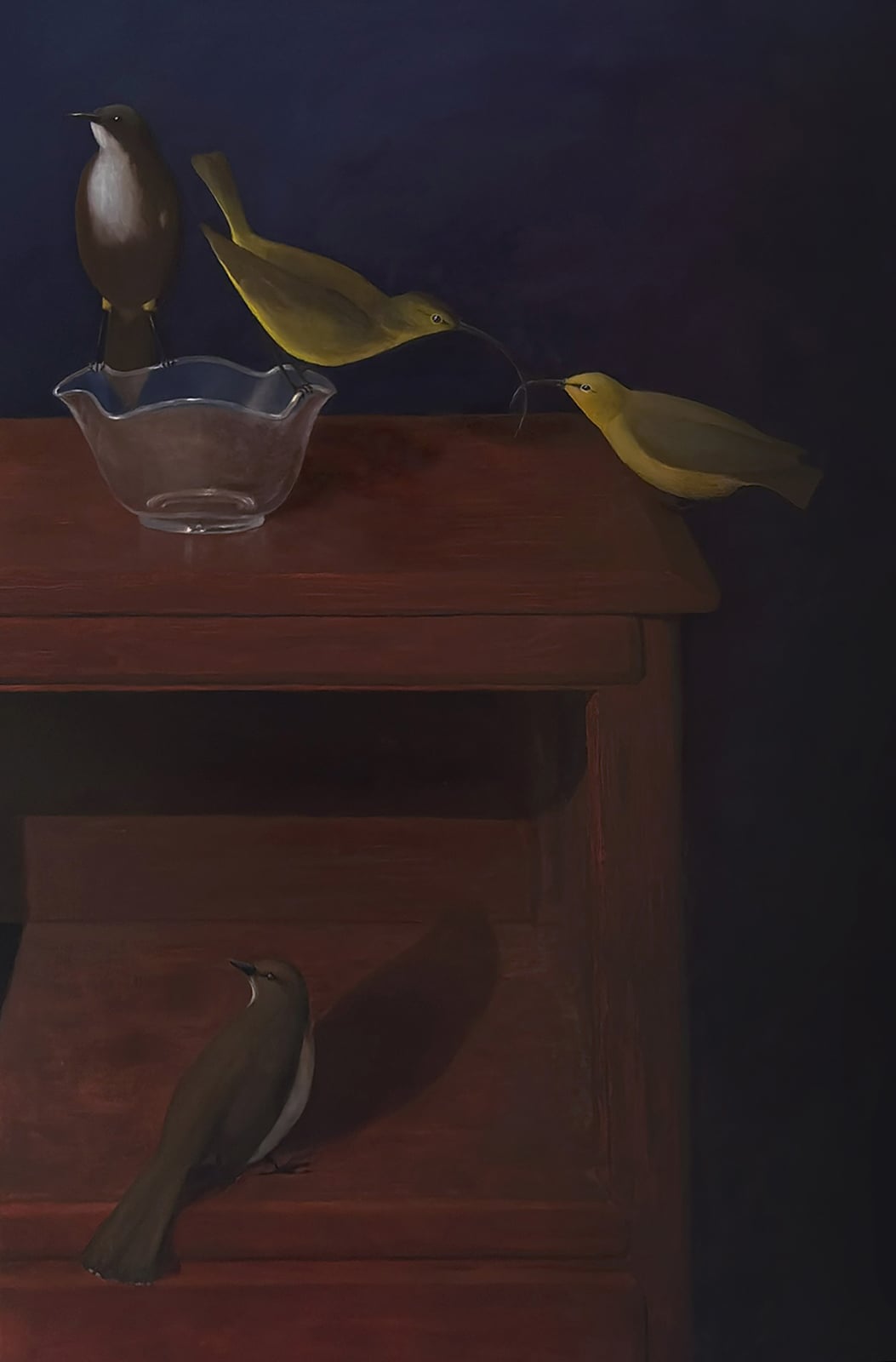
Clockwise from the upper left: Moho braccatus (ʻōʻō in Hawaiian), Akialoa stejnegeri (‘akialoa in Hawaiian), Hemignathus hanapepe (nukupu’u, in Hawaiian), and Myadestes myadestinus (Large Kauaʻi thrush, or kāmaʻo in Hawaiian).
Three birds from Maui were declared extinct. They were last seen in field surveys in the remote, largely inaccessible forests of the Hanawi Natural Area Reserve, on the slope of Maui’s Haleakalā volcano. The last ʻākepa was seen in 1980, the last nukupu’u in 1996, and the last po’ouli died in captivity in 2004. I’ve painted them sitting on that same grandmother’s quilt; her home, though in the Deep South, could get cold in the winter, and her quilts hold up to our long Minnesota winter nights.
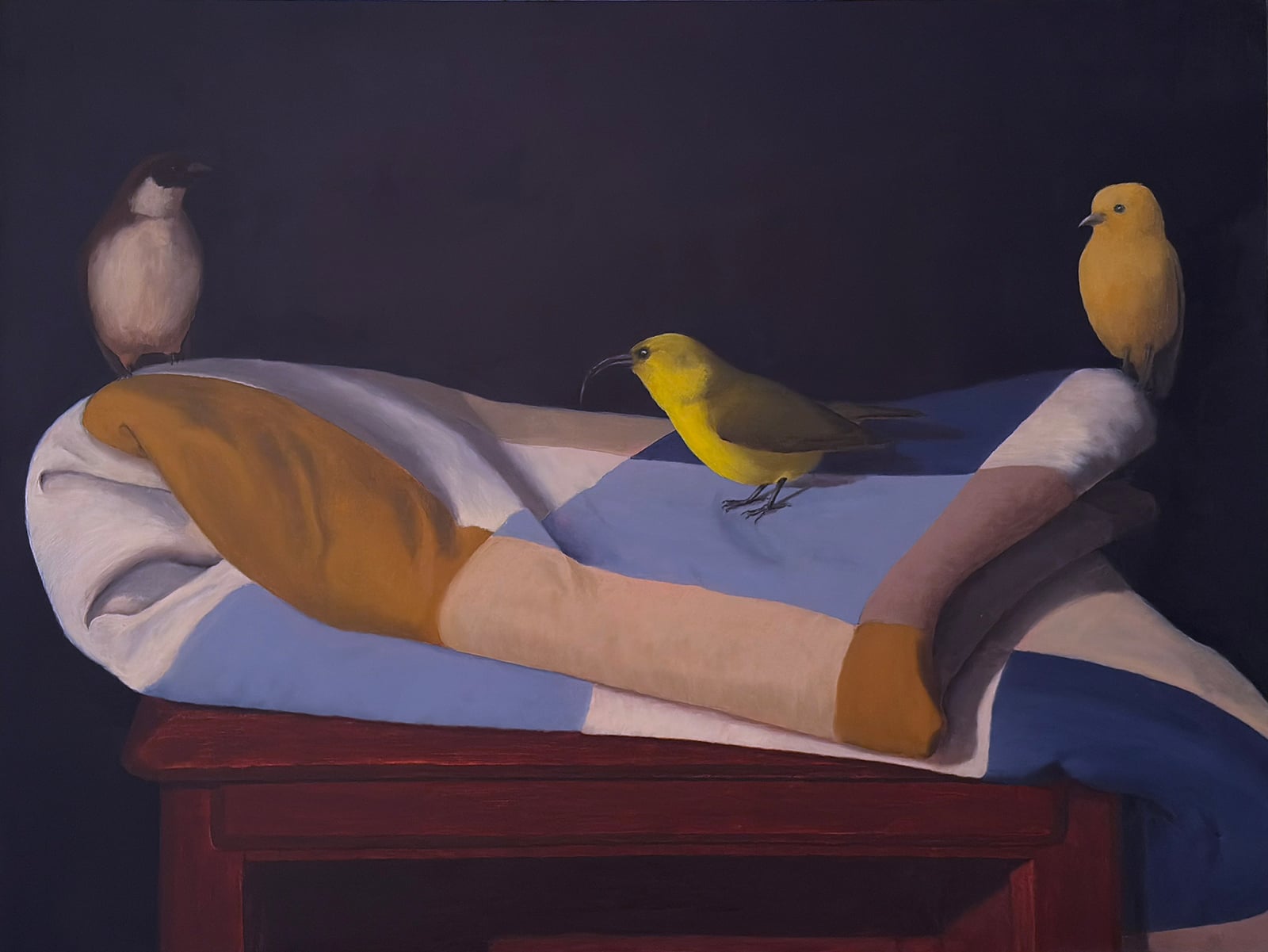
Left to right: Melamprosops phaeosoma (Hawaiian black-faced honeycreeper, or po‘ouli in Hawaiian), Hemignathus affinis (nukupu’u in Hawaiian), and Loxops ochraceus (ʻākepa in Hawaiian).
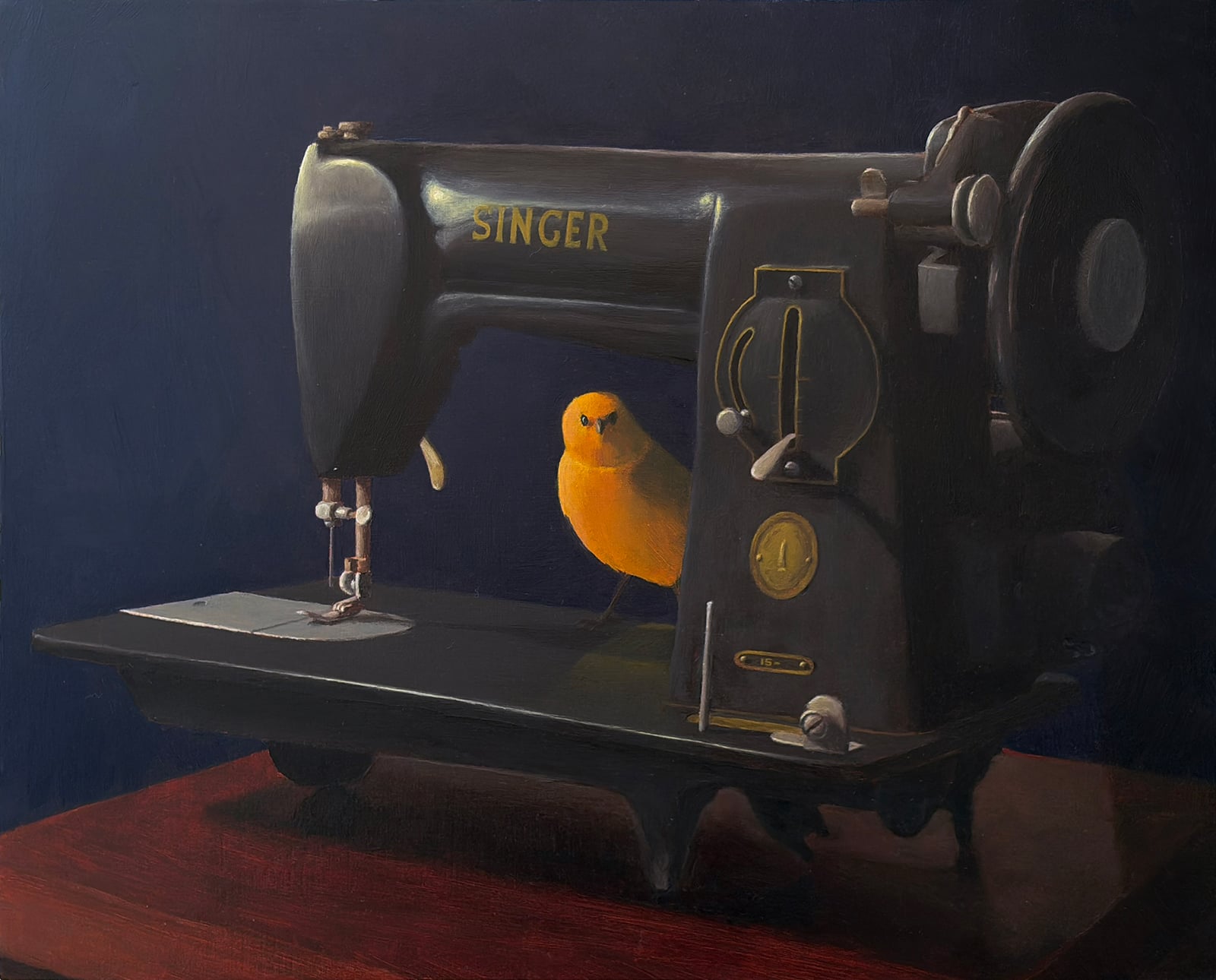
The final painting in this series is of the Molokai creeper, or kākāwahie in Hawaiian. It was last seen in 1963 on the west rim of Molokai’s Pelekunu Valley, a place accessible only with a good jeep on a dry day. It’s peeking through my other grandmother’s Singer sewing machine. Pieces of the machine are now missing and the leather belt rotted away, but she still used it to mend clothes in my early childhood.
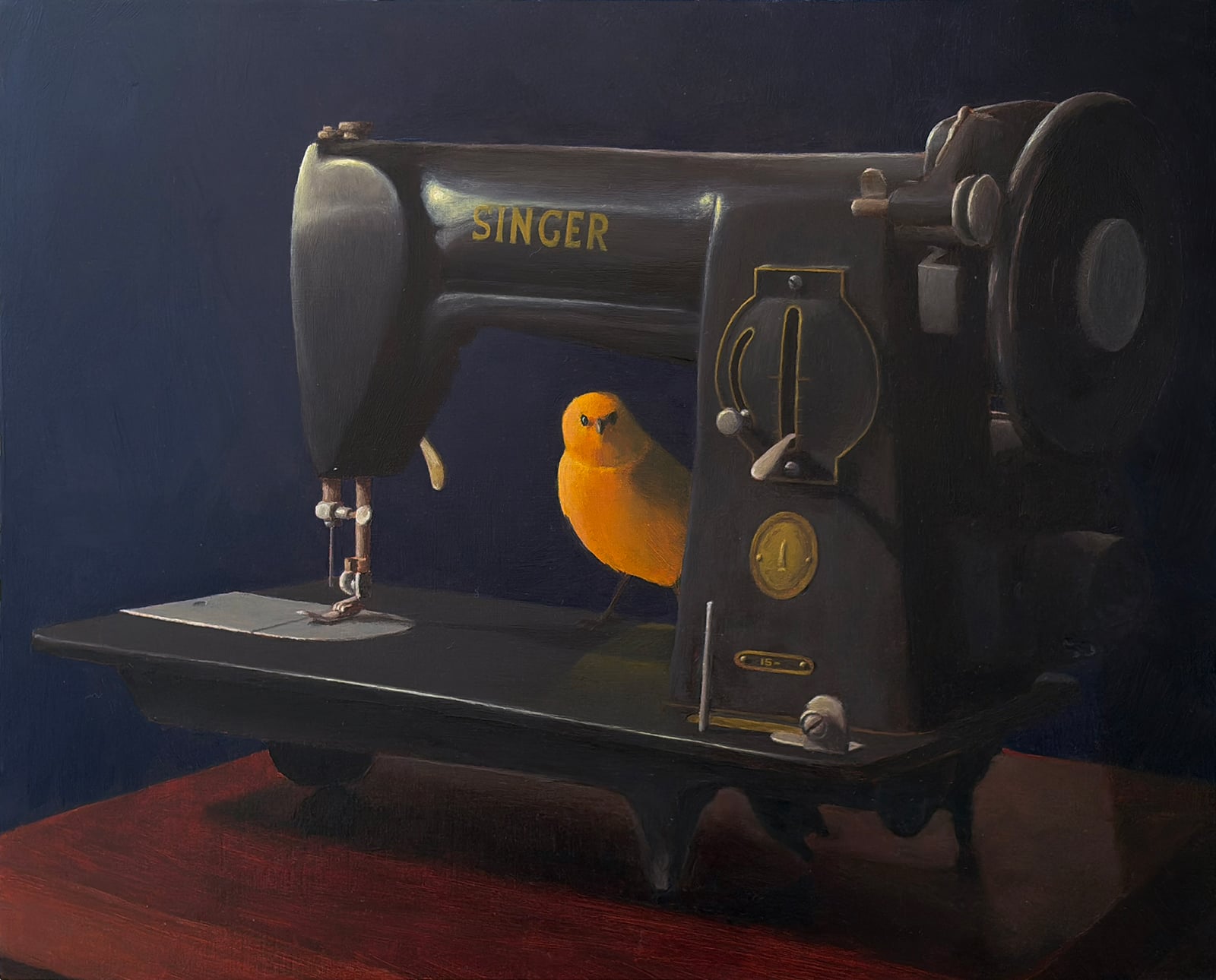
Paroreomyza flammea (Molokai creeper, or kākāwahie in Hawaiian).
About the Artist
 Richard Bohannon is a painter and printmaker based in Minneapolis, and a professor in interdisciplinary studies at Metro State University. His work explores themes of environmental loss and impermanence.
Find more of Richard’s work at rrbohannon.com and on Instagram @rrbohannon.
All images by Richard Bohannon. Header image: Kākāwahie with Granny’s Singer.