
Somehow everyone knew that whatever story he was telling ended with us all looking bad or pitiful. And we were tired of looking bad and pitiful.
Here’s how hot it was when Noor came to town. Kids didn’t ride their bikes in the street, even though it was summer and we were poor. Frogs died by the dozen on the blacktop, their feet sticking up from the tar like little broken kites. The tall grass turned to brown dust in our hands. People fried eggs on their truck hoods, then left them there to crisp and blacken when they realized they’d forgotten butter. The river was dried up. This hadn’t happened in 80 years, although the fact that it had happened before was ammo enough to shoot down the doomsayers and then sit back in your shade and endure Hell smugly, if that was your disposition. But it really was dry. Rain came, once, though the droplets never reached ground, blowing away from town like a silvery locust swarm in search of better food. There were no flowers that summer. The bugs were very loud. Although the bugs were always loud I guess, especially outside my window, where a big catclaw bush kept me from escaping in the night and gave the katydids a nice opera house where they screeched and screeched and screeched, the only devils that didn’t care about the heat. Noor had moved into the house across from mine, and I’d stay up many nights watching her orange bedroom light through the thorns, heavy like a fruit, wondering what she was getting up to away from me.
Her daddy was something called a “long-form journalist,” which basically meant he told big stories about people and places. He wasn’t shy about what he did, walking around with a tape recorder and a fancy pen that needed special ink bought separately, which he let the rugrats play with and pretend was a little gun to kill each other with while he tried to get their parents to talk. He was quite nice. Folks didn’t trust him. He was brown and smart, though a different kind of brown and smart from Johnny Ramirez who was our mechanic and a pretty good one too. It didn’t matter that he respected us and was interested in us. Somehow everyone knew that whatever story he was telling ended with us all looking bad or pitiful. And we were tired of looking bad and pitiful. We believed we could be quite proud, actually, if the world would only leave us alone. When Noor’s daddy came to our wheeless trailer with his big smile and long shadow, tape recorder in hand, my daddy made sure to put his holster on nice and high before strutting over to answer the door, like he was John Wayne in Chisum. He didn’t open the door, though, even though John Wayne would’ve. Sorry, was all my daddy mumbled, peering through one raised blind. Don’ wan’ to let the heat in.
Noor was a different story. Noor didn’t seem to care that she was here, or that all the kids at the pool talked smack about her RBF whether she was looking at them or not (she usually was not). I was 12 and she was 13, but it felt like she had lived a whole lot longer than me than one more year. Nothing we threw at her could impress her, one way or another—not our cannonballs, not our bottlerockets, and certainly not our Indian-whooping five-starring chicken-fighting shenanigans. It was all old hat to her. Boring. She read big black books in the deep end and spent a lot of time on her phone, typing up long texts to someone. Someone who wasn’t here.
I finally worked myself up enough to talk to her one day, walking home from the pool. We walked the same way, as did some other kids, but they thinned out early and then it was just us two walking in silence for a hot mile to the outskirts of town. As the Texas kid I wanted to seem brave about the heat, but I was a sweater, and a red-faced one at that. Noor always seemed cool.
“So, you like the pool?” I asked, whilst wringing my towel out in front of me. The drops turned to vapor in the shimmering air-skin that coated all the paved earth, rising dead before they even hit the ground. I liked the little coughs they made as they burst, the snap of unravelling. Such waste didn’t feel morbid yet.
“Not really,” she replied, thumbs flying over a text. “But I like swimming. I’ll swim anywhere.”
“Yeah? Where else have you swum before?”
She looked up from her phone to square me with her dark eyes—crow eyes, I thought them as—and then she looked back down again. “All over.”
“Like where?”
“Last place I lived was New York. I was born in Hawai’i though—the Big Island. But I don’t really remember that. I also lived in St. Petersburg and Hanoi. I’ve been to Cairo a few times too. I really like Cairo.”
“Lots of important places,” I said, though I didn’t know where half those places were. I was watching the tattoo on her ribs waggle. A dung beetle.
She shrugged. “My dad says everywhere’s important.”
“Even here?”
“I guess so.”
We had to stop our conversation then. The freight train that cut through town once a month was rumbling past, lurching like a big black caterpillar in our path. It stretched on for the longer part of a mile, oil tanks sloshing, going from the desert to somewhere, shaking screws loose the whole town over as it munched and squealed through us. We walked in silence after that. There wasn’t much further to go.
I don’t remember how, but we started hanging out soon after our first talk. We didn’t do anything interesting at first; I wanted to show her how to fish, but there wasn’t any river to fish in. So we just walked the riverbed, stepping between the mud cracks like awkward egrets, listening to the bugs drone in the dead brush overhead. We couldn’t get enough of that walk. I felt an odd peace with her. An adult peace, maybe, quiet and fatalistic. Like we were two fugitives who’d fallen in step with each other, strangers on the run from the same law. I didn’t know what I felt guilty of, only that heat and drought evoked general images of punishment in my young Baptist brain. There were dogs after us. And no river to throw their scent. Why bother running.I knew the land’s secrets. We lived off of melty dino shit. The sun rose from emptiness and set in emptiness.
“I like this walk,” she said once, staring down the winding riverbed with her crow eyes. “It’s the only place here you can’t see the end of.”
I nodded, staring too. That was exactly it. The comfort of a journey. Of a little furrow to follow. Miss Dowd’s social studies class came to mind, her talks on the pioneers and gold rushes and Manifest Destiny led by that big glowing lady floating just ahead of the covered wagons—the rabid excitement of it all. She’d talked with such a shine about it, like 200-year-old feelings were supposed to be contagious to us, like the gold might still be out there. But I never did understand it. Maybe the wide-open majesty of the plains had felt thrilling to the settlers, but not to me. I knew the land’s secrets. We lived off of melty dino shit. The sun rose from emptiness and set in emptiness. If that big glowing lady had ever existed, she’d gone the way of the river, I thought. And she had left me behind.
“How long you figure you’ll stay here for?” I asked Noor then, suddenly anxious. “In Wayneville, I mean.”
Noor had stopped. She was poking at a dark spot in the mud with a stick. To my amazement, water began bubbling out, a little drink at a time. The air turned it to vapor as fast as it came. Noor scraped some sand over the spot with her foot, stamped it in like a cork, then walked on. I followed like a baby bird. Enough time had passed that I’d given up on my question, but she responded then, out of the blue. Noor generally rewarded patience.
“My dad says we’ll be here at least a year. But sometimes a story takes him longer than that,” she said.
“A whole year for a story?”
“I know. It’s crazy.”
“Well, I guess sometimes it takes that long for things to happen.”
I said this as if it were wise, but really it was just me being hopeful. I’d never seen anything happen before—not in real life at least. I’d been hoping Noor’s presence here meant something was about to change, though. Not that I could have said what it was I wanted to be different, or what I would change it to. I ran my fingers along the exposed bank, feeling the bones of the river, waiting for her response.
Noor was grimacing as she thought about something. She made that face a lot when I brought up her dad, I was noticing. Like she’d bitten into cake that was made with salt instead of sugar.
“He’s a vulture,” she said then. “It grosses me out.”
“A vulture?”
“Like he follows dying things until they die. I don’t like it.”
“Are we dying? Is something happening here?”
She looked at me, disbelief making her face cruel. “Of course you are.”
I went to Noor’s room exactly once. My folks didn’t like me hanging around in a girl’s room, and while Noor’s dad didn’t seem to care at all what his daughter did or didn’t do, I couldn’t help but worry that he’d start caring just in time to hit me. But we were very thirsty after one of our riverbed walks, and my folks were at the rig and I’d forgotten my key, so Noor invited me in for lemon and mint juice. Their house was very clean. They traveled very lightly. There were no chairs in the living room, only two green cushions on the floor like big lily pads, and so I sat on one and stared up at Noor while she got to fixing our drinks in the blue dustless room. The sunlight through the window did nice things to her hair. It was the first time I’d appreciated the sun that summer.I couldn’t imagine sleeping under all that memory.
“What do you want to be when you grow up?” she asked me, stirring the mint with the sugar. It was the first question she’d ever asked me.
“Maybe a wide receiver,” I said, although I really wanted to be a quarterback. “Or a sniper in the Marines, if that doesn’t work out.”
“Marines are colonizers,” she replied offhandedly, dropping big blocks of ice into a glass.
“My brother’s a Marine.”
“Your brother’s a colonizer.”
“No he’s not. He’s coming home when his tour’s done.”
She snorted at that, then came over and put my drink in my hands, the ice already shriveled and slimy from the dry air. I just stared down at it, hot-faced. I didn’t have the words to fight her.
“Never do what your family does,” she said then. She sounded very serious.
“So you’re not gonna be a journalist?” I mumbled, still grumpy.
“Hell no. I don’t want to be sad all the time. I’m going to be a museum curator, back in Egypt.”
“What’s a museum curator do?”
She didn’t answer for a while, and so I looked up from my drink to see that she was crying silently, staring out the window. I had no idea what to do. All animosity left me. “Noor?” I said, grabbing her foot.
“I’m sorry I said that about your brother.”
“Apology accepted. I didn’t even care.”
“Well I’m still sorry.”
She turned and pulled her foot away, then walked to her room. And what could I do but follow?
I was wrong; Noor didn’t travel lightly. Her room was full of things. Smells, first—quilt must and bronze and dried flower petals. Chemicals for preserving things. There were Polynesian sculptures and broken clay pots, a rice hat over a set of combs. Many, many photos. Lots of her smiling with people from all over the world, but also some really disturbing ones: a homeless man crying on the side of a street, dried blood splattered on an adobe wall, a small collection devoted to roadkill. I couldn’t imagine sleeping under all that memory.
Noor had curled up on her bed, which was just a sleeping pad on the floor with a holey tapestry for a blanket. She looked like a stray dog to me. The light here was orange and heavy, like streetlight.
“Noor?”
“I’m tired.”
“That’s okay.”
“I’m always tired.”
“Oh.” None of my parents’ platitudes seemed right here. Go to bed on time. Drink water. If I was older, maybe. But at my age it seemed fair to me that Noor was worn out. I just stayed and sat with her, staring at a picture of a run-over camel. At some point, I’d started rubbing her back. She hadn’t stopped me.
“We should do something,” she said eventually.
The way she said something told me it wasn’t a casual something. “Like what?” I asked.
She sat up. “Something to mess up my dad’s story.”
“Why would we want to do that?” If we messed up his story, I thought, then Noor would leave sooner. But her eyes were alive now, wide; this was the first time I’d seen something like light in her.
“Because if we change his story, maybe the bad thing won’t happen.”
It was my turn to look at Noor with disbelief. This was very childish thinking; even I was old enough to know that our fathers don’t control fate. But my look didn’t communicate anything to Noor—her eyes were focused on something far away, some fire, or some light on some water, and I was at least willing to listen. And maybe even do.
But Noor didn’t say anything after that. The sun set, and the train passed, shaking everything, and then we sat in the dark, watching nothing, listening to the house settle back into itself.
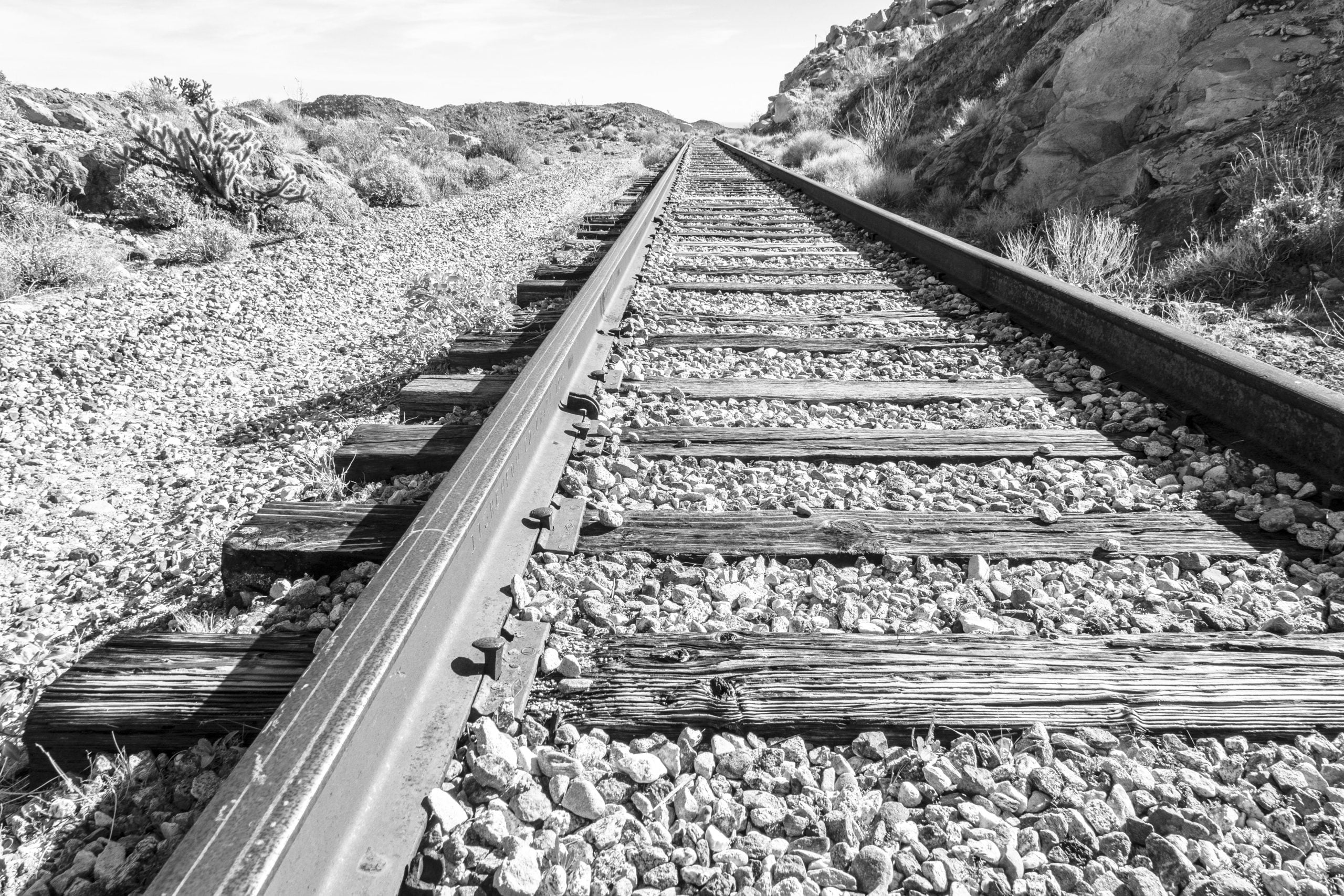
When Noor showed up at my door with a pipe wrench the next day, I already knew what she wanted to do. I also knew that it was foolish and wouldn’t work, but I was bored and with Noor you never really did know. We ate breakfast in silence. Then we went to the train tracks, just ahead of town.Something was happening. Something illicit and wild and promising, and any train could be the last train now.
We tried all different kinds of grips and positions. We just couldn’t get purchase. And then, like magic, one of the spikes came loose. Then another, a little down the track. Eventually, we had five of them piled up in the sand, red from old rain, like giant crucifix nails.
“Think that’s enough?” I asked, nauseous and dizzy from the sun. My palms were slick with sweat and blister blood.
She shook out her own bloodied hands, frowning. “No. Not even close. We’ll have to come back next month.”
“Why?”
“’Cause the train will shake up more spikes then. We just need to do a few at a time. It’ll get easier and easier. You’ll see.”
I laughed at her—she talked like she’d done this before. But she was right of course. Every time the train rumbled by, the loosened tracks wiggled up a few more spikes, and then we would come and collect them like carrot farmers. And the time passed easier too. Something was happening. Something illicit and wild and promising, and any train could be the last train now. And it wasn’t thought-out, but then none of this was—the laying of the tracks, the drilling of the wells, the burning of the fuel. And all the killing it took to do all this. But that was Noor’s rationale, not mine. Mine was much simpler, and therefore burned brighter and faster. I liked Noor, and I hated that train. I hated the dusty clockface I was on, and the dark hand that spun through it once a month, wheeling us fitfully to midnight. I wanted it gone. If I was doomed to live a static life, I wanted to live on Noor’s wall instead, in one of her photographs, one of the glad ones. A fixed point in happy time. Because the dark thing was that I knew that she was leaving at the end of all this, no matter what happened to that train. She was leaving, and I was staying. That was the decree. I couldn’t help being a kid.
It had been four months of us working like convicts on the railroad, and the tracks still hadn’t budged. School had started, and Noor did very well there. She was a grade above me though, and so I only heard stories about her quickness in the classroom, how she wasn’t afraid to answer trick questions or even correct the teacher. She was a challenger. A stink-raiser. Little Miss Enlightened, the principal called her once, to let the stupid parents know he was still on their side. I smiled at these stories, but I was sad at the reminder of the distance between us. I didn’t like that she was ahead of me, if only just a little. We spent less and less time together; our crowds didn’t touch much. In the summer we’d been something like equals, drawn together by our sense of our commonness in God’s grand design. But I had a growing feeling now that we were not common in the same way. Noor was a star and I was a blade of grass. I belonged here. Noor belonged everywhere.
“Noor,” I said on the tracks one night—what would prove to be the last night. “What’s this all for to you?”
She was on her hands and knees a ways behind me, in the other direction, feeling the warm metal in the dark as I was, looking for chinks in the armor. It was the first time we’d been alone all month, and we hadn’t exchanged any niceties before setting to our quiet work.
“What do you mean?” she asked back. She sounded irritated, like she was annoyed I’d ruined the silence between us. I knew she was just tired—as long as I knew her she couldn’t escape being tired. But I was deciding to take it personally now, like my folks did with me.
“You know, this whole story-ruining thing. Are you just trying to get back at your dad?”
“Oh, come on. Get back at him for what?”
“For bringing you out here. You hate it here, right? You want to be back in New York or Hawai’i or something.”
“I never said that.”
“You might as well have.”
“Well I didn’t, and I don’t. I’m just tired of watching things happen. Aren’t you?”
“’Course I am.”
“Then what’s the problem?”
I thought hard about this question, stumped now. What was the problem? If we were both motivated by the same thing, why was there conflict? Why was I not tagging all the loose spikes I was finding? Noor was leaving, and I was staying. That was true whether the spikes were removed or remained. I knew things this far. So why sabotage our friendship while I still had it?
I never answered her, and the silence came back meaner than before. The katydids were shrieking in the dead grass. Heavy moths fluttered into our faces, lapping desperately at our sweat. Fall had come, but only in name. It was as hot as it had ever been, and no train would stop that now. Not anymore. Not since long before I was born. We deserved what was coming. I lingered over each spike I passed, hammering it in noiselessly with the butt of my palm. I imagined each one was a different person. Me, Noor, my dad, Miss Dowd, John Wayne, the president, God—anyone with any connection to my life, however tenuous. I hated them all then. I wanted to seal us all in to the same fate, like one of those mustache-twirling villains tying damsel after damsel to the tracks. The rails hummed with the force of my strikes, carrying it off in two directions at the same speed. As far as hate could fly.
And then, Noor yelped. I thought at first that I had done it, that one of my strikes had leapt up and zapped her from the rail, but she kept on wailing, and then I came to my senses. I rushed over and saw her crumpled on the tracks. There was a large mass slithering away from her, into the tall grass. I grabbed her; she had a raised gash on her hand where the rattlesnake got her—the snake I’d been too angry to check for. There were two hot holes where its fangs had staked her flesh. The rest of her was already cold.
Nauseous guilt filled me with shaky power. I carried her—she was lighter than a tin of ashes—but I could tell I was hurting her, so then I left her and ran, scared that the wind would scatter her before I returned with help. I ran so fast. I don’t know why I never thought to call anyone. It was late, and I knocked on every door I passed, not waiting for an answer before sprinting on to the next trailer, crying out like a motherless chick. Eventually, someone must have understood my babbling, because a helicopter did come for Noor, and it lifted her up into the night towards a hospital far away, in Odessa. This happened while I was searching. All I saw of it was the chopper going off at a tilt, passing briefly before the moon and then dashing against the wall of the universe. And she was gone then.
Nobody ever came for me. Days passed, and I never received any questions, saw any police, heard any word about Noor. She might have been buried already, for all I knew. I knocked on her door, but her dad was gone too, and the whole town seemed relieved for this, glad that some other tragedy had taken his attention away from us, as if the omen being gone meant the doom was gone too. Spirits were high. It almost felt cooler. But all I could picture was Noor in that helicopter, floating up and away from me in the starry sky, like a balloon I’d let go of in a fit.
I couldn’t take it anymore. One evening, I stole my dad’s truck, and I couldn’t believe I knew how to drive it just from watching, what a stupid childish machine it really was, and I drove it all the way to the hospital where I knew Noor had been brought. I told the desk lady that I was Noor’s brother, and she knew that wasn’t true, but she told me where to go. I kept my eyes down in the narrow white halls, which smelled of death and dryness and made me think of the riverbed, how it had led me to here, here of all places, and not the ocean or a lake or some green oasis in the desert waiting for me and Noor like I had let myself believe was waiting for us. A snakebite. A faster death. That was as far as it took us. This land’s last secret.
I opened her door. There she was, asleep in a giant white bed, her hand suspended in a giant white bandage. She seemed smaller than I remembered, and gray veins were visible under her gray skin. Her father was there too, sitting darkly by her side in a large black trenchcoat, as if he’d come from a much colder place. He was gaunt with insomnia, writing in his notebook with his special pen. He didn’t look up as I entered, hunched and ugly over his daughter. I remembered how Noor had called him a vulture, and a chill ran through me. A hatred for him. I wanted him away from Noor. Some part of me was still looking for someone else to blame.
“Is she okay?” I asked, stiffly.
He didn’t reply, or even glance at me, scratching at his notebook with his beak-like pen.
I was quiet for a long time. Then, I said, “Do you even care?”
He looked up at me then, fixed me with his eyes. I couldn’t believe what I saw in his eyes. Sickness and horror. Poverty, rape, massacres. Decades of it, all bottled inside of him, churning quietly as he soared over the world, drinking in our poisons. Making them inert. I thought that an incredible power. I’m still chasing that power.
“You knew Noor,” he said, almost serenely. “Tell me, what was she doing out there?”
“She was trying to bring down the train.”
“Why would she try to do that?”
“She said she wanted to ruin your story. So the bad thing wouldn’t happen to us.”
He snorted. “So she wanted an oil spill instead.”
“I don’t think she thought that far ahead.”
He looked at me. He knew I was in on it too, then. “And what about you? What did you think would happen?”
“Not this, sir.”
A great sigh escaped him, like he was landing for the first time in a long time, and he put down his pen and put his fingers in his eyes, kneading them hard until I was sure either blood or tears would start coming out. Nothing came out though, and this disturbed me. Like his eyes were two smooth stones. “I’m very tired, young man. I forgive you. And if you want Noor to forgive you, she already has. I can promise you that. Now leave us alone, please. The surgeon is coming at nine.”
And I did leave them alone. And the whole drive home, the image of a man in scrubs sawing a rail of metal over Noor’s wrist played through my mind. Back and forth. Back and forth. I drove right past my exit without even realizing it. A patrolman pulled me over somewhere on the highway, near the border. I was going a hundred and eight.
Noor had indeed ruined her dad’s story. They left town soon after the surgery, and I never saw them again, or even caught which way they were flying. I had never gotten Noor’s number. She had never taken a picture of us together. My father had licked me good for stealing his truck, then forgiven me, even praised me. Little racer just can’t wait to drive. The sun still rose and set. The train still ran, right on schedule. It was winter now, and still in the high 90s. As it stood, everything had been for nothing. But then, I reminded myself, it was always going to be this way.As it stood, everything had been for nothing. But then, I reminded myself, it was always going to be this way.
I was doing very poorly. I was becoming an inward person. Most of my life was spent in a daze; I’d learned I could go weeks without looking at a soul. It followed easily then that I was the only one who had one. Spring didn’t bring rain. There were no more dark spots in the riverbed like Noor had found. So little had changed that her footprints were still in the dust. I could walk in my own, right next to hers, and I’d follow our ghosts until the footsteps stopped and I lost the heart to keep going. I did this many times, as if I expected new prints to appear one day. I think I was probably losing my mind.
And then, one evening the next summer, the train didn’t pass through. Instead, there was a great boom that blew all our windows in, springing me instantly out of my chasm. The whole town rushed outside, just in time to see the huge wings of fire finish unfurling from the carapace of the train, which lay in a ruin in the dead grass a half-mile away. Black smoke streamed out in enormous quantities, darkening the day, making the world less, until the sun was just an orange flare falling slowly in the sky. People ran in to help, in spite of the danger, and that made me proud of them again. But I couldn’t move. I just stood there, grinning stupidly at the disaster, trying to put things together. I hadn’t pulled out any more spikes. Did that mean Noor had come back? That she’d been here the whole time, camping out in the desert, continuing our work without me?
No. I knew exactly how many spikes we’d removed—37—and that was exactly the number the Tribune reported missing in their investigation, months later. Our work had finished when she left. But it also hadn’t. The tracks had loosened, and they shifted slightly with each passage of the train, and most of the time it would roll by like normal, but eventually it would not. And that eventually was enough. We had done enough. And so, then, maybe others had too, on a much grander scale, many years before we got any half-thought ideas stuck in our half-grown heads. Or maybe that’s just the best I can hope for. Nothing’s happened yet. All I can do is sit in my shade, watch for more flames on the horizon. Promise myself I’ll rush in to help too, next time.
It’s gotten even hotter lately. The river comes back sometimes, but never for long, and never with its old body. It’s usually gone though; it’s no longer a noteworthy thing. The town’s almost spent. We’ve all become rather inward people, the folks who’re left. It’s not natural to hate the sun so much, just for being our closest star. But, when the river’s gone, I make sure to go out and walk in its rut, to feel the dead grass on its banks, and I walk and walk until I stop sweating and I start seeing things—wet futures blooming in the red distance. So far I’ve always turned back. I always wondered if she’d read that Tribune story, even though her dad hadn’t been the one to write it. If she did, I wondered if her thoughts also took her to the riverbed. If it still keeps her going too.
 Wesley Kocurek is a writer, editor, teacher, and former park ranger based out of Maine. He received his bachelor’s in history from Yale University and his MFA in creative writing from the University of North Carolina Wilmington, where he specialized in fiction. He writes literary and genre fiction and has work featured in The Cincinnati Review.
Header photo by Lee Savidge, courtesy Shutterstock.