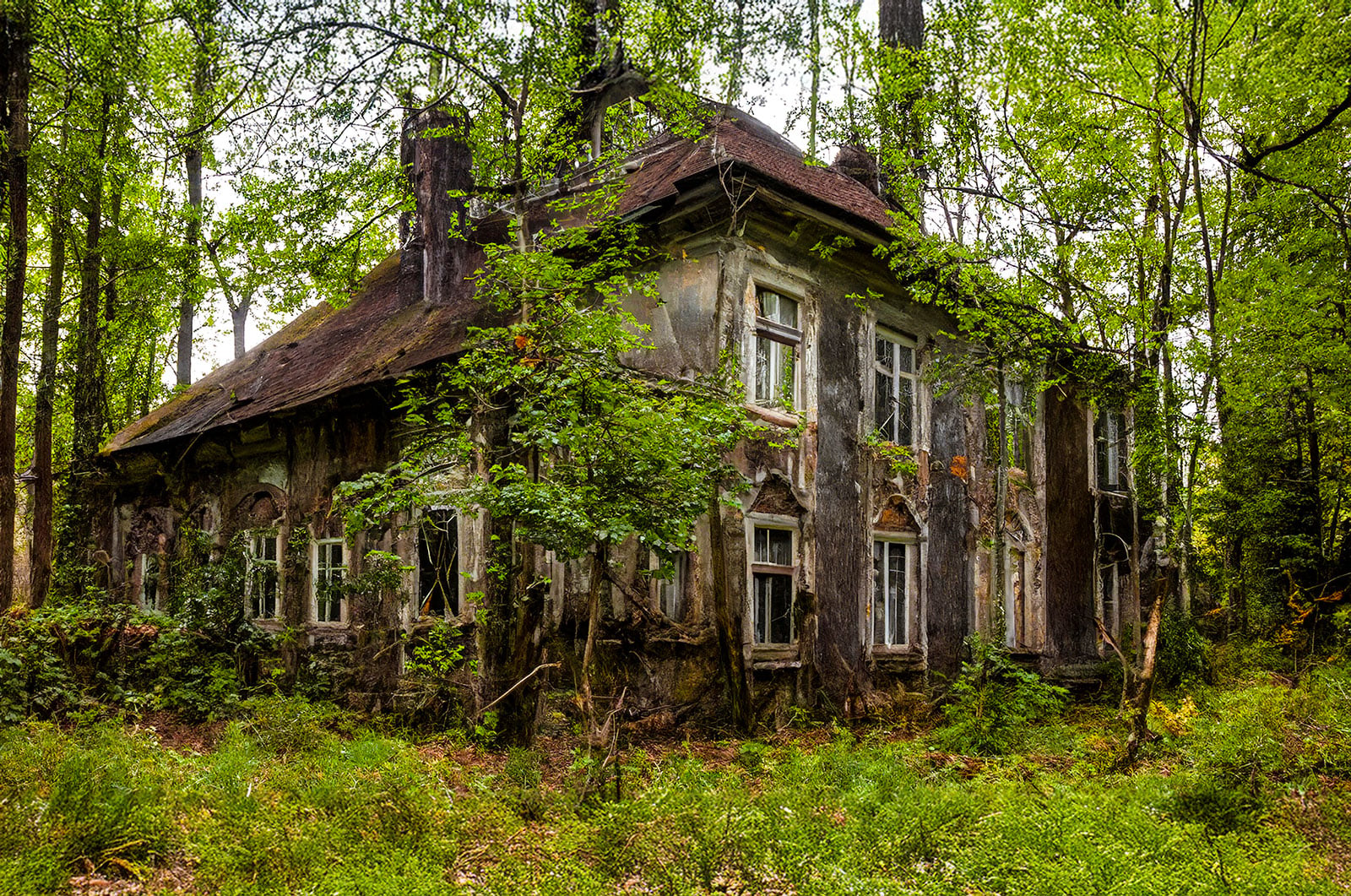

The old cottage is hers now. She has inherited it: two miles from tarmacked road and not far off derelict. No one would guess, now, where the boundary lay between this property and the surrounding forest, for garden has merged its green with undergrowth, and forest has swallowed up fences and wooden sheds. The cottage itself is large, time-scarred, unattractive, neither a habitation nor a habitat, but she will work on it. She has plenty of time.
She creeps inside, slow like a questing snake, tasting the dank mildew-laden air. Old carpet molders on the floor and a tattered curtain still cuts out the sunlight that has filtered through the trees. These things must go.
Upstairs, some roof tiles have fallen and rain is rotting the floor. There are small shufflings in the walls and fireplace, and a whipping of wings as a pair of nesting swifts flit to and fro. She will let them complete their season’s work: breeding, feeding, dropping guano and debris to join the sliding scree of the roof. There is ivy over the chimney; it will enter the house when the falling roof lets in enough light. Small patches of moss are everywhere, inside as well as out. Mosses are slow, but they never stop so long as dampness lingers.
She knows what this place needs. Restoration: turning abandoned rooms back into spaces for life, submerging the traces of redundant artefact, vanquishing the stagnant emptiness.
She wanders through her broken cottage every spring, checks on its progress throughout the summer months. Straight lines and square corners are softening; holes widen. There are foxes now in the coal chute, and badgers under the floor. At last a sapling or two has claimed ground inside the walls. Bricks and stone will shift and crumble in the grasp of growing tree-roots until all distinction is lost between indoor and outdoor, and forest has come back to its place.
She smiles in summer greenery, laughs in the flickering of foliage. She has restored this place to everything she envisioned. One day she will crawl back across whole cities, breaking rectangles down into ever-unfurling fractals of life. She knows what to do. She is waiting her chance. All throughout the concrete and tarmac of towns she has corners of moss, small patches of grasses and weeds, level manicured gardens ready to run free and riot. She will restore it all in the end.
 Fiona M. Jones writes short fiction, nonfiction, and poetry. Her published work may be sampled on her website, fionamjones.wordpress.com.
Header photo by Alesia Malinovskaya, courtesy Shutterstock.