
Prose by Gregory McNamee
Photos by Stephen Strom
 |
 |
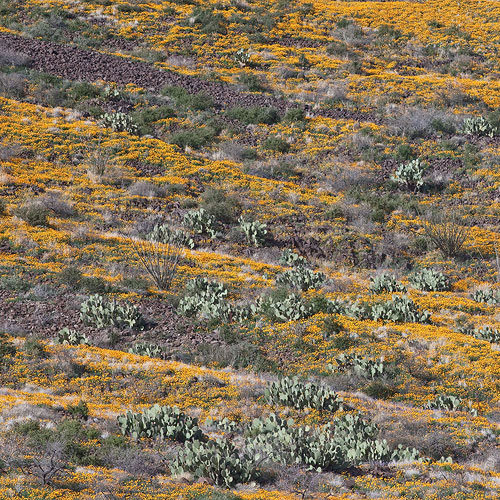
Desert. The very word conjures up mystery, evokes the windswept fastnesses of Beau Geste and Lawrence of Arabia. That mystery may be a sign of its imprecision, for the term embraces an improbably vast range of landscapes, from the comparatively lush columnar cactus forests of Arizona and Sonora to the Antarctic, where 90 percent and more of the planet’s freshwater lies locked in ice. Even among scientists there is considerable disagreement about just what desert means. By most lights it involves, in the biologist Edmund Jaeger’s words, a region’s receiving “less than ten inches of unevenly distributed rain throughout the year.” Attempting a more rigorous definition, in 1918 the Austrian ecologist Wladimir Köppen developed a complex series of climatological and geomorphological indexes that other scientists have gone on to refine. Volcanic hillside north of Safford, Arizona, after El Niño rains |
| |
Terrain.org: A Journal of the Built & Natural
Environments
© Copyright 2010 by Gregory McNamee and Stephen Strom. All rights reserved.