Index of Artists
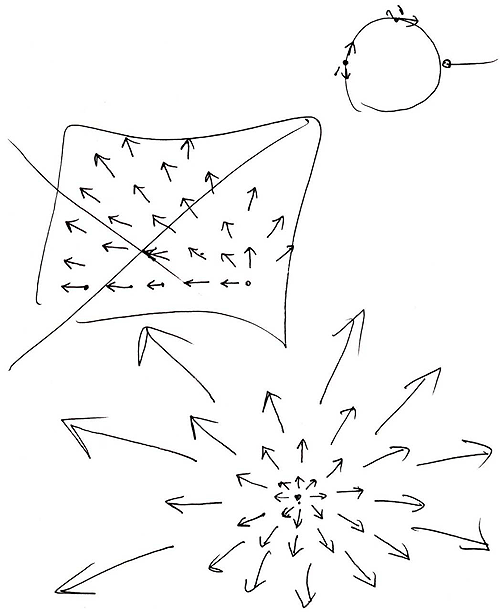
I asked the artists to draw in the order I met them. When I moved to Tucson in the summer of 2003 to pursue my MFA in Creative Writing at the University of Arizona, I quickly met Ted Springer (stanza 1), who has become a dear friend and brother amidst the new beginnings of many a creative universe. A graduate of the UofA’s MFA Sculpture program, he soon introduced me to the first of two personally vital communities of artists. The Shop, a $tudio of metal fabrication and wood craftsmanship, is co-operated by Brian Horton (stanza 2), also holding a UofA MFA in Sculpture, who in his drawing resounds his devotion to the guitar, which he builds himself in our spare time. Joe Quarnberg (stanza 3), who is dating The Sweat Band and here preludes his comic book skills, and Gustav Masure (stanza 4), who here pays tribute to Tom Traveler, an eminent Shop scholar who’s speed has not been slowed by Vietnam or his subsequent decades on the street, and Emily Yetman (stanza 5), a jeweler of gallery pieces who became the first to change the rules of this book, all hold UofA Art BAs; all three of these hip Tucsonans have been associated with The Shop in myriad forms for years. The second community of artists, while related to the first in many ways, has more directly informed my Creative Writing studies: the following four artists are all UofA MFA Sculpture candidates. Ted introduced me to Kate Hodges (stanza 7) and began colliding with her before I could, but I did drink some of the micro-brew with which she spun into Ted’s life. Kate then rooted and synapsed me to the world of The Annex: the MFA Sculpture big dipper where she creates meaning with Marie Bower (stanza 8), who here revisits a tendency toward disturbing yet playful motifs, Jerry Castillo (stanza 6), whose grasp of the tools of the trade has not ceased to amaze, and Gina Cestaro (stanza 9), who did not stitch through the page but manages to minutely connect big concepts with even larger ones. Finally, I met Lucinda Bliss (stanza 10) a week before this book was bound, who, while visiting her mother, Alison Deming, excitedly accepted the offer of the last drawing and within a day’s notice successfully floats the poem’s final statement & question above the page in an intimate yet violent return to childhood, the womb, the beginnings of human creativity, the universe, and this poem. Without ever having seen each other’s work or their corresponding stanzas, the first drawing speaks to the last stanza, and the last drawing speaks to the first. While the false lines of politics and religion make humanity seem distant from its self, may we all, even as we fall apart, become together something new.
|