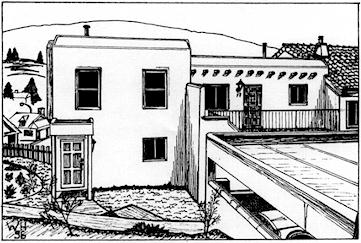
�La
Dera� Townhomes
Vernon, British Columbia
The stated amenities of "La Dera" (the hillside)
include that of "desert landscapes." The developers had
travelled extensively in Southern California and Mexico, but not in New
Mexico. A vacation in Spain in 1993 confirmed their attraction to
Spanish building styles. "La Dera" was designed
as a marriage between Mediterranean-California styles and Santa Fe style.
This development selects forms of Southwestern pueblos for its version
of Santa Fe style. The townhomes appear to replicate the seemingly
haphazard arrangement of the Rio Grande pueblos, with rectangular flat-roofed
blocks of rooms not subject to uniform setbacks or uniform levels.
This arrangement is ideal for the preservation of privacy within and between
units. An attempt to replicate tapered adobe walls has been accomplished
in sloping the top two feet of the exterior walls. This stylistic
innovation produced difficulties in obtaining building permit approvals:
"building inspectors don't understand roofs without overhangs and
flashing" (developer). The carports are also designed as blocks
which contribute to a pueblo-like appearance. Paned windows are
small and inset in careful consideration of a key visual element of Santa
Fe style: "the less uniformity in windows the better" (developer).
Several units have imitation vigas on facades, reinforcing the
regional image of the development. Gas flues are enclosed in tapered
surrounds, another detail contributing to authenticity. Every third
unit has a sloping roof crowned with authentic clay Spanish tile.
These particular units conform more closely to the visual elements of
California Mission Revival style than to Santa Fe style.