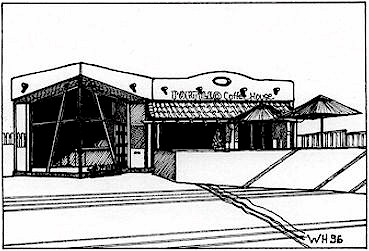
Portillo
Coffee House
Vernon, British Columbia
An automobile repair bay with its overhead door clearly reveals
one of the former functions of the Portillo Coffee House, others being
a taxi stand and periodic flea market. When the original owner evaluated
design options for its transformation, he looked to fondly remembered
styles from Chile and other parts of Latin America where he had resided
and vacationed. When asked why he selected certain visual elements
of Santa Fe style for the coffee house, he stated: "the architecture
of the American Southwest is not a whole lot different from that of South
and Central America." He also identified a perceived similarity
between the natural environments of the Okanagan Valley and the Southwest
(climate, sky, colors, and aridity): "it mirrors the landscapes of
its origin." When asked for his opinion as to why Santa Fe
style had been transferred to the Okanagan Valley, the owner observed:
"people just plain like it! They like the soft and warm earth
tones, the gentle curves and rounded or stepped walls and the pine logs
with knots." The building contractors cautioned that to capture
the essence of Santa Fe style it was best "to keep it simple...less
is more...even flowers against light toned walls should be of the same
variety...this simplicity is what people like about it." Notable
features of the Portillo Coffee House are the rounded pedimented gable
with its oval opening, suggestive of a bell loft in a Spanish mission
church, vigas, peeled pine logs of columns and framework for the
sloping sunshade, and rounded walls enclosing outdoor seating. However,
the Spanish tile on the sunshade and the brilliant white exterior surfaces
are more representative of California Mission Revival style than the regional
architecture of New Mexico.