Santa
Fe Style Housing
Taos, New Mexico
Some of the most appealing attributes of Santa Fe style are its
simplicity of form, and freedom from the tyranny of straight lines and
absolute symmetry of walls, windows, or facades. However, it is
not uncommon in New Mexico to have civic legislation in place which
compels builders and residents to conform to design guidelines.
An ordinance passed in 1957 specified design guidelines applicable to
all buildings within the city limits of Santa Fe. These design guidelines
have defended Santa Fe's unique architectural and visual coherence.
Members of the Taos Society of Artists (TSA) influenced the visual image
of Taos in the 1912-1927 period by example rather than by enforcement.
Prominent members of the TSA (E.L. Blumenschein, O. Berminghaus, J. Sharp
et.al.) enlarged their summer studios into architectural prototypes
of Santa Fe style: the remaking of Taos in Santa Fe style was assured.
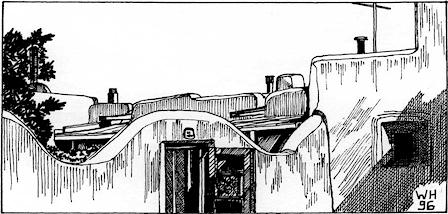
Meticulous attention to architectural authenticity and visual coherence
of townscape is illustrated in this housing unit in Taos. The general
plan is based on the fortified placita-centered house of the Spanish
Colonial/Mexican period. The rooms are located in a rough square
around a placita, a small interior courtyard. Rooms open
onto the placita sheltered by long portales. Parapet openings
over the placita replicate the defensible positions of fortified
haciendas, their contemporary function openings for canales.
Fireplace flues are disguised in adobe surrounds appearing as buttresses;
the gas flues are not so easily disguised. The undulating uneven
external wall is personalized with decorative tile and a heavy wooden
door reminiscent of the fortified zaguan doors of the haciendas
of the region.