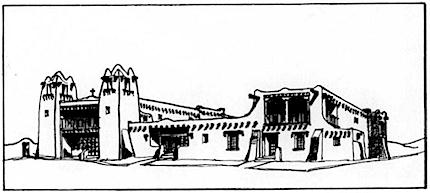
New
Mexico Building
Panama-California Exposition
San Diego, California 1915
Secondary archetype for Santa Fe style. By the early 1600s,
Spanish enterprise in New Mexico was motivated by the religious and colonial
objectives of the Franciscan missions. This generated a demand for
permanent structures which could be built quickly with local materials.
The building techniques of the Pueblo Indians were applied to construction
of the earliest missions and civil structures, with innovations from New
Spain such as adobe brick contributing to building durability. This building
exemplifies the form of Franciscan missions which became the model for
major civil buildings in Santa Fe and Albuquerque from 1904.
The New Mexico building looked to the magnificant Acoma Pueblo mission
of San Estevan del Rey as its architectural archetype. It synthesizes
Anasazi community planning with European Christian mission monasticism.
The Acoma Mission plan was similar to the Renaissance utopian layout of
the era of evangelization in central Mexico, a single-nave church flanked
by a cloister(convento) built around a patio(placita).
Distinctive features include tapered twin church towers with
bell lofts. The pinnacles and low domed projections on the tops
of the towers are an interpretation of Spanish mission churches by Isaac
Hamilton Rapp, commissioned to design the San Diego exposition building
in 1914. Rapp attempted to unite indigenous Pueblo forms with the
Spanish: irregular adobe walls, vigas, and canales are a
backdrop for the decorated balconies and corbelled collonades of the Spanish
missions. The pedimented, curved gables of the church, placita
and convento are Spanish innovations, a simplification of Spanish
baroque. The forms of the San Diego exposition building have been
incorporated in major civic structures in Santa Fe and Albuquerque, e.g.,
The Museum of New Mexico(Figure 3) in Santa Fe and the Campus of the University
of New Mexico in Albuquerque. These forms are also widely used in
commercial structures in New Mexico and throughout the Southwest.
The diffusion of Santa fe style in this case was carried by a 'hallmark
event' (Hall 1989), evocative of leisure lifestyles and an important component
of contemporary(urban) cultural aesthetics.