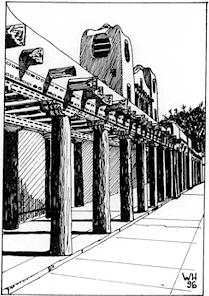
Museum
of New Mexico
Museum of Fine Arts
Santa Fe, New Mexico 1917
The success of Rapp's Panama-California
Exposition building further entrenched the stylistic standards set by
the architectural and artistic communities of New Mexico for buildings
of the stature of the Museum of New Mexico, Museum of Fine Arts.
Rapp's inspiration for the design of the Musuem was again the Acoma religious
complex, with additional picturesque features selected from the Hispanic
mission churches at San Felipe, Cochiti, Laguna, Santa Ana, and Pecos.
These missions provided the model for the twinned towers with bell lofts
united by a curving pedimented gable. Rapp embellished the twin
towers with pinnacles and low-domed projections, replicating his 1915
exposition building. None of the above mentioned mission churches were
adorned with these tower projections. This building represents the
imposed stylistic uniformity of Southwest regional architecture up to
Rapp's commissioning for the design of La Fonda (hotel) in Santa Fe in
1920. Native Americans and Hispanics were not consulted in the process
of identification and selection of these stylistic elements of Santa Fe
style which became formalized at this time. The prominent portales
are an important contribution to Santa Fe style from Spanish peninsular
antecedents. Mather and Woods (1986) identify portales as
the Southwest's most profound contribution to architecture. The
adjacent Plaza is dominated by portales on the three sides facing
the Palace of the Governors. The peeled pine logs of the portales
were incorporated in Spanish colonial design from native American building
techniques. The ornamental corbels for the lintels over the log
columns were one of the few decorated surfaces in Spanish colonial architecture
in New Mexico. Corbels were commonly carved in volute shapes and
decorated with chiselled notches which were painted in a variety of bright
colors. Key visual elements of Santa Fe style as conceived by Rapp and
the New Mexico artistic community have been incorporated in the redevelopment
of Mission Park Shopping Center in Kelowna, British Columbia (Figure
9).