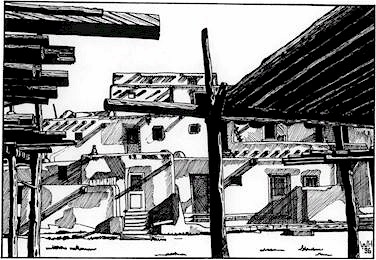
Taos
Pueblo
Taos, New Mexico
This is the primary archetype for the regionally distinctive architecture
known as Santa Fe Style. The upper Rio Grande pueblos were patterned after
structures and communities of ancestral Anasazi homelands: multistoried
dwelling blocks of ashlar masonry and adobe, a haphazard jumble of levels
built around a central plaza. The Anasazi built stone walls with
adobe veneer; the Pueblo peoples used puddled adobe until they learned
to build with adobe bricks, a technique introduced by Spanish colonists.
The use of local building techniques, local materials(adobe, stone, and
pine logs), in adaptation to the local environment, makes this a truly
vernacular architecture of a particularly pure type. J.B. Jackson(1984)
associates vernacular landscapes with mobility and change, in its pragmatic
adaptation to changing circumstances and unpredictable mobility.
The Upper Rio Grande pueblos are expressions of factors of mobility and
change in the Southwest in the context of culture contact between Native
American, Spanish, and Eastern North American(Anglo) culture groups.
Taos Pueblo clearly exhibits visual elements which have been incorporated into contemporary expressions of Santa Fe style in retail and residential environments throughout Western North America: exposed ceiling joists or beams, peeled pine logs (vigas) were neither perfectly straight nor of standard diameter producing irregular roof lines; pine logs also used for ladders and ramadas, frames for drying corn, chilis, and meat products; walls thicker at the bottom with support provided by buttresses; roof parapets pierced by canales, extended drainspouts to carry rainwater away from easily erodable walls; small deeply recessed windows to retain natural insulating properties of thick adobe walls. The Native American contribution to Santa Fe style is fundamental and pervasive. Santa Fe style is clearly identified with a culture hearth (an area within which ideas or technologies develop and from which there is spatial diffusion of material and nonmaterial expressions of cultural innovation).