Agritopia's Design Principles
 |
|
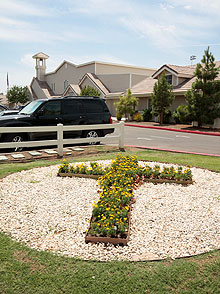
Gilbert Christian Schools, located in the center of Agritopia. |
|
Foundational Principles
We, the Johnston brothers, are Christians who believe the Bible is the unchanging and perfect Word of God. Creation, the fall of man, and the plan of salvation through Jesus Christ are real to us and affect all aspects of our lives. We believe it is the purpose of man to enjoy a personal relationship with God and glorify Him. The question is how to do that with respect to a project like this. The Bible is exceedingly clear about such things as sin, helping those in need, and so on. In other areas, there is considerable freedom. Being imperfect, we will come up with a far less than perfect approach, but it is our intent to glorify God through this process.
Note: This is not going to be a "Christian" community. Places and things are not Christian or non-Christian, individual people are. No one can be made or coerced into being a Christian by another person. All people are welcome in this community. Nevertheless, we believe that Biblical principles applied to the design of the physical infrastructure will have a positive impact on all residents, no matter what their faith.
We believe that it is important to focus on people rather than “stuff.” People are the most valuable result of creation and meaningful relationships between people are to be fostered. A simpler life, devoting time to relationships, rather than acquiring and maintaining “stuff” is a richer life.
Also, we can see from God’s creation in certain attributes. Among those are form, beauty, variety, order, and functionality. All good design flows from consideration of these fundamentals.
Note: The Christian basis for our principles is not necessarily shared by anyone else in the design and execution of the project. We speak for the Johnston Family here, not for anyone else.
 |
|
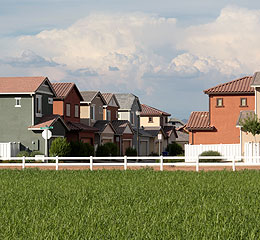
| Cottage homes adjacent to pastures. Photo by Simmons Buntin. |
|
Derived Principles
The following principles flow out of those mentioned above. Furthermore, we think that there are significant problems with current development, and would like to address them.
Reduce Physical Barriers to Relationships
To the greatest extent possible, we would like to eliminate those things that tend to isolate people. Such barriers include: block walls, overly wide streets, uninviting streetscapes, lack of porches or other social space, garage doors on the streets, lack of usable parks, and speeding traffic. We’ll also do things that favor pedestrians over cars. While we need cars, walking and visiting is more apt to build a relationship than driving around.
Reduce Social/Economic Barriers to Relationships
In many suburbs, neighborhoods tend to become uniform in their demographics. For example, a neighborhood might be characterized as a starter home, family, “yuppie,” or a retirement neighborhood. This is largely a function of a limited offerings of home sizes and prices in a neighborhood. We would endeavor to offer a broader range of floor plans and prices so as to create a more diverse neighborhood.
Promote Sharing
We think that it is beneficial to share pools, parks, and other public space versus everyone having their own pool and large yard. It encourages personal interaction and saves families time (in maintenance) and money. People will be able to have their own pool, but the community pool makes doing so less of a necessity. Sharing is also good when it comes to organizations. It is better for the schools and the community center to share parking and sports facilities rather than each having their own. This saves each organization money and is much more efficient in terms of land use.
Promote a Simpler Life
It is our desire to do what we can to reduce the stresses of modern life. Time is a precious commodity. If we encourage sharing, make homes more maintenance free, have easy pedestrian access to most of a resident’s needs, and encourage people to buy only as much house as they need, we can help in this area.
Promote the Formation of a True Neighborhood
By doing the previous things, we believe that we can set the stage for the development of a rich, vibrant neighborhood. In addition, we plan to create numerous “meeting places” such as mini-parks, paths, a community center, a coffeehouse, and so on . Their purpose is to create places where people can informally “hang out” and converse. Ultimately, however, we can only set the stage. The residents themselves will be the ones to make it a real neighborhood.
 |
|
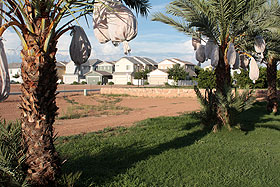
Date orchards next to a cluster of cottage homes. |
|
Choose Style and Beauty over Size and Sizzle
We think that people know style and beauty when they see it. Homes of earlier times were developed using classic rules of proportion, design, and detail. Today, size and "sizzle" (features that attract a buyer, but are just for show) seem to be sought after. We intend to use classic measures of beauty and proportion throughout the project, rejecting oversized and poorly designed buildings and homes.
Honor Agriculture
Due to urbanization, many people do not have a thorough understanding of plant life and the production of food crops. There is something therapeutic and very satisfying about gardening and farming. We intend to preserve some of the farming heritage of Gilbert and offer our residents an opportunity to live with a farm, to enjoy it, and to learn from it.
Create a Balanced Project
It should be possible for a person to work, live, shop, send kids to school, exercise, dine, and play within the project. Obviously, we can’t have everything on 166 acres, but we will try to create a very balanced place. It will not be a place that is divided up into a bunch of individual uses; rather it will be seamlessly woven together like many of the older communities.
Source: Agritopia.com