 |
|
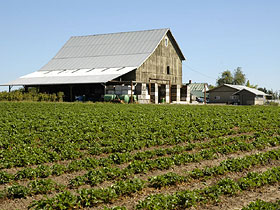
| West Union Gardens barn and field. Photo by Thomas Harvey. |
|
West Union Gardens:
We Grow Everything We Sell
by Martha Works and Thomas Harvey
Urban-oriented agriculture has found its place in the protected rural landscape of metropolitan Portland. West Union Gardens, located in the urban-rural fringe just three-quarters of a mile from the urban growth boundary (UGB), epitomizes the trend. Jeff and Cheryl Boden started farming on a 50-acre former dairy in 1987. They chose an easily accessed location on NW Cornelius Pass Road, a major rural route close to suburban populations. At that time, the UGB was in place but development had barely pressed against it. Today the boundary is highly visible, the result of housing subdivisions built since 1990.
The Bodens grow more than twenty types of berries, vegetables, and herbs. In their early years, they sold virtually all of their produce to consumers—about half at their farm stand and u-pick fields, and the other half at farmers markets in Portland and Beaverton. Today their on-farm sales remain at around 50%, while sales at farmers markets have declined to around 10-15%. The rise in the number of farmers markets in the metropolitan area has not been matched by an proportional increase in customers, and West Union Gardens now goes only to the Beaverton Farmers Market on Saturday and Wednesday’s Portland Farmers Market. Direct sales to local grocery stores, including locally-owned New Seasons Markets and several Thriftway grocery stores, now make up the balance of their operation. As large national grocery chains have purchased regional and local groceries, they have found it difficult to sell to other stores.
 |
|
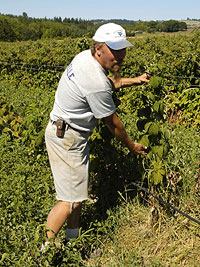
| Farmer Jeff Boden in a raspberry field. Photo by Thomas Harvey. |
|
West Union Gardens was featured in the first episode of Chefs A’Field, a nationwide public television program produced by KCTS-TV in Seattle. The program pairs producers with chefs to promote locally grown and sustainable food production and consumption. Chef Cory Schreiber, whose Portland’s Wildwood restaurant emphasizes local cuisine, went to the Boden’s farm “in search of the perfect summer berry.”
Urban proximity brings customers to West Union Gardens and provides access to local markets. West Union Gardens maintains another urban connection with a leaf composting program. The City of Hillsboro delivers 500-600 truckloads of leaves to the farm. These are then composted and used to increase soil tilth.
With the benefits of their metropolitan location come some conflicts, however. Suburban commuter traffic on Cornelius Pass Road can be heavy. There is strong pressure for additional housing development in Washington County, with the potential expansion of the urban growth boundary. Land prices in their immediate location reflect a level of speculation and make it difficult, if not impossible, for farms like West Union Gardens to expand their farm through land purchases or for new urban-oriented farms to become established. For the time being, however, Oregon’s strict rural land use protections seem to be working.