 |
||
|
||
|
||
|
|
|
 |
 |
 |
|
|
|
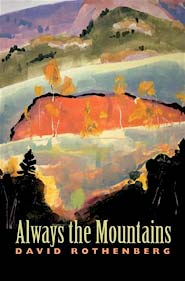
Conversations on the Mountain Terrain.org staff reviews Always the Mountains by David Rothenberg
Yes, the Index, for sometimes that can quickly tell us about the book better than the jacket cover (inside or out) or the Contents. Not better, of course, than the essays within the book itself (as in this case), but we’ll get to those in just a bit. The Index begins on page 275 with Abbey, Edward, and ends on page 281 with Zen and music. From beginning to end, then, David Rothenberg’s Always the Mountains is a book of philosophy and music. Glancing through the interior of the Index confirms this admittedly acute conclusion—Alnœs, Finn; Burke, Edmund; ecology, deep; listening; Naess, Arne; silence; and so on. Published by the University of Georgia Press in 2002, Always the Mountains is an eclectic mix of essays, stories, and even one long poem from environmental philosopher, clarinetist, teacher, and Terrain.org editorial board member David Rothenberg. But just as it’s not fair to peg Rothenberg into these categories (for what is an environmental philosopher versus philosopher, anyway, if we accept that the environment is all around us, even within us?), it’s not fair to try to fit these essays into a category, even the category of “eclectic,” which makes them seem like a random mix. And yet even Rothenberg thanks the Press’s Barbara Ras “for convincing me that it could all fit together into one book.” Perhaps the fundamental question, then, is this: Does it all fit together into one book? Our answer is a resounding yes! Not only do the eighteen essays and one long poem fit together, but they play off each other in a dynamic, uncalculated way that takes us on an exploratory journey not unlike climbing a mountain:
The journey begins with Rothenberg’s simple question: “What exactly are we climbing when we speak the word ‘mountain’?” From there, he leads us not only to a series of places, but more viscerally into a discussion—between the author, other characters, and the reader—that teaches us how to question what the place actually is. Not only does Rothenberg share his philosophy (and sometimes he purposefully doesn’t), but he clears the path for our own deep thinking. Reading Always the Mountains is like hiking a trail with both friend and mentor, with every step a new discovery and subsequent, exciting conversation. The path looks something like this:
And:
And:
The most exciting discoveries for us are in the conversations Rothenberg has either with or, in a way, on behalf of other philosophers and critical thinkers of our time. Or even well before our time, as with “Will the Real Chief Seattle Please Speak Up?” a sharp, historical investigation of the oft (mis)quoted speech from Seathl to Isaac Stevens, Commissioner of Indian Affairs for the new Washington Territories, in 1854. From there, we are introduced—or perhaps re-introduced—to philosopher Henry Bugbee, desert curmudgeon Edward Abbey, Norwegian deep ecology philosopher Arne Naess, composer John Cage, and many others. The series of conversations summits, however, with the essay “The Firefest,” a post-partem dialogue between Rothenberg—who at the time is conducting research for one of his books—and Norwegian author Finn Alnœs, “known as a writer of long, turbulent novels, the most artistic spokesman of the country’s økobevegelse (eco-movement).” Over a four-day period, Rothenberg chronicles his secretive visit to Alnœs’s home, where he and the Norwegian author exchange ideas and passages—and we have the good fortunate of “reading” Rothenberg’s thoughts all the while. The essay is complex and enthralling, the writing brilliant, the characters utterly fascinating:
After scaling the mountain and meeting so many new voices, we are reminded of the character in A.R. Ammons’s poem “Prospecting:”
Or, as Rothenberg concludes:
|
|
|
||||||||||||||||||||||||||||||||||||||||||||||||||||||||||