|
||
|
||
|
||
|
|
|
 |
 |
 |
|
|
|
by Richard Cumyn We live across from a graveyard on a busy street on the edge of downtown Halifax, Nova Scotia, a small but vibrant port city. The cemetery, we've been told, made it into the Guiness Book of World Records because it was - and perhaps still is - the only one in the world that contains a traffic light. Sure enough, when we walked by to verify the claim, there was the light standard sitting just inside the fence at the corner of Robie and Jubilee. Indeed, there are times when the pedestrian traffic through the cemetery and around its perimeter is heavy enough to make one think about the need for a stop light inside. In wintertime, while the Public Gardens, one block east of the cemetery, are closed, a group of martial arts enthusiasts crowd the space where bisecting lanes running through the cemetery intersect, and there they practise sword and long staff drill. They are always polite about making way for us, intimidating as they are with their mock weapons and aggressive stances, for they share this unique throughway with joggers, dog walkers, people on their way to work, people with nowhere in particular to go, and those paying their respects to the dead. At this intersection sits a white chapel with the seating capacity of a mid-size car, and in front of it are benches where people eat their bag lunches. Around the perimeter of the enclosure, just inside the black wrought-iron fence, is a similar lane, and it is here that the serious runners lay down their laps, their bright colours flashing between the taller, more prosperous monuments. I had never lived in a place like this where graveyards are so much a part of the urban landscape, for our cemetery with the traffic light is only one of a conspicuous handful that fills large blocks of the city core. Occasionally we see people strolling between the rows of well-tended headstones and reading those names and dates that are still legible, and I imagine them to be orphans constructing a family tree for themselves. Some famous names reside here: a Provincial Supreme Court Justice after whom is named the boulevard where the grandest homes in the city are found; the brew master beside whose obelisk youthful devotees of his product leave cut flowers in drained beer bottles; renowned scholars with monuments cut in the shape of lecterns. The cemetery with the traffic light is closed to the public after dark, its two large gates on opposite sides padlocked by a police patrol to discourage the vandals who have toppled and defaced grave markers in the past. The cop knows our faces now, we are such regular passers-through, and he has had to wait for us on occasion when we have ventured in one gate while he is closing the other. He never makes us feel bad about holding him up. After all, given the nature of the residents and their eternal patience, what's the rush? A more relaxed defender than he of public property and safety I've yet to meet. Like a golf course, a cemetery is a real estate frill. To build a new one of either, especially near a city, is to incur the censure of any number of groups: environmentalists, urban planners, politicians, neighbourhood blocks, farmers, aboriginal Americans. Land set aside for living, playing, working, growing food, and building upon is at a premium these days, and to reserve large tracts of it for the burial of corpses is to many people an unthinkable waste. Better to cremate. Even better, if it were feasible, would be to let desert scavengers pick clean our bones. Still, alternative means of dealing with the dead, as ecologically preferable as such disposal techniques may be, fail to replace the cemetery as an important public and private place in the human landscape.
This spring a few hundred Kosovar refugees came to stay in this province and many were able to travel into the city. The high school just up the street from us hosted a special dance for Kosovar teens, who to a person loved it here. What's not to love? We have beautiful old trees, verdant parks, lovingly restored heritage buildings, tall ships, fast food, lively bars, cigarettes aplenty--and peace. They practised their English on anyone who would speak with them. They devoured TV shows, videos, music on the radio. For the first time in months, possibly years, they could sleep at night without being afraid that armed soldiers would break down their doors in the middle of the night. As refugees fleeing ethnic cleansing, they were short steps away from a permanent life in Canada. A dream life. And yet, when the peace deal was signed, most chose to fly back to Pristina and greater Kosovo. "Why?" they were asked. "Your homes were burnt, your identification papers taken from you, the men of your family stood up against walls and shot. Even with UN peace keepers there, what guarantee can you have that the hatred will not continue, that further blood will not be shed, that you yourself will not become an avenging killer in your grief and anger?" "Yes," they replied, "we know all this. "Don't you think we haven't thought about it, about almost nothing else? Nevertheless, we have no choice. We must go home. The land is sacred. It is the place where our dead are buried." An Old World notion. In North America--Canada, the United States, the changing face of Mexico under NAFTA--those who define their homes as being the geography where their dead are buried are a shrinking minority. Most of us live in cities and most of us have moved our place of residence more than once, probably to follow the prospect of a job, and most of us if asked could not say for certain where the final resting places of our great-grandparents are located. If we know where the remains of our forebears lie, the place is probably far enough away that visiting it is a major commitment of time and money. Who on this continent can say they have the Old World connection to the land that the Kosovar Albanians feel? First nations peoples. The wealthy who have never had to move away from the family plot. Farmers, who, if they are aren't employed by one of the agro-business giants, are wondering when they will be forced off the land. The lucky, usually residents of small towns, people who have been able to make a living in one place for generations, and who put fresh flowers on the graves of their people every month. Few else.
I've noticed that when we enter the cemetery with the traffic light we usually stop talking, and that my thoughts concerning our momentary and mundane problems become clearer and more sharply focused. Often by the time we have reached the far gate and are waiting for the traffic on Robie Street to break, I have made a decision, or seen something in a new way, or found a solution. I like to think that I have a few thousand wise consultants, well-rested seers who have had a long time to mull over the big questions of existence, eavesdropping on my deliberations and helping to clarify them. Lately on our strolls through the graveyard I've been thinking about bigger things, about origins and change. It may be that the only characteristic truly indigenous to post-Columbus America is change, and that our notion of permanence exists only as an artificial construct. Our buildings survive more than a century only if they are given a special historical designation. Our myths outlast our roads and highways, which require their own "perpetual care." The great railway that held a fledgling Canada together against political and economic forces of disintegration is in many places being dismantled and converted to nature trails. The indoor shopping mall has replaced Main Street. Cemeteries remain largely untouched by the juggernaut of change. Sometimes an excavation for a new building will uncover the remains of a Potters' Field. Coffins will shift position underground and emerge in sewer systems or in ditches or out of a river bank. (We may be a long time dead, but we don't necessarily sit still for it.) But for the most part we live near these city blocks full of carved stone and have lost touch with their raison d'être. So often they are hidden from sight at the end of a long drive, camouflaged by strategically-placed fences and shrubbery. If they are open and visible, as they are in this city, they have all but lost their significance for the general populace. They are simply there in a monolithic way; we won't see them ploughed under or paved over in our lifetime, but neither will we recapture that sense of the sacred that turns a plot of land into a touchstone by which we define ourselves and our home.
In the end, all of those still living who pass through the cemetery with the traffic light have their own reasons for wanting it to continue and to remain open to the public. For some, it is merely a shortcut to somewhere else. For others, it is a means to physical fitness or spiritual peace or the relief of one's beagle. For me, it has come to be a daily memento mori. That I have no personal ties to this place is no impediment to its effectiveness in that regard. On the contrary, it is its very nature as a public thoroughfare that makes it such an evocative symbol of all that is extraordinary about life. Like author Muriel Spark, I know that if I can spend some small part of each day contemplating my own death (inevitable, I believe, despite the claims of all the "You Can Live Forever" gurus), then I will be more likely to live a fuller, more selfless life. All I need do is remember Fishwick and his giggling debutantes. If that isn't an antidote to the vicissitudes of life, then what is?
|
|
|
|||||||||||||||||||||||||||||||||||||||||||||||||||||||||||||


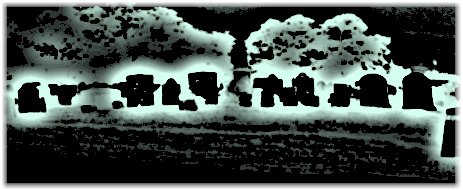
 Some
of the plots in the cemetery with the traffic light have a
service called "perpetual care" built into the cost of burial.
Headstones will always be righted and repaired, and even if
no family remains to do it there will always be someone to
change the cut flowers or spruce up the plastic bouquet or
replace the helium-filled balloons that read "Life of the
Party!" Sometimes a car seeking a particular row will
creep up the central lane. We don't see many cars in the graveyard,
though, and in two years of cutting through on our way elsewhere
we have yet to see a funeral in progress or a freshly dug
grave. Usually we don't even think about the thousands of
lives represented by the acres of slowly dissolving stone;
we stride through, preoccupied with the concerns of our present
lives: where to get a good haircut now that our stylist has
taken a job as a hair transplant technician; what to feed
finicky eaters visiting for the weekend; how to move a massive
desk up a narrow flight of stairs without dismantling anything.
Some
of the plots in the cemetery with the traffic light have a
service called "perpetual care" built into the cost of burial.
Headstones will always be righted and repaired, and even if
no family remains to do it there will always be someone to
change the cut flowers or spruce up the plastic bouquet or
replace the helium-filled balloons that read "Life of the
Party!" Sometimes a car seeking a particular row will
creep up the central lane. We don't see many cars in the graveyard,
though, and in two years of cutting through on our way elsewhere
we have yet to see a funeral in progress or a freshly dug
grave. Usually we don't even think about the thousands of
lives represented by the acres of slowly dissolving stone;
we stride through, preoccupied with the concerns of our present
lives: where to get a good haircut now that our stylist has
taken a job as a hair transplant technician; what to feed
finicky eaters visiting for the weekend; how to move a massive
desk up a narrow flight of stairs without dismantling anything.
 My
eldest daughter graduated from high school this year. The
father of one of her friends is a photographer, and
he had planned to take pictures of a group of them in their
long dresses. The proposed venue for the shoot had been the
Public Gardens, the traditional place for posing wedding and
graduation photos, but it had rained in the night and the
girls didn't want to risk getting the hems of their gowns
damp before heading on to the prom. Instead, we dashed across
Robie Street and into the graveyard, where the girls arrayed
themselves around a broken headstone belonging to a man named
Fishwick, who had died a hundred and fifty years ago, and
there they mugged vampishly for the camera. Sacrilegious?
Perhaps, to some. Disrespectful? I'm not so sure. For one
thing, old Fishwick in the company of such a bevy of radiant
beauties hadn't had that much fun in a long time. I have no
doubt he chose his plot near the center lane to be near the
action. In another way, that impromptu photo shoot represents
all that is affirming and lasting about the burial ground.
My
eldest daughter graduated from high school this year. The
father of one of her friends is a photographer, and
he had planned to take pictures of a group of them in their
long dresses. The proposed venue for the shoot had been the
Public Gardens, the traditional place for posing wedding and
graduation photos, but it had rained in the night and the
girls didn't want to risk getting the hems of their gowns
damp before heading on to the prom. Instead, we dashed across
Robie Street and into the graveyard, where the girls arrayed
themselves around a broken headstone belonging to a man named
Fishwick, who had died a hundred and fifty years ago, and
there they mugged vampishly for the camera. Sacrilegious?
Perhaps, to some. Disrespectful? I'm not so sure. For one
thing, old Fishwick in the company of such a bevy of radiant
beauties hadn't had that much fun in a long time. I have no
doubt he chose his plot near the center lane to be near the
action. In another way, that impromptu photo shoot represents
all that is affirming and lasting about the burial ground.