|
||
|
||
|
||
|
|
|
 |
 |
 |
|
|
|
by Carolyn Steinhoff Smith “Museums began as places to preserve valuable objects,” said art journalist Anita Feldman. “Historically, a continuum exists between storing and preserving, and a more recently developing mission to educate.” At one end of the spectrum are venerable institutions like the Louvre, which served as King Henri VI’s private gallery, almost a century before anyone thought to allow the public in. Today, according to the American Association of Museums Code of Ethics for Museums 2000, “collections . . . are the basis for research, exhibits, and programs that invite public participation.” While more and more museums become interactive, the City Museum of St. Louis is at the cutting edge of this educative, participatory trend, and its methods have implications not just for museums, but for all the institutions of our society.
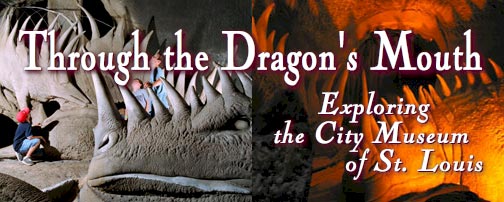
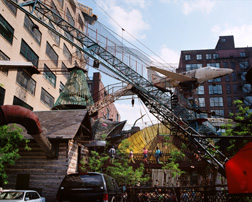
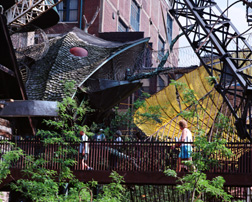
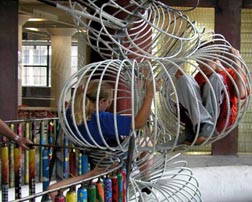
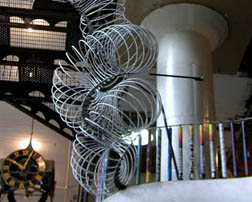
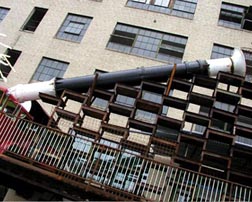
The Caves and MonstroCity “Come on, Aunt Carolyn, I’m down here,” the voice of my seven-year-old niece echoed from a maze of softly lit tunnels under downtown St. Louis. Calli and I live in different states, and we were meeting to enjoy the Caves, one of nineteen innovative exhibits at the City Museum, where everything is recycled, from the stair railings to the floors. Even the old warehouse that contains the museum was originally a shoe factory. The Original and the Enchanted Caves, and the outdoor exhibit called MonstroCity, are the highlights, and probably the most popular, of the museum’s attractions. They are fantasy climbing environments, which visitors—the museum calls them explorers—can enter through ramps, tunnels or stairs. Of all the good times Calli and I have had, climbing around the Caves was the most fun. The museum’s director, Elizabeth Parker, described the evolution of the Enchanted Caves this way: “Ten years ago Bob Cassilly, City Museum founder and artistic director, looked at the old spiral slide conveyor system that factory workers had used to send the shoes down from the tenth floor. Did you ever stare at the ceiling as a kid, and see faces and pictures in the cracks? Well, in his mind’s eye Bob saw caves and slides and tunnels. The seven-year-old in him came out and wouldn’t go back inside.” Unlike most of us who have fantastical fantasies, Cassilly brought his vision into reality, and today the Enchanted Caves extend 135 feet into the building’s space. “It took six years for Bob to create them,” Parker told me. “It’s pretty astounding. The Enchanted Cave is a giant concrete dragon-dinosaur labyrinth.” Explorers can climb tunnels whose openings are gaping animal mouths, and slide down the backs of fanciful creatures. MonstroCity, which the museum calls “the most monumental montage of monkey bars in the world,” includes two real airplanes, a castle turret, and “several 4-foot-wide wrought iron slinkies” tunnels climbers can look down from onto downtown St. Louis five stories below.
Transforming Museums and Relationships The City Museum redefines visitor participation, but the experience it provides also has profound larger implications. As I observed families having great times together in the Caves and MonstroCity, I saw a set of values emerging, principles we can use as guidelines to enrich many of the institutions of our society. Principles arising from the climbing environments are:
As my niece and I climbed together, our relationship was altered, as were those of the families around us. “Here children are the carrots. If adults set aside their expectations and come with their children, they have the greatest time,” said Parker. Of course Calli was better than I at navigating the passageways, so even though she was a child, she was the one who took the lead. How different than our previous museum experiences! How often Calli had reluctantly followed her parents and me, or had played in children’s museums while I stood by. In contrast, I didn’t have to cajole her to climb in the Caves, nor did I merely watch her. Instead, we played happily together. I’m not saying it never happens, but in the three days I was in the museum, I did not witness any scolding parents or crying children—in fact, families seemed relaxed, happy and enthusiastic. As I tried to understand why this was, I realized it was the exhibits’ physical characteristics that led people to relate differently. The museum doesn’t need to set many rules adults have to enforce, since all limits, challenges and opportunities are inherent in the exhibits’ structures. “We try to put up as little signage as possible,” said Parker. I could see that Cassilly had created the Caves to be safe. This gave me the freedom of knowing I didn’t have to worry about my niece. And each environment is self-contained, with only one access point. While Calli and I met and parted ways within the tunnels many times, I knew we would meet up eventually, because the access points, like plazas in European cities, serve as central places where people reconnect. The Caves also promote inclusiveness and the rediscovery of capacities, since their pathways vary in degrees of difficulty. I could exit a steep tunnel any time—but I enjoyed finding I had untapped reserves of strength and agility. And I wasn’t aware of it, but the Enchanted Caves and the World Aquarium are wheelchair-accessible. “They have a big built-in wheelchair ramp, but it’s subtle. If you need it, you notice it,” Parker told me. This means people are free to engage at their own level, each in their own way, with the comfort of knowing no one is sizing up their performance.
Our Relationships with Things, Time and Place As the City Museum reshapes relationships between us as human beings, it also heightens our connectedness with the world around us. “The point of collections and museums . . . revolves around the possession of ‘real things’,” wrote Susan M. Pearce in Museums, Objects and Collections, according to John Simmons in Museum News. “What distinguishes the museum from other educational, scientific, and aesthetic organizations,” wrote Simmons, “is its relationship with its collections.” These statements emphasize the unique and time-honored affinity between museums and precious objects, but not more a recent development—the relationship between museums and the public. Parker described the traditional museum. “People feel they shouldn’t make fast movements or talk too loudly. In art museums, they feel self-conscious about looking too closely or too long at the works; they’re afraid they’ll seem as if they don’t ‘get’ the art. People feel reverent, but they feel alienated.” Most museums continue the collecting tradition by offering protected objects for individual visitors to look at in silence, almost as interlopers in the relationship between the objects and the museum. Even when newer, interactive exhibits encourage touching as well as looking, visitor participation is still circumscribed and mediated. While the City Museum, too, exists to house things, its focus is not on the objects, but on the relationships that revolve around them. “Bob likes to say the City Museum is a home of the Muses,” said Parker. What are The Muses but mythical beings that inspire our creativity and so enhance our love for life? The objects the City Museum holds become the elements of a noisy, colorful, rich and complex milieu that supports a lacework of relationships between people, and between people and the world. For instance, when I visited the exhibit called The World Aquarium, a foot-long bamboo shark’s rubbery back was available for touching, with a staff member instructing a group of preschoolers. Several varieties of rays winged their ways around a “touching tank” visitors could reach into, and rabbits, ferrets and a guinea pig were in open cages for us to pet and even pick up, with no staff in sight. (Though not water animals, these came to the exhibit when people offered pets they no longer wanted to the museum.) In 1995, Bob Cassilly began discussions with St. Louis Aquarium director Leonard Sonnenshein, and in the summer of 2004, their collaboration bore fruit as the World Aquarium. The new exhibit was open but still in progress when I visited. “The City Museum has a reputation for opening exhibits as soon as possible,” Parker explained, “because we’re so excited about them. It’s summer, visitors are coming, and we have sharks to offer. There’s no point in making people wait.” It seemed to me that the rays were swimming over to me as I dipped my hand in their tank, but I discounted these thoughts, until Parker, surprisingly, confirmed them. “The rays like to be petted,” she said. But couldn’t they sting me? I wondered. “They have their stingers removed. We wouldn’t let you touch them if there was any danger,” she reassured me.
What about danger to the animals? “Kids know the animals are fragile, and their gentleness is greater than we expect. We extend a lot of trust. Staff constantly regulate the pH and temperature of the water, and we put the animals on R & R rotation. They take a week with the public, then a few weeks in the back to rest.” Like the Caves, the Aquarium promotes rediscovery of capacities, as the museum trusts visitors to engage in their own ways, in mutual enjoyment with the animals as well as with family members, friends and strangers. The exhibit presents the animals as fellow beings we are close to and responsible for, not as exotic curiosities for us to exploit. Principles arising from the World Aquarium also include collaborative participation—as it provides community member Sonnenschein a supportive venue to realize his dream, and as we are welcomed into unpredictable, lively encounters with animals, staff and fellow visitors—and acceptance, as the exhibit is always in progress, thus encouraging us to accept that our lives are “in progress,” that we don’t have to be perfect to learn from and enjoy one another. We can also learn important principles from the exhibit called The Architecture Museum. Like the rest of the museum, this exhibit goes beyond simple recycling, displaying cornices, lintels, and other exquisitely crafted relics from demolished buildings, with placards telling where the building stood, and what replaces it. Like the Aquarium, the Architecture Museum arose from Cassilly’s openness to the ideas and passions of the St. Louis community—in this case, the exhibit’s curator Bruce Gerrie. Gerrie is a creative entrepreneur who salvages and resells architectural materials. He hopes the Architecture Museum will awaken St. Louisans’ appreciation for the city’s rich architectural heritage. “The Architecture Museum lets architecture be reborn, digested, brought back out, seen anew,” said Parker. A sign next to a three-foot-high block of wood informs us that “150 years ago this timber was part of the Bronson Hide Company, a building on Lacledes Landing. From its rings, we know it was over 90 years old when it was cut down. At the signing of the Declaration of Independence, this tree was already 20 years old.” In fact, the museum building itself has literary and historical resonance, since the playwright Tennessee Williams worked in it when it was a shoe factory, and based the character of Tom in The Glass Menagerie on his experience there. I had visited St. Louis many times, but the Architecture Museum deepened my admiration for the city. Gerrie hopes it will encourage preservation instead of demolition of his town’s historic buildings. In our fast-paced, throwaway culture, this treatment of what was once mere wreckage changes our relationship with time itself. Principles arising from the Architecture Museum are love for our particular locale, as, like all the museum’s exhibits, it emerged from local materials and ideas; and location in the continuity of history, as beautiful reminders of our past are given new life in our present.
Our Relationship with Money In living out principles such as the centrality of relationships, love for our locale, and the other values arising from the museum’s operations, financial practices are still the bottom line. “When the museum started, it was not-for-profit,” Parker told me. In this it was typical—AAM’s Code of Ethics describes not-for-profit status as a trait all museums share. But Cassilly broke ground, as he did in every aspect of the museum, when he converted to for-profit status. “He wanted to expand beyond the limits grantors set,” Parker explained. The museum embodies the principle of community entrepreneurship, as Cassilly, Parker, the staff and community members find a venue for their creativity, and participate in determining the museum’s direction. “Now we’re funded purely by admission fees and facility rentals,” said Parker. “It’s such an exciting place to be in that people rent it out for parties and weddings,” Parker told me. “And our influence has spilled out. People on both coasts want to film movies here. They send us questionnaires to pick our brains.” The City Museum’s success inspires and informs all who want their organizations to incorporate community talents and ingenuity. It shows us that people will pay to spend time in, contribute to, and be part of institutions that embody its principles:
Larger Implications These principles can inspire and guide museum professionals, but what about members of other institutions? Can families apply them to their day-to-day lives? Can schools? Certainly. As parents, instead of controlling our children, we can nurture relationships and collaborate in activities with them. Educators can engage with students in explorations that draw on intellectual, emotional, imaginative, and physical aspects of their beings. Schools can seek out ideas and contributions from people who live and work in the neighborhoods they serve. They can integrate the arts into every facet of their lives, making their buildings beautiful and inviting with materials recycled from their communities. They can initiate mutually supportive exchanges with small local businesses, individuals, and organizations. These are just a few examples of how we can apply the principles we learn from the City Museum of St. Louis to many of our society’s institutions, to enhance our well-being and quality of life, and improve our communities. The City Museum does more than provide an example of an innovative, imaginative and creative museum. It embodies a successful way of life that every visitor can learn from, and in which every St. Louis resident can take part.
|
|
|
|||||||||||||||||||||||||||||||||||||||||||||||||||||||||||||||||||||||||||||||||||||||||||||||||||