|
||
|
||
|
||
|
|
|
 |
 |
 |
|
|
|
Guest Editorial The Living Desert: Our Most Valuable Lesson?
The Sonoran Desert is known for its harsh environment, and yet it is suggested that the earliest known Native American people, the Hohokam, chose to call this desert their home. Today, it is estimated that over the next 25 years an additional 25 million people will move to the Western United States. Arizona is the second fastest growing state in the country, based on the last census. By all accounts, the West can expect to continue to see much of the explosive growth that has characterized the last 20 years. The City of Tucson, Arizona, is taking steps in this direction with Building from the Best of Tucson. The goal of the Building from the Best of Tucson program is to “create a vibrant, livable Tucson community surrounded by healthy, connected landscapes.” Awards were created to encourage best practices by local builders and developers, and the City of Tucson adopted a vision statement to guide appropriate development. A Tucson Community Design Academy also trains residents as design ambassadors within their neighborhoods and across the city.
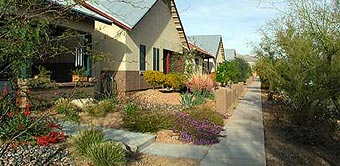
In a broader context, the region surrounding Tucson provides strong examples of how communities can influence and encourage development that is compatible with protection of natural open space. In the late 1990s, Pima County began a comprehensive planning process that integrated designation of urban growth areas with protection of surrounding unbroken landscapes, resulting in the Sonoran Desert Conservation Plan. In the growth areas of southeast Tucson, the City of Tucson and the Arizona State Land Department began a large-scale planning process that emphasized progressive tools to reduce impact on natural areas and promote livability within neighborhoods. The planning process became known as the Houghton Area Master Plan, named after a major road that runs through the area. The plan, which is expected to be formally adopted in 2005, encourages pedestrian- and bicycle-friendly streetscapes, connectivity between neighborhoods, creation of community centers to allow for small commercial enterprises and common areas, a mix of housing types and densities, and preservation of open spaces and sensitive natural features. Developments that reflect these qualities are detailed in the Sonoran Institute’s Growing Smarter at the Edge.
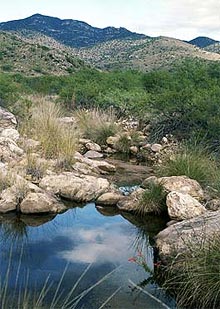
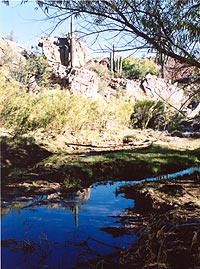
Thoughtful growth management is essential to absorb the influx of residents to the desert. Likewise, preservation of natural open spaces provides a critical balance to master-planned development. For example, open space in the Cienega Creek watershed—known locally as the Cienega Corridor—just east of the Houghton Area Master Plan area provides numerous services to our community. Large, intact portions of the Cienega Corridor allow for rain and snowmelt to enter the ground and recharge our drinking water reservoirs. Native vegetation throughout the open lands provides habitat for many different kinds of wildlife. Many federal and local recreation areas have been established to allow for hiking, camping, horseback riding, hunting, and other activities. By preserving open space, rural communities, ranching heritage, and historic sites are also able to survive. The rural Cienega Corridor was recently recognized by the Cultural Landscape Foundation as one of the nation’s top seven endangered cultural landscapes. It was chosen based on the presence of archaeological sites, ghost towns, railroad camps, and current and historic ranches and transportation routes. These cultural resources are at risk because of rapid growth and development in the adjacent urban edge of Tucson. In its designation, the Cultural Landscape Foundation recognized not only the values of the Cienega Corridor landscape, but also the value of a diverse group of citizens, land managers, scientists, and other stakeholers who have formed an alliance to help protect that landscape: the Cienega Corridor Conservation Council.
The mission of the Council is “to protect, steward, and enhance the cultural and natural resources of the Cienega Corridor.” Specifically, it is working with a land use planner in a community-led process to develop the tools necessary to preserve open space, wildlife habitat, and cultural values, including a cooperative agreement and strategic plan for the Corridor’s stakeholders. The recent report Prosperity in the 21st Century West concludes that protection of public lands can be a positive economic driver for Western communities. The new global economy demands that successful communities have easy access to nearby protected open spaces, as well as large markets and an educated workforce. Places such as Tucson, on the northeastern edge of the Sonoran Desert, have all these factors, and can reap the benefits. As Jeff Comer, CEO of Tucson’s Northwest Hospital, recently testified, “Northwest Hospital depend[s] on Tucson’s blue skies and open lands to recruit our nation’s top healthcare professionals to our community.” A living desert is a growing desert: balancing human demands with nature’s needs. If we appropriately apply this knowledge, we will have learned the Hohokam’s most valuable lesson of all—sustainability is the essence of survival.
|
|
|
|||||||||||||||||||||||||||||||||||||||||||||||||||||||||||||||||||||||||||||||||||||